Goldman Sachs research: AI risks 2.5% of U.S. jobs, not apocalypse
Goldman Sachs research finds just 2.5% of U.S. jobs at risk if current AI use cases scale, and predicts a temporary 0.5 percentage-point rise in unemployment during the transition.
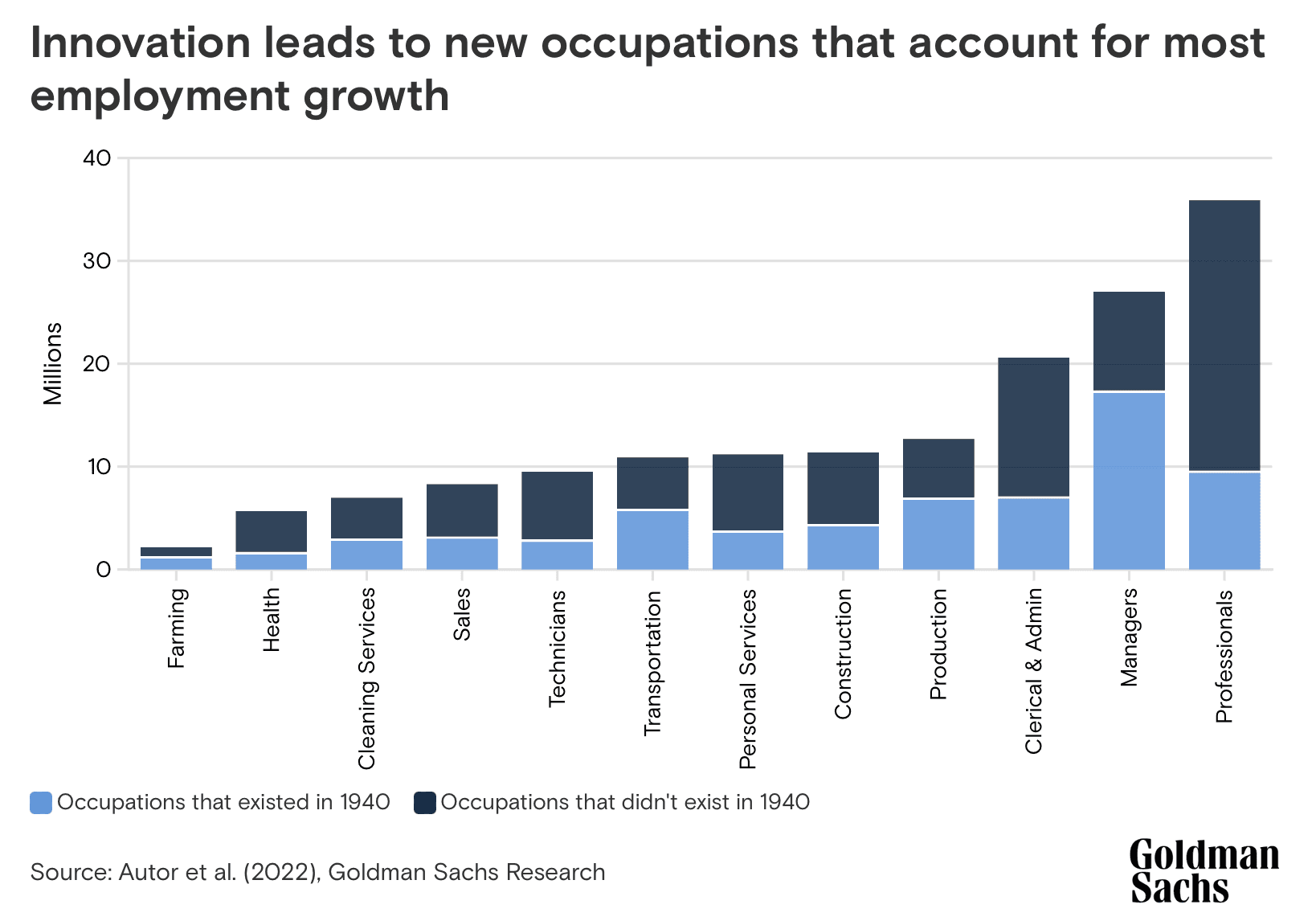
Goldman Sachs Research projects a limited macro hit from AI adoption: in a scenario where current AI use cases were expanded economy-wide and employment fell proportionally to efficiency gains, an estimated 2.5% of U.S. employment would be at risk of related job loss, and unemployment would rise by roughly 0.5 percentage point during the transition. The Aug. 13, 2025 report frames that impact as modest and relatively temporary, stating, “Despite concerns about widespread job losses, AI adoption is expected to have only a modest and relatively temporary impact on employment levels.”
The report identifies specific occupations that are relatively higher risk: computer programmers, accountants and auditors, legal and administrative assistants, and customer service representatives. Researchers Briggs and Dong describe their approach as task-level, weighing factors such as task repetitiveness, the consequences of errors from AI tools, connections between tasks, and the value of AI-exposed tasks compared with prevailing wages. They write that “frictional unemployment is not unique to AI and occurs during most periods of rapid technological change,” and add the historical claim that “Historically, upheaval from technological innovation has proven to be temporary—after two years there is no noticeable impact.”
Goldman’s researchers acknowledge current company behavior: executives in technology and finance report efficiency gains from generative AI that are sufficient to slow hiring in operational and back-office functions. The report nonetheless stresses that “the range of affected positions remains narrow,” framing the observed hiring caution as a manageable headwind rather than an economy-wide collapse in roles.
Company leadership at Goldman has echoed that restraint. On the Goldman Sachs Exchanges podcast, chairman and CEO David Solomon rejected the “job apocalypse” narrative, saying “I’m not in the job apocalypse camp” and adding, “If we get this right, I don’t think it significantly lowers the number of people we have.” Solomon framed AI’s role as providing “the capacity to invest in growth” the firm previously lacked and cautioned that “Changing processes in a big enterprise is hard work. And it’s going to take some time.”

Yet contemporaneous filings and public statements paint a more complex picture. Wired reporter Paresh Dave reviewed New York state mass-layoff notices and found that, in filings since last March, over 160 companies filed notices and “none—in a group that includes Amazon, Goldman Sachs, and other employers that are adopting AI tools—attributed their workforce cuts in those filings to ‘technological innovation or automation.’” Wired further records “over 750 notices spanning 162 employers and affecting nearly 28,300 workers” in New York without AI being cited. New York records cited by Wired list Goldman Sachs as leading with “more than 4,100 workers affected by layoffs or location closures,” Amazon with 660 affected workers, and Morgan Stanley with 260 workers out of job.
Wired also cites broader reporting that complicates the statutory filings: “Overall, nearly 55,000 US companies attributed job cuts to adoption of AI last year, according to an analysis of public statements by the job search firm Challenger, Gray & Christmas,” and an unnamed Bloomberg source told Wired that “a small portion of Morgan Stanley’s layoffs reflected AI and automation use.” Wired suggests possible reconciliations: jurisdictional limits on New York filings, companies avoiding the AI label in mandated disclosures, or affected employees located outside New York.
Taken together, Goldman’s quantitative modeling, Solomon’s executive framing, and the New York statutory record produce a consistent headline for bankers and employees: measured risk concentrated in specific roles, a likely temporary uptick in unemployment as workers reallocate, and a public debate over how transparently companies attribute cuts to AI. As the original brief summarized, Goldman Sachs research indicates declining tech employment but limited AI impact so far, and that layoff fears are overstated while hiring caution remains a manageable headwind.
Know something we missed? Have a correction or additional information?
Submit a Tip