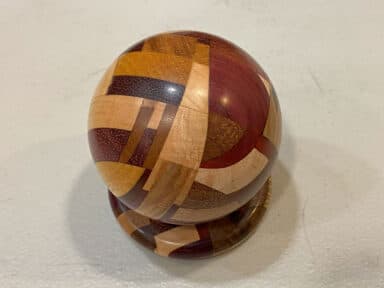
Got Wood? LLC details Bloodwood characteristics and lathe handling
Got Wood? LLC's primer spotlights bloodwood's "brilliant natural red heartwood" and Countyfloors lists a Janka of 2900—expect hard, splinter‑prone timber and take dust and finishing seriously.

Got Wood? LLC published an in‑depth profile of Bloodwood (Brosimum rubescens) on Wednesday, 4 March 2026 (posted 11:33 AM), explicitly framing the piece as "a full species primer aimed at turners and woodworkers." That announcement and the Countyfloors excerpt together make one thing clear: bloodwood is visually striking and mechanically serious—beautiful to behold, demanding at the lathe.
Identification and context Common name: Bloodwood. Scientific name: Brosimum rubescens. Got Wood? LLC labels the piece an "in‑depth profile" for turners and woodworkers and calls the species' centerpiece its "brilliant natural red heartwood." Countyfloors complements that line with a broader color range, describing the heartwood as varying "from a grayish red to a deep, rich crimson." Together the sources establish why turners chase this wood: the color can be vivid and lustrous, but it also changes with time and treatment.
Appearance: color, texture, and figure Countyfloors paints the visual picture in full: "The heartwood of this species varies from a grayish red to a deep, rich crimson." The site adds that "the texture of bloodwood is exceedingly fine and smooth, almost silky," and that "the grain can range from straight to variable." Expect occasional variegation—"This wood is quite lustrous and may have variegated red and yellow stripes." Finally, keep the aging curve in mind: "Untreated, bloodwood ages to a deep brown color, unless lacquer is applied to extend aging in order to help preserve the distinctive red color of the wood." In short, the fresh red is often brilliant but not eternal unless you plan your finish strategy.
Mechanical profile and hardness Countyfloors provides a concrete hardness benchmark: "Janka Hardness: 2900." That number places bloodwood among the hardest commonly used woods; Countyfloors further quantifies the difference: "It is just over one hundred and twenty‑four percent harder than red oak, twice as hard as hard maple…" (the supplied excerpt ends with a truncated comparative clause: "slightly over fifty‑nine percent harder" without specifying the comparator). Got Wood? LLC also characterizes the species as a "very dense hardwood" in its fragmentary description ("density (very dense hardwood with Janka typi..."), corroborating the Countyfloors picture of a dense, high‑hardness material. The bottom line: tools, edges, and fasteners will feel the difference.
Workability, splintering, and what that means at the lathe Countyfloors warns that despite strength—"Bloodwood is durable and has high crushing and bending strength"—the wood "does tend to splinter" and "possesses characteristics of medium stiffness and resistence to shock." Those two facts together explain what turners notice: tear‑out and sharp, stubborn chips are possible even while the finished piece ends up strong. Because the explicit Got Wood? LLC excerpt supplied to us is truncated mid‑density clause, it’s not possible here to reproduce any additional lathe‑specific procedures the primer may include; however, the Countyfloors descriptions alone make clear that working bloodwood requires respect for both its hardness and its brittle tendencies.
Durability, uses, and marketplace notes Countyfloors calls bloodwood "a very hard wood flooring species," which reflects its traditional commercial use where hardness and decay resistance are valued. The same durability—"very resistant to decay and insects"—makes the wood attractive for long‑life objects, but that durability also ties into the health side of the ledger: those resistant properties "may contribute to a possible allergic response to the dust." Got Wood? LLC targeted their primer at turners and woodworkers, signaling that turnery and fine woodworking are intended uses; Countyfloors’ flooring example shows the species crosses from decorative to structural applications where hardness is a selling point.
Finishing and color preservation Countyfloors repeats the practical finishing observation twice in the excerpt: untreated bloodwood "ages to a deep brown color, unless lacquer is applied to extend aging in order to help preserve the distinctive red color of the wood." If preserving that brilliant red is central to the project, plan a finishing schedule that includes stabilizing or sealing treatments—lacquer is explicitly mentioned by Countyfloors as a means to extend the red. If a warm brown patina is acceptable or desired, allow the natural aging to proceed.
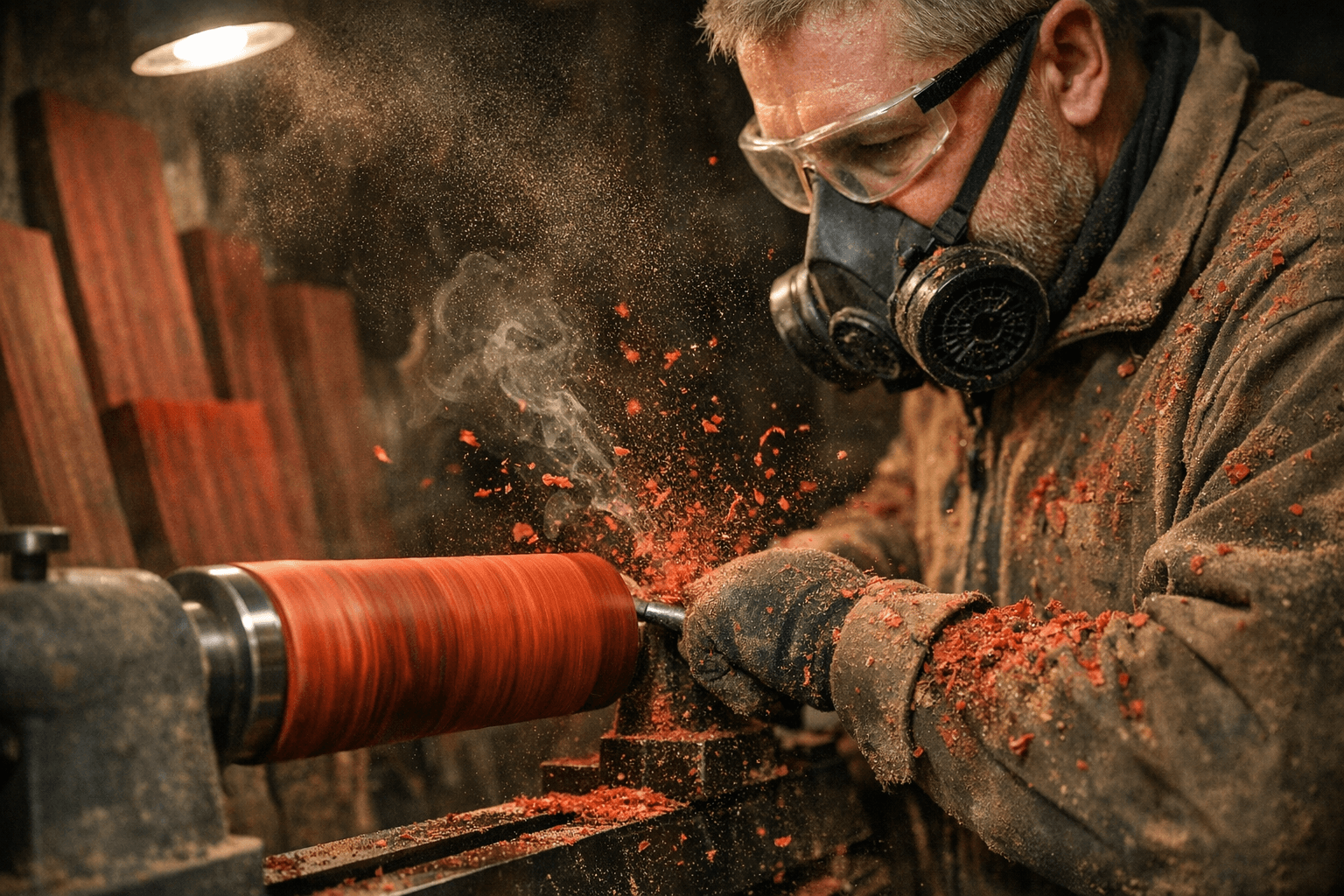
Health and safety flags every turner should note Countyfloors issues a clear caution: because the wood is "very resistant to decay and insects; these resistant properties may contribute to a possible allergic response to the dust." That’s an explicit warning: treat bloodwood dust like a real respiratory and skin irritant. While the supplied excerpts do not include an MSDS or PPE specification, the dust hazard is spelled out and should be the basis for any workshop safety plan: dust collection, respirators, and minimized airborne dust should be standard when turning or sanding bloodwood.
- Expect a dense, very hard timber (Countyfloors: "Janka Hardness: 2900").
- Anticipate splintering and variable grain; plan for potential tear‑out ("it does tend to splinter" and "the grain can range from straight to variable").
- Keep finish intent in mind: lacquer can "extend aging in order to help preserve the distinctive red color" while untreated wood "ages to a deep brown color."
- Treat dust as a possible allergen and control it accordingly ("these resistant properties may contribute to a possible allergic response to the dust").
Practical considerations for turners (a curated prep checklist)
Based only on the evidence in the two sources—Got Wood? LLC’s primer label and Countyfloors’ technical notes—here are concise, source‑grounded items to prepare before you mount bloodwood:
Note: these points are curated from explicit lines in the sourced material; Got Wood? LLC’s full primer may add turner‑specific techniques not available in the fragment supplied here.
What the supplied sources do not complete (and why that matters) The Got Wood? LLC excerpt ends mid‑phrase ("Janka typi..."), so any numeric Janka statement from that primer cannot be confirmed from the supplied text. Countyfloors’ excerpt contains some duplication and one truncated comparative phrase ("slightly over fifty‑nine percent harder") without naming the comparator—so avoid presenting that last percentage as a complete fact until the full Countyfloors text is checked. Those gaps matter because they leave out potentially useful specifics for lathe handling, drying behavior, and safety thresholds; the explicit pieces you can rely on today are the date and audience of the Got Wood? LLC profile (Wednesday, 4 March 2026, 11:33 AM; "a full species primer aimed at turners and woodworkers") and Countyfloors’ explicit descriptors and numeric Janka of 2900.
Bottom line and next move Bloodwood earns attention for a reason: Got Wood? LLC calls its heartwood "brilliant natural red heartwood," and Countyfloors backs that up with a spectrum from "grayish red to a deep, rich crimson," an "exceedingly fine and smooth, almost silky" texture, and a Janka rating of 2900. Those visual and mechanical traits make it a prized but demanding choice—great for showpieces and flooring where hardness and color matter, but also a wood that requires planning for splintering, dust hazards, and finish‑driven color preservation. Expect the piece to reward careful prep and respect at the lathe; where the sources leave blanks (truncated lines, duplicated segments), seek the full Got Wood? LLC primer and the complete Countyfloors entry for any lathe‑specific techniques, drying data, and safety documentation before you start your next bloodwood project.
Know something we missed? Have a correction or additional information?
Submit a Tip