Governor and congressional primary races remain too close to call
Three Maine primary contests were still headed to ranked-choice tabulation, with Shah, Charles and Baldacci leading but none clearing 50%.

Maine’s governor and one congressional primary were still unresolved after first-choice ballots were tallied, and the delay reflected the state’s election design rather than a counting failure. The Secretary of State said the Democratic and Republican governor primaries and the Democratic primary in Congressional District 2 would move into ranked-choice tabulation because no candidate earned a majority of first-choice votes cast.
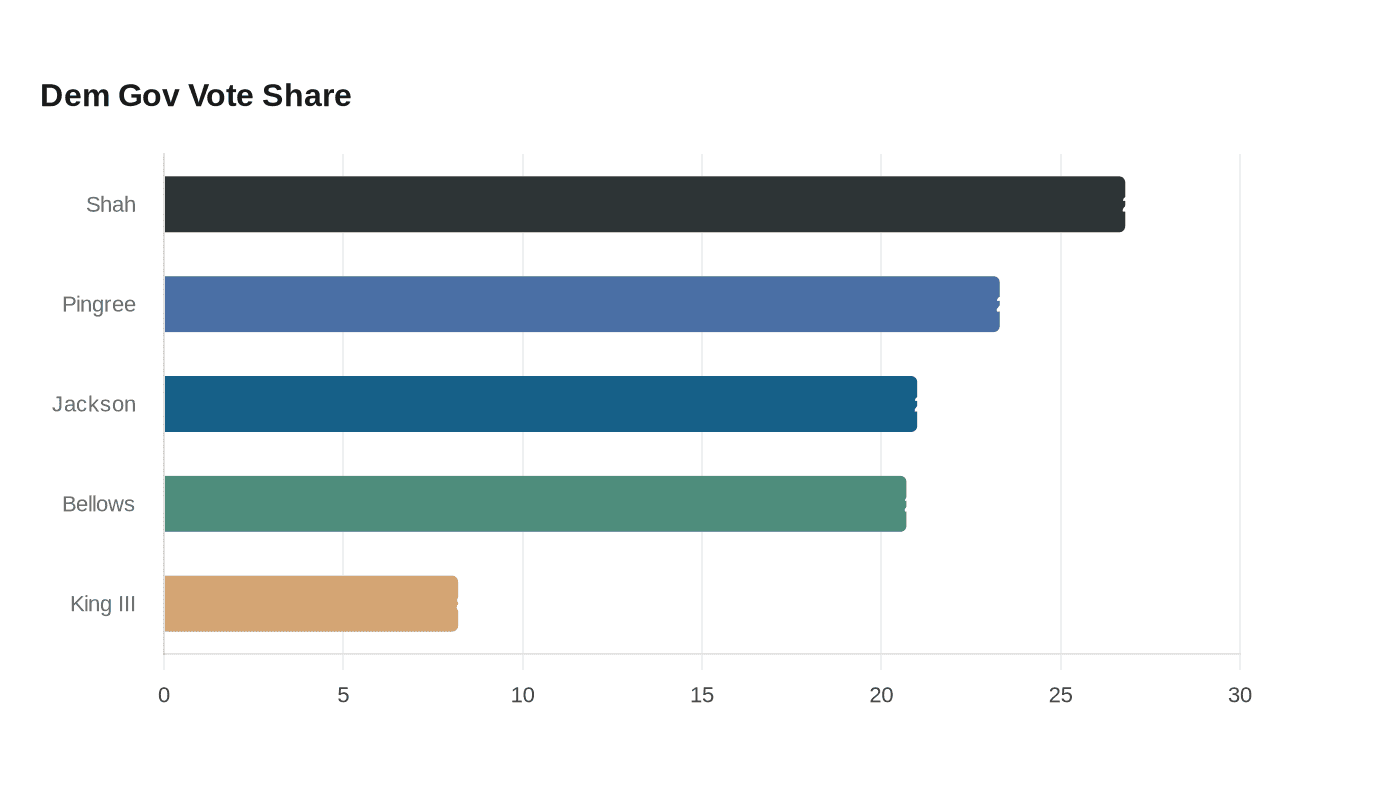
In the Democratic governor race, Nirav Shah led with 55,804 votes, or 26.8 percent, followed by Hannah Pingree at 23.3 percent, Troy Jackson at 21.0 percent, Shenna Bellows at 20.7 percent and Angus King III at 8.2 percent. In the Republican contest, Robert Charles held 44,193 votes, or 37.3 percent, ahead of Benjamin Midgley at 20.3 percent, Jonathan Bush at 20.0 percent, Garrett Mason at 11.3 percent and Owen McCarthy at 3.9 percent.

The Democratic primary in Congressional District 2 was tighter still. Joseph Baldacci led with 21,948 votes, or 31.6 percent, followed by Jordan Wood at 29.2 percent, Matthew Dunlap at 28.9 percent and Paige Loud at 10.3 percent. With three candidates separated by less than three points, the ranked-choice rounds were set to matter more than the first count alone.
Under Maine law, the tabulation begins in Augusta on Friday at 1 p.m. at the Department of Public Safety headquarters, is open to the public and media, and will be livestreamed. The process proceeds in rounds, eliminating the lowest-finishing candidate each time until one candidate tops 50 percent in the final round. Recounts are handled separately, and in a ranked-choice race only a candidate who finished in the top three at the end of the penultimate round may request one.
The state’s slower pace is built into the calendar. Unenrolled voters may choose one party’s primary ballot, enrolled voters may vote only in their own party’s primary unless they changed enrollment at least 15 days earlier, and absentee ballots counted in the primary had to be received by 8 p.m. on Election Day. Officials said the ranked-choice tabulation was expected to be finished next week, before the Juneteenth holiday, with official results posted within 20 days after the election.
This article was produced by Prism’s automated news system from verified source data, official records, and press releases, then run through automated quality and moderation checks before publishing. The system is built and supervised by the people who set the standards it runs under. Read our full AI policy.
Did this article answer your question?

