Harborplace Remains Vacant, Baltimore’s Downtown Renewal Shows Signs of Stalling
Harborplace has yet to break ground while the Sheraton on Conway Street has closed and downtown office vacancies sit in the low-20% range, raising fresh doubts about Baltimore’s revival.
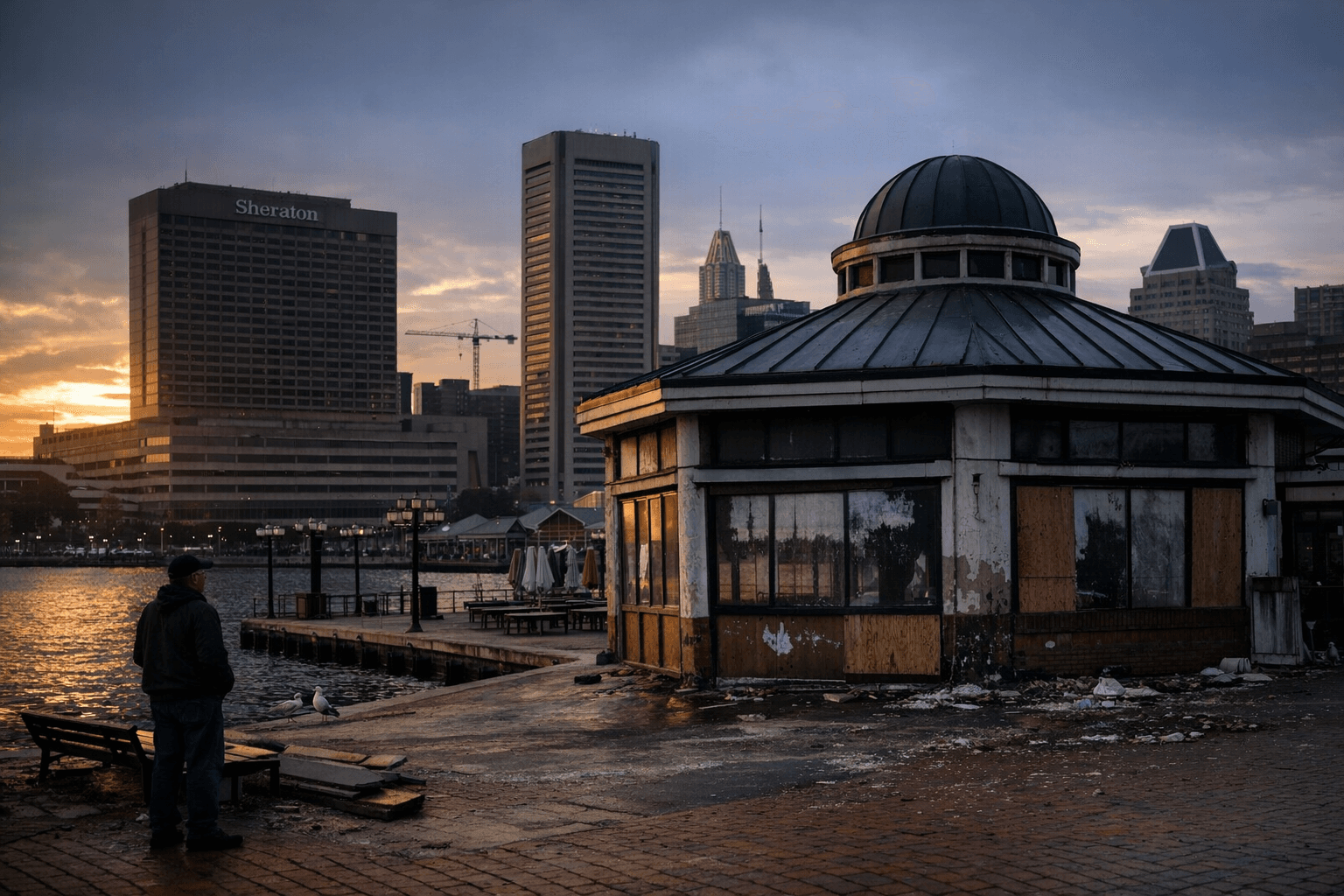
Harborplace remains unbuilt, the Sheraton hotel on Conway Street has shuttered, and downtown office vacancy rates are stuck in the low-20% range, a cluster of setbacks that panelists say makes Baltimore’s downtown renewal look fragile. On WYPR’s Midday, guest host Jayne Miller summed the moment bluntly: “Rising office vacancies. The Sheraton hotel on Conway street recently closed. And long after plans for a completely reimagined Harborplace were unveiled, the vaunted development project has yet to break ground. What's going on?”
The WYPR discussion, broadcast March 2, 2026, featured Melody Simmons, who covers development for the Baltimore Business Journal and joined Jayne Miller in Studio A. Simmons and other contributors pointed to several concrete signs of strain: a major convention-area hotel closing steps from the Convention Center, Camden Yards, and the waterfront, and persistent office vacancies in the city core that Mdbaynews reported as “hovering around the low-20% range.”
Mdbaynews framed the hotel closure as more than a single business loss, writing, “It was a symbolic blow,” and asking, “When a large hotel in that location cannot sustain operations, it raises a deeper question: Are we overestimating downtown demand?” The same outlet reported that downtown hotel occupancy and revenue per room have softened and that other hospitality properties face financial strain as national chains quietly exit, a dynamic that erodes investor confidence in Baltimore’s convention and tourism ecosystem.
Harborplace, long the centerpiece of the Inner Harbor, is at the center of the debate. Urbanland Uli recalled the site’s past impact, noting that Harborplace “was a proverbial rock in the pond that spread ripples of economic activity far beyond the Inner Harbor,” and that after the 1970s redevelopment the American Institute of Architects called it “one of the supreme achievements of large-scale urban design and development in U.S. history.” Urbanland Uli also states a stark recent fact: “Yet it became insolvent in 2019.”
Developers and designers have produced renderings, including images credited to MCB Real Estate and a Harborplace master-plan file dated October 2023, that show massive new residential units, an accessible waterfront, and mixed-use public spaces. Despite those visuals, multiple outlets note the same hard fact: the redevelopment “has yet to break ground” and Harborplace is “sitting idle” years after its unveiling.
City leaders point to the $6.9 billion Downtown RISE master plan as evidence of momentum, a decade-spanning program that the press describes as including housing, transit improvements, infrastructure upgrades, and public safety initiatives. But commentators have been equally blunt about the gap between concept and delivery: “Plans don’t revive downtowns. Execution does,” Mdbaynews wrote.
Until developers break ground, hotel operators stabilize, and office occupancy trends improve, the visible markers of revival remain plans and renderings rather than new residents or guests. The question Jayne Miller posed on WYPR’s Midday endures as a practical test for the Downtown RISE promise: will Baltimore translate $6.9 billion of vision into construction and commerce, or leave Harborplace—and the economic confidence it symbolizes—sitting idle?
Know something we missed? Have a correction or additional information?
Submit a Tip