Historic Rockwall County Courthouse, Downtown Square Showcase Local History and Attractions
Stand on the courthouse square at 101 E Rusk St and you’ll find a 1940s WPA‑era Moderne courthouse, 19th‑century storefronts, and a calendar of community events that keep downtown Rockwall active.
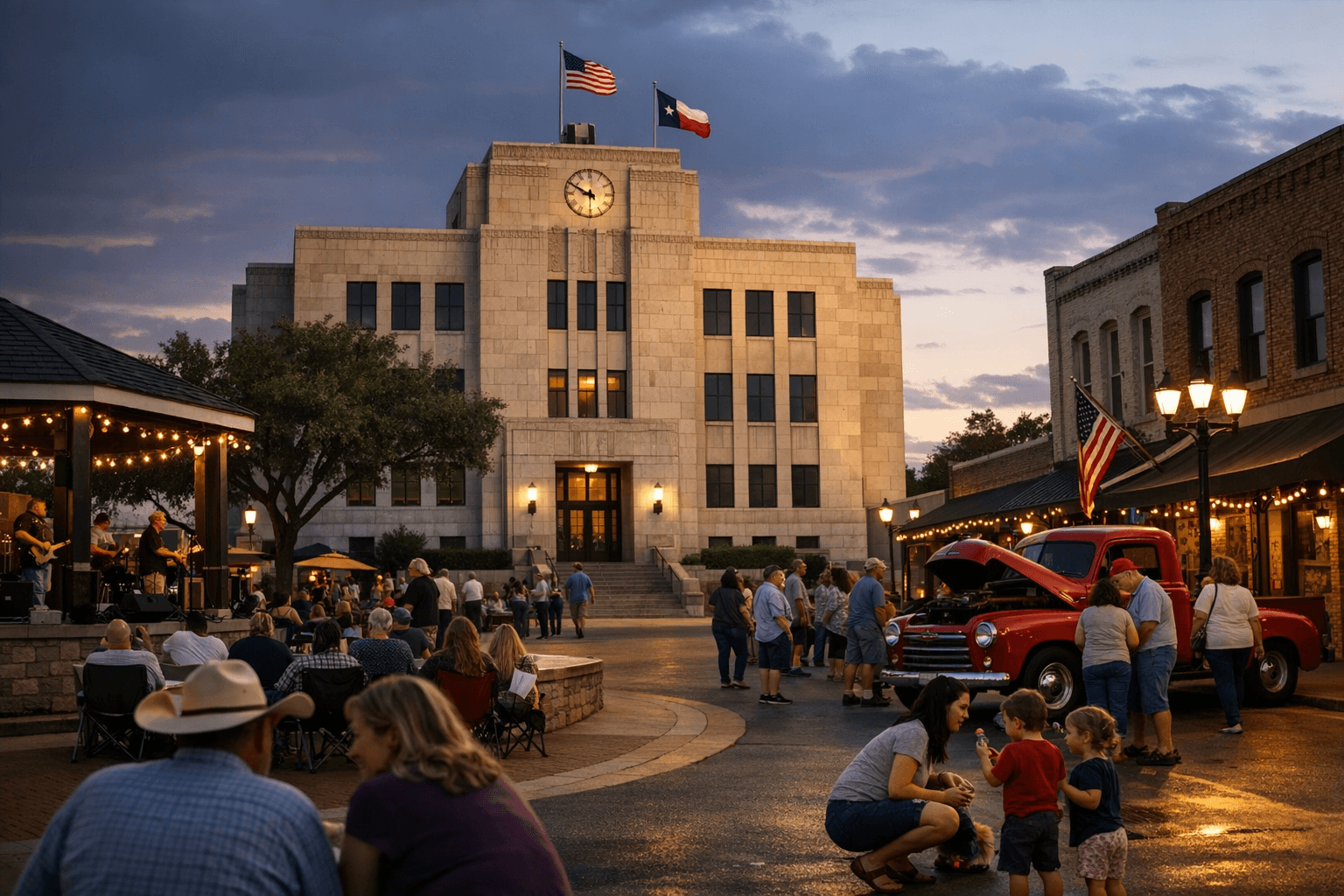
Stand in the square outside 101 E Rusk St, Rockwall, TX 75087 (coordinates 32.9310567, -96.46115) and the layers of county history are immediate: a stone Moderne courthouse from the WPA era overlooks 19th‑century storefronts, while schedules for Founders Day, Aspasians Arts and Crafts and Concert by the Lake fill the municipal calendar. The courthouse and the surrounding downtown square function as the civic and cultural heart of Rockwall, anchoring commercial life and county government in the city core.
- Historic Rockwall County Courthouse: built as a WPA project in the early 1940s (sources list construction beginning in 1940 and completion or "Year Built" often cited as 1941), architects Voelcker & Dixon, $100,000 Moderne style stone structure.
- Address/coordinates: 101 E Rusk St; 32.9310567, -96.46115.
- Restoration and later changes: restored in 2002; most county activity shifted to a larger new courthouse built around 2010–2011; the historic building still houses the Rockwall County Commissioners’ Court and Tax Office according to available records.
A brief factual snapshot
These facts place the courthouse as a preserved public building with active county functions and a distinct role in downtown vitality.
How the courthouse emerged: the 19th and 20th century sequence Rockwall County was organized March 1, 1873, and named April 23, 1873 “for a curious geological formation, an underground rock wall,” text that still appears on the county historical marker. The county’s courthouse history is episodic: a wooden courthouse was built in 1878; a destructive fire in 1891 sank the second courthouse while a separate stone clerk’s building survived. Construction began in 1892 on a sandstone courthouse built on the present site, though some records reference an 1893 building; by the late 1930s crumbling mortar and condemned second‑story spaces led to razing and replacement. Sources indicate the sandstone courthouse was razed in 1940 and replaced with the present WPA‑assisted structure that stands today.
Design, New Deal funding and the Depression context The present courthouse is credited to architects Voelcker & Dixon and described as a $100,000 Moderne style stone building erected with Works Progress Administration support. The socioeconomic rationale for WPA projects is visible in county detail: “Rockwall County ,,, was primarily agricultural during the Great Depression. By 1940, fifteen percent of the available workers were doing relief jobs or in search of work. The federal government kept the county government from bankruptcy with federal relief funds.” That figure—15 percent—underscores why federal relief funds and local WPA projects mattered to Rockwall’s municipal infrastructure and public employment during that era.
Architectural notes and restoration history The courthouse’s Moderne styling and stone construction mark it as a mid‑century civic building that replaced an earlier sandstone structure. County and preservation records show a restoration completed in 2002; a submission to the Texas Historical Commission by Hendricks & Brontner Architects for a Master Plan was logged but rejected, and the courthouse was nevertheless restored. Local real estate and preservation commentary describes the building as standing “on a quaint square in the middle of town,” an observation that captures its civic siting and streetscape relationship to contiguous 19th‑century storefronts.
Where county government sits today—and policy implications County business has migrated: records and local accounts say trial court functions moved to a newer, larger courthouse constructed offsite around 2010–2011, and “Most County activity occurs at the massive ‘new’ courthouse built in 2010,” while the historic courthouse “still houses the Rockwall County Commissioners’ Court and Tax Office.” That division of functions has policy implications for access to justice, downtown foot traffic, and municipal services. Concentrating trials in a newer complex can improve courtroom capacity but also shifts visitors—and economic activity—away from the square. Keeping Commissioners’ Court and the Tax Office downtown preserves some civic visibility but invites questions about accessibility, parking and service hours across two sites; definitive office lists and operating hours should be confirmed with county administration for planning purposes.
Downtown square life, events and civic engagement The courthouse square is not merely symbolic: it supports recurring community events that sustain civic participation and local commerce. Founders Day each spring anchors the calendar on the square. The Aspasians Arts and Crafts show—listed as occurring every April and September—has run for roughly 30 years and funds scholarships for local high school seniors, a direct tie between downtown programming and youth civic investment. Seasonal programming extends to Concert by the Lake at the Harbor Amphitheater in spring and summer and Rockin On The Docks, an all‑day October event on the Harbor at Lake Ray Hubbard. These events channel residents into downtown spaces where public meetings, voter outreach and local commerce intersect.
Rock Wall, local lore and scientific closure The city’s name comes from a striking geological feature known locally as the Rock Wall: Visit Rockwall materials describe it as “a natural limestone formation that inspired the city’s name, is 20 miles long and seven stories high.” Excavations in the late 1870s generated sensational theories—some linked the structure to Native Americans or “maybe even extraterrestrial influence”—but subsequent studies by colleges and organizations concluded it is “just a unique formation of limestone rock that had appeared to look like bricks.” The formation and its lore remain points of civic identity and tourism, and any precise measurements cited in coverage should be verified against geological surveys or academic work if relied on for planning or interpretive signage.
Preservation questions and things to verify Several timeline details differ across records and deserve confirmation before formal citation: construction dates for the WPA courthouse are variously listed as beginning in 1940 with a 1941 completion; the county’s newer courthouse is cited as built in 2010 in some sources and 2011 in others; and the sandstone courthouse’s exact 1892/1893 chronology is ambiguous in surviving fragments. For public‑sector decision‑making and historical interpretation, verify start/finish construction dates and the exact mix of county offices housed in the historic versus the new courthouse with Rockwall County facilities, the County Clerk’s Office and the Texas Historical Commission. The Living New Deal listing was submitted by Larry Moore on June 10, 2014 and provides location coordinates; county records and THC files will be the definitive sources for architectural and restoration documentation, including the Hendricks & Brontner Architects submission referenced in THC notes.
- Address for the historic courthouse and square: 101 E Rusk St, Rockwall, TX 75087 (coordinates 32.9310567, -96.46115).
- The historic courthouse currently houses county offices including the Commissioners’ Court and the Tax Office; trial court business relocated to a newer facility around 2010–2011—confirm specific office hours and service locations with Rockwall County before planning court appearances or administrative transactions.
- Downtown features surviving 19th‑century storefronts and the Lovejoy Building, which stood on the south side of the courthouse square as of historical accounts in 1983; the courthouse square hosts seasonal events that support scholarships and local nonprofits.
Practical guide points for visitors and civic users
Conclusion The Historic Rockwall County Courthouse and downtown square combine architectural heritage, New Deal history and ongoing civic functions. The building’s WPA provenance, the 2002 restoration and the continued presence of Commissioners’ Court speak to a municipal balancing act: preserving an emblematic public building while accommodating modern court and county needs in a newer complex. That balance will shape downtown economic activity, public access to government services and how Rockwall’s history is interpreted for residents and visitors—matters that merit continued public oversight and clear county documentation.
Sources:
Know something we missed? Have a correction or additional information?
Submit a Tip