Hockney's art celebrated gay domestic life and challenged taboos
Hockney turned gay domestic life into a quiet act of defiance, painting intimacy with calm precision while the law still criminalized the people he loved.
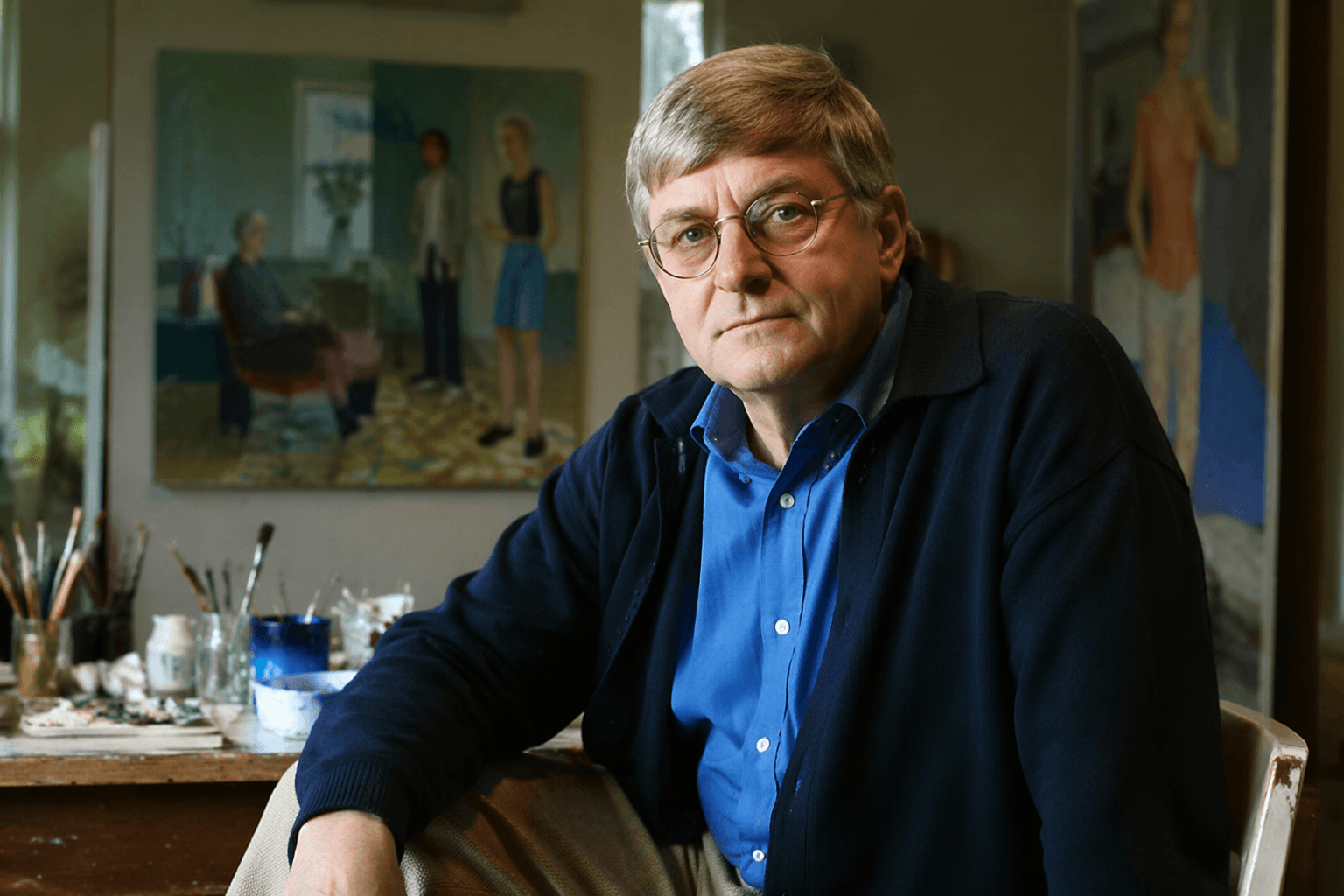
David Hockney made ordinary gay domestic life look quietly revolutionary. His paintings and prints did not shout their politics; they showed lovers at ease, rooms lived in, and private moments that the law and much of public culture still treated as suspect. That tension, between serenity on the canvas and hostility outside it, is what made his work so disruptive.
Intimacy as defiance
Hockney broke social taboos by celebrating same-sex relationships in art at a time when male homosexuality in England and Wales had only been partially decriminalised in 1967. Tate traces the harsher legal backdrop back to the abolition of the death penalty for sodomy in 1861 and forward through the 1885 Labouchere Amendment, which made homosexuality illegal in Great Britain, before the Sexual Offences Act 1967 loosened the law. The result was a long period in which persecution and visibility existed side by side, with queer communities still finding one another and building forms of collective life.
That is the sharpest context for Hockney’s domestic scenes. He did not simply depict gay men; he pictured gay life as settled, affectionate, and part of the ordinary fabric of modern existence. In that sense, every quiet interior and every tender exchange carried a political charge, because it insisted that same-sex love belonged in the same visual culture as any other private life.
A young artist enters public view
Born on 9 July 1937, Hockney first came to public attention in 1961 while he was still a student at the Royal College of Art. Tate describes him as one of the most influential British artists of the 20th and 21st centuries and an important contributor to 1960s pop art, but his importance also lies in how early he made personal identity central to his work. He did not wait for a later, more permissive era to do so.
That urgency appears clearly in A Rake’s Progress, the early print series he created in 1961-62 and published in 1963. MoMA describes Hockney’s art as “deeply autobiographical,” rooted in his personal relationships and homosexuality, and that series projected a deliberately frank homosexual persona. The work showed that autobiography could be a form of artistic strategy, turning lived experience into a visual language that was both intimate and unmistakable.
California light, domestic rooms, and a broader life
Hockney later built a life that expanded the emotional range of that early candor. Tate notes that he has lived intermittently in California since 1964, a fact that matters because California became one of the settings where his attention to light, space, and domestic interiors could develop on a larger scale. His work increasingly linked place to feeling, and private rooms to the shape of a relationship.
That arc is visible in Tate’s current Hockney exhibition, which includes more than 200 works and ranges from trailblazing 1960s explorations of queer love and desire to tender depictions of his parents and recent works exploring private moments in Hockney’s home and studio. The scale of the show underlines how consistent his concerns have been. Whether he was drawing queer desire, family life, or the hush of a studio, Hockney kept returning to the same proposition: intimacy is worthy of serious art.
Why the calm matters
The force of Hockney’s work lies partly in restraint. He did not need shock tactics to challenge taboos because the image of ordinary domestic ease was itself subversive in a culture shaped by criminal law and social stigma. A couple in a room, a body at rest, a private corner of a home, these scenes undermined the assumption that gay life had to be hidden, deviant, or fleeting.
Tate’s Queer British Art exhibition makes that larger historical point explicit by framing 1861 to 1967 as a period in which legal persecution coexisted with the formation of queer communities. Hockney’s art sits inside that contradiction. It registers the cost of invisibility while refusing to let queer life be defined by secrecy alone. In that respect, his paintings are not just records of a changing society; they are part of the change itself.
A legacy that still speaks to censorship and memory
That legacy matters now because debates over visibility never really ended. Questions about what can be shown, which lives are considered respectable, and how cultural institutions preserve queer memory remain active in museums, schools, and public life. Hockney’s work offers a clear answer to those pressures: to depict gay domestic life without apology is already to make a claim about whose experience belongs in history.
His art endures because it turned the private into the historically significant. By placing same-sex intimacy inside the calm, durable language of painting, Hockney challenged a legal order that once punished the people he portrayed and helped build a visual record that still resists erasure.
This article was produced by Prism’s automated news system from verified source data, official records, and press releases, then run through automated quality and moderation checks before publishing. The system is built and supervised by the people who set the standards it runs under. Read our full AI policy.
Know something we missed? Have a correction or additional information?
Submit a Tip