Home Depot Says Online Sales Reach $25 Billion, Accelerates AI
At its December 17 Investor Day, Home Depot told investors its online business now generates roughly $25 billion in annual sales, and outlined broad investments in fulfillment and artificial intelligence across its digital and logistics operations. The moves aim to speed same or next day delivery for more than half of stocked items, a shift that will reshape store, delivery, and asset protection work for thousands of employees.
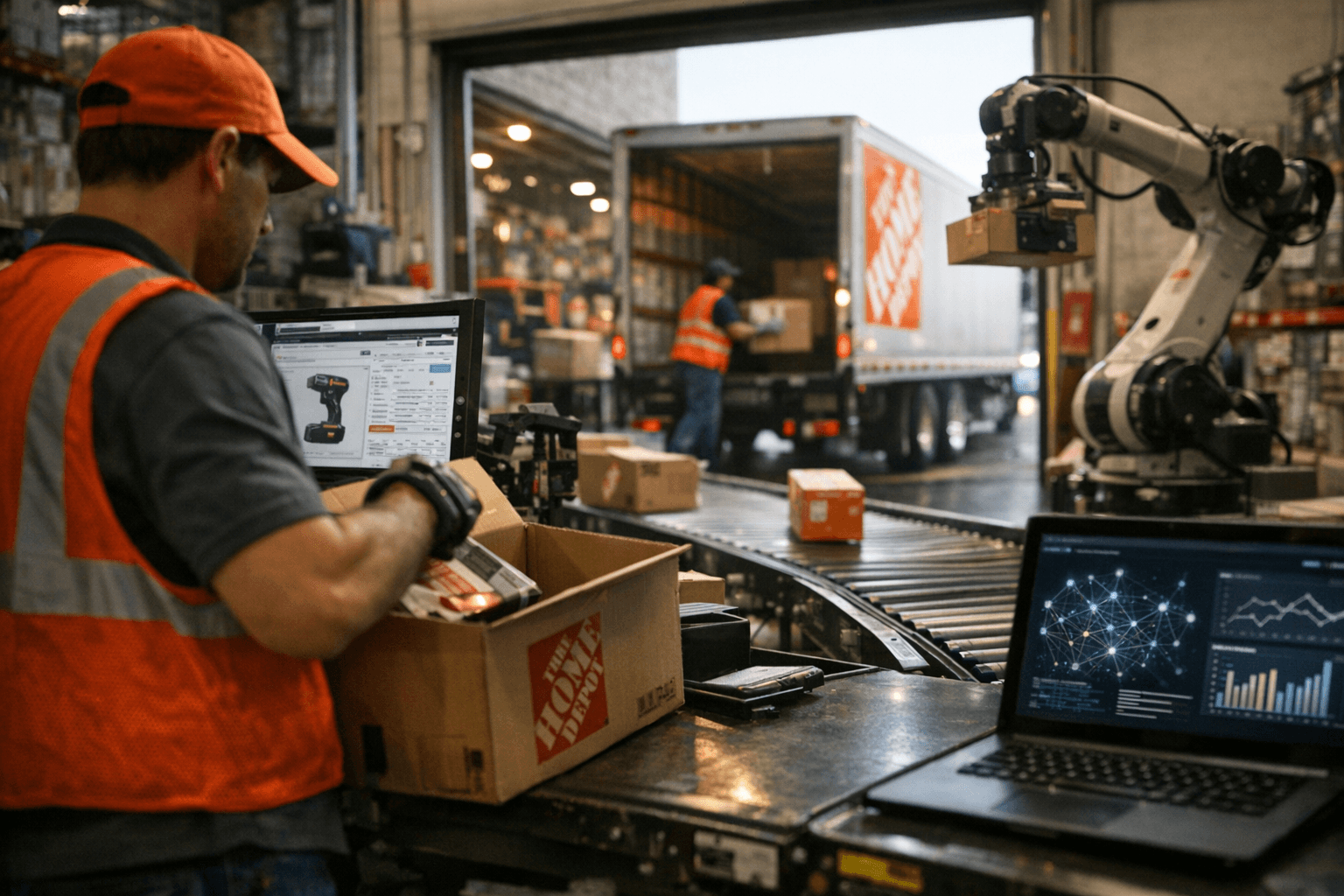
Home Depot used its December 17 Investor Day to lay out a strategy that ties its stores, delivery assets, and associates more tightly to digital platforms in order to speed fulfillment and improve reliability. Executives, including Jordan Broggi, described an interconnected operating model that uses stores as active fulfillment nodes alongside hundreds of logistics facilities to deliver same or next day service for a growing share of stocked items. The company said its online business now produces roughly $25 billion in annual sales, underscoring the scale of the digital shift.
The company detailed investments in fulfillment infrastructure, noting hundreds of logistics facilities and upgrades aimed at shortening lead times and reducing delivery failures. Executives said more than half of stocked items are now eligible for same or next day delivery, and the company is expanding real time tracking for bulky deliveries while seeking to raise delivery customer satisfaction. Those operational goals are supported by a wave of artificial intelligence applications across the catalog, ordering and delivery flow.
AI is being applied to catalog enrichment, routing and sourcing logic, and customer facing tools. The presentation highlighted a generative AI shopping assistant called Magic Apron and a Blueprint Takeoff Tool targeted at professional customers to speed materials estimation and ordering. Internally, AI driven routing and sourcing logic is intended to reduce missed deliveries and improve first time success for bulky items that often require store coordination and asset protection oversight.
For workers, the changes will mean shifts in daily tasks and responsibilities. Store associates may spend more time picking, staging and loading orders for fast fulfillment, while delivery teams and logistics employees will operate with tighter schedules and more real time tracking. Asset protection teams will remain central to managing large item handoffs and shrink prevention, but they will also work more closely with digital systems that surface exceptions and delivery risk. The company signaled ongoing investments in technology and facilities, which will require additional training and operational adjustments across stores and distribution centers.
Home Depot presented the moves as a way to better serve both retail and professional customers, but the combination of faster fulfillment metrics and expanded AI tools will reshape workplace dynamics, job tasks and the skills employers expect from frontline and logistics staff going into 2026.
Know something we missed? Have a correction or additional information?
Submit a Tip