Homeland security chiefs face House scrutiny after Minneapolis shootings
Acting ICE, CBP and USCIS leaders testify before the House amid outrage over Minneapolis enforcement deaths and a looming DHS funding deadline.

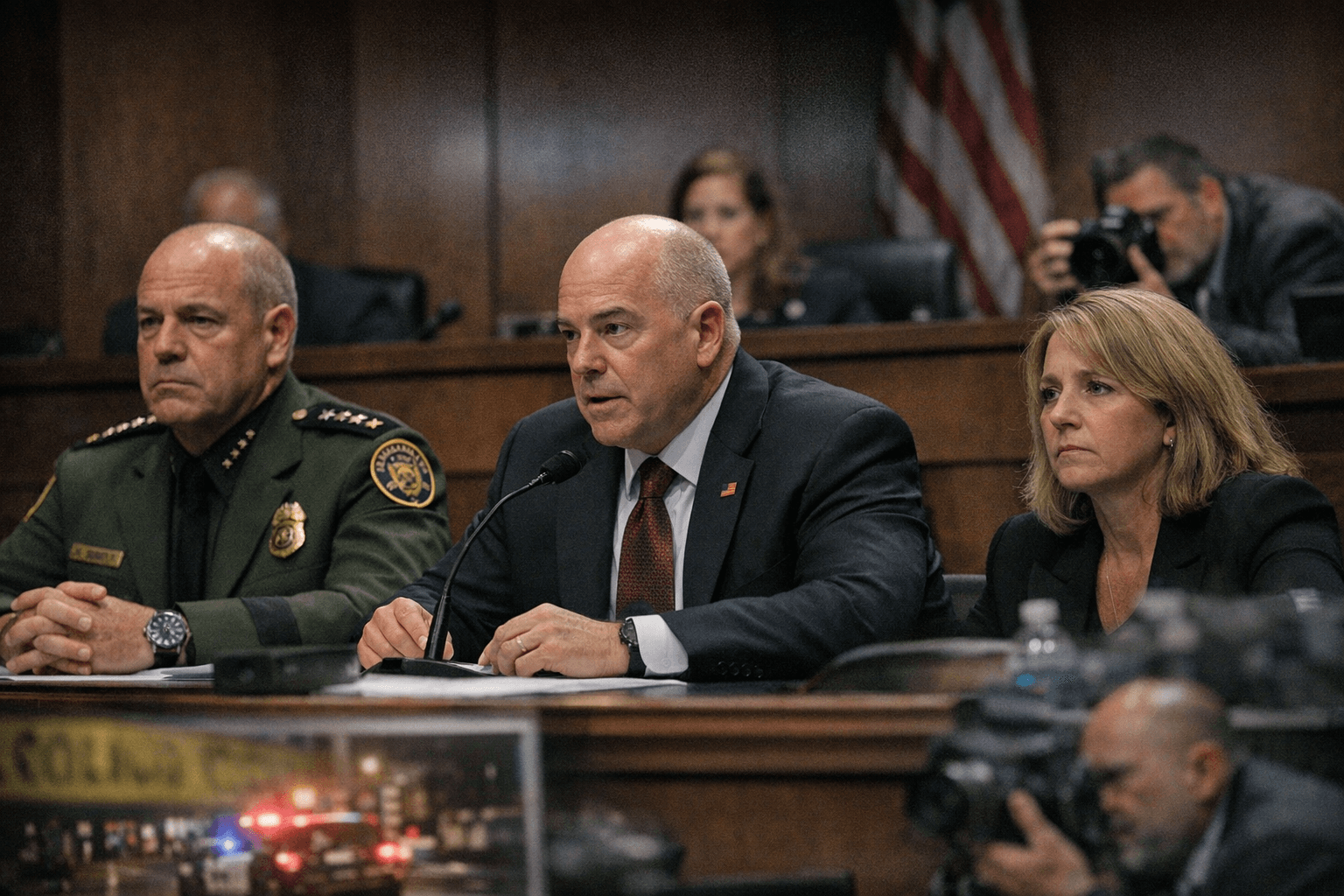
Acting ICE Director Todd Lyons, CBP Commissioner Rodney S. Scott and USCIS Director Joseph Edlow testified before the House Committee on Homeland Security on Feb. 10, defending agency tactics as lawmakers pressed for explanations after deadly federal enforcement operations in Minneapolis.
The hearing, which the committee carried out over roughly three and a half hours, was convened after federal officers shot and killed two protesters in Minneapolis, identified as Alex Pretti and Renee Good. Committee Chair Rep. Andrew Garbarino said the session was intended to provide transparency and to address rising tensions as Congress weighs continued Department of Homeland Security funding ahead of a Friday deadline.
Lyons framed his agency’s posture around an aggressive enforcement agenda, telling lawmakers in opening remarks, "We are only getting started." He repeatedly defended ICE officers and said they would not be intimidated as they implement the administration’s expanded deportation operations. Joseph Edlow appeared alongside the two counterparts but provided no quoted remarks in the committee’s public summary; his prepared statement was submitted as part of the record.
Scott’s prepared testimony focused on operational metrics and interagency cooperation. He described Customs and Border Protection as representing "more than 67,000 dedicated men and women of CBP, the largest law enforcement agency in the United States" and said the agency recorded an 8 percent increase in drug seizures over the prior year. Scott cited nearly 11,000 pounds of fentanyl and 185,000 pounds of methamphetamine seized nationwide, and he portrayed CBP as a "foundational partner" in the President’s Homeland Security Task Force, working across all 50 states to dismantle transnational criminal organizations.
Those operational claims underscore the political calculus behind tightened enforcement: agency leaders point to rising interdictions and large seizures as evidence that additional resources improve public safety. Republican members, led by Garbarino, stressed oversight and the need to ensure "historic resources provided through reconciliation" are used effectively. Garbarino said, "Transparency and communication are needed to turn the temperature down," and he thanked DHS leadership for making witnesses available.
Democrats countered that enforcement has outpaced oversight and raised civil liberty concerns. The Minneapolis shootings have intensified calls for restrictions and reforms, including making body cameras mandatory for federal officers. DHS Secretary Kristi Noem has announced deployment of body cameras to every field officer in Minneapolis with plans to expand nationwide "as funding allows," while Democratic lawmakers are seeking to codify camera requirements into law.
The hearing takes place against a backdrop of full appropriations for DHS enacted last year that committee Democrats say has given the agencies latitude to broaden enforcement nationwide. Lawmakers from both parties signaled they would continue the issue on the Senate side later in the week, with the same agency heads expected to appear for additional questioning.
Beyond the immediate political flash point, the session highlighted a longer-term trade-off facing Washington: whether to prioritize aggressive, nationwide immigration enforcement backed by measurable interdiction data or to impose statutory constraints and new transparency mechanisms after high-profile incidents. The agencies offered statistics to justify scope and scale, but the Minneapolis deaths have sharpened scrutiny and raised the prospect that funding and policy conditions could become leverage points in upcoming appropriations and reform negotiations.
This article was produced by Prism’s automated news system from verified source data, official records, and press releases, then run through automated quality and moderation checks before publishing. The system is built and supervised by the people who set the standards it runs under. Read our full AI policy.
Did this article answer your question?

