House Democrats split over symbolic bid to cut Israel aid
103 House Democrats backed a failed bid to cut off Israel aid, a sharp break from just 37 who supported a similar effort two years ago.
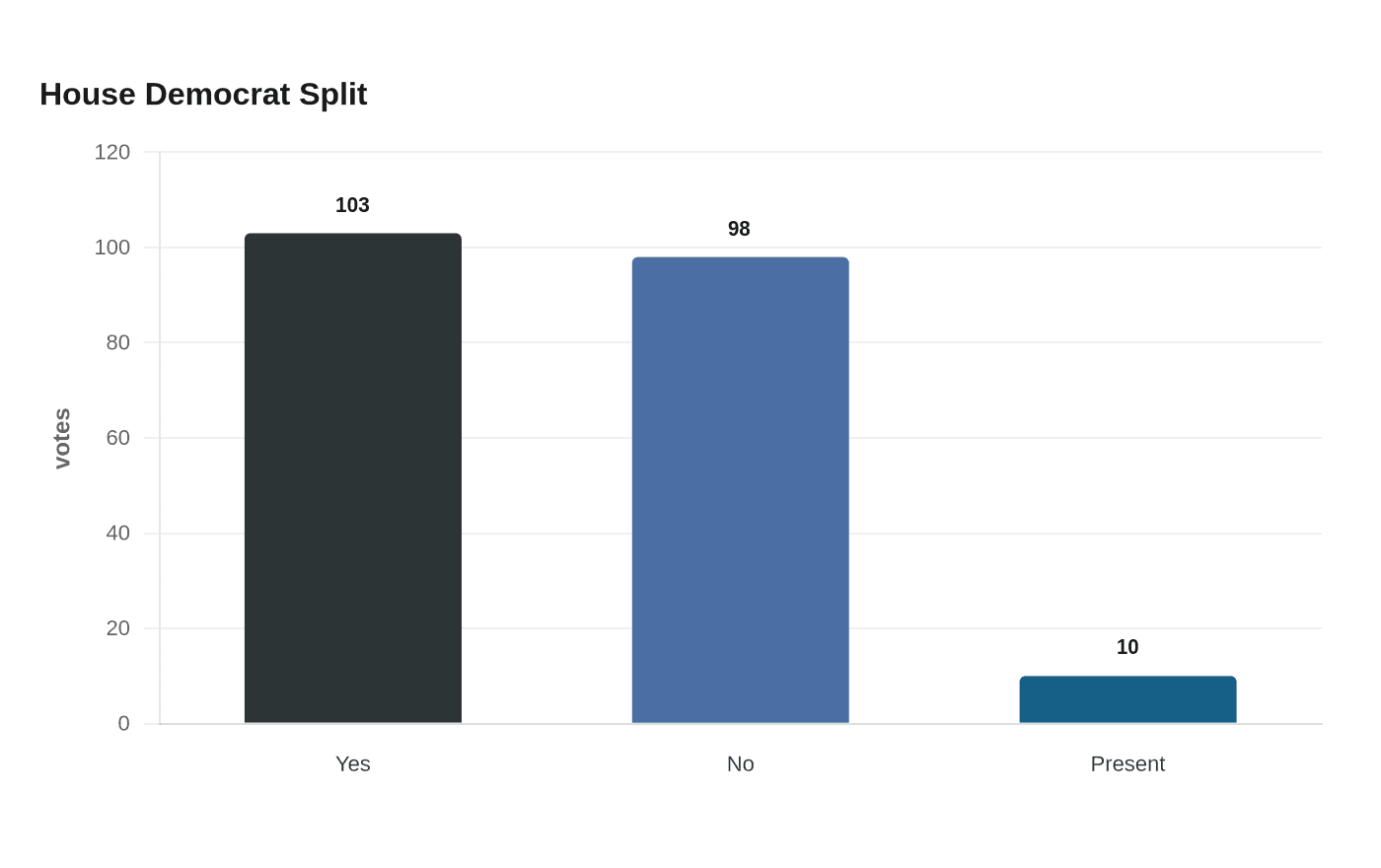
The House rejected a Republican amendment 314-104 that would have blocked State Department funding from being used for Israel and ended $3.3 billion in annual security assistance. The tally showed the depth of the split inside the Democratic caucus: 103 Democrats voted yes, 98 voted no, 10 voted present, and Kentucky Republican Thomas Massie was the only Republican to back the measure.
The vote was designed to fail, but it still forced House Democrats into a stark public test over Israel and Gaza. House Minority Leader Hakeem Jeffries opposed the amendment as too broad, arguing it could restrict humanitarian aid, refugee resettlement, peace-building, embassy operations and the ability to confront Hamas and Hezbollah. House Minority Whip Katherine Clark broke with him and voted yes, saying, "the status quo is not tenable." Her vote put the leadership divide in plain view at a moment when the party’s internal argument over Israel has become more visible and more politically costly.

The level of support for the amendment marked a sharp change from just over two years ago, when only 37 House Democrats backed a similar effort. This time, nearly half of House Democrats supported cutting off aid, reflecting pressure from the party’s progressive wing and from primary voters angry over Israel’s conduct in Gaza. The issue has become a test in Democratic primaries, where candidates are increasingly being pressed to define where they stand on military assistance and the war itself.
The vote also unfolded against the backdrop of a devastating war. Hamas-led fighters killed about 1,200 people in Israel on Oct. 7, 2023, and Israel’s offensive in Gaza has killed more than 73,000 Palestinians, according to the Gaza health ministry. Much of Gaza lies in ruin and nearly all of its 2 million people have been displaced, intensifying the political pressure on Democrats who once treated support for Israel as a near-automatic position.
Even if the amendment had passed the House, it still would have needed Senate approval and would almost certainly have faced a veto from President Donald Trump, who has made support for Israel a centerpiece of his foreign policy. The contrast with September 2016 was striking: the House then voted 405-4 for a resolution backing the U.S.-Israel memorandum of understanding, a 10-year, $38 billion military aid agreement for fiscal years 2019 through 2028.
This article was produced by Prism’s automated news system from verified source data, official records, and press releases, then run through automated quality and moderation checks before publishing. The system is built and supervised by the people who set the standards it runs under. Read our full AI policy.
Did this article answer your question?