How Frederick Douglass used photography to advance abolition and dignity
Frederick Douglass turned portraits into abolitionist strategy, using the camera to reject racist caricature and claim dignity. His self-fashioning still speaks to today’s fights over who controls public image.
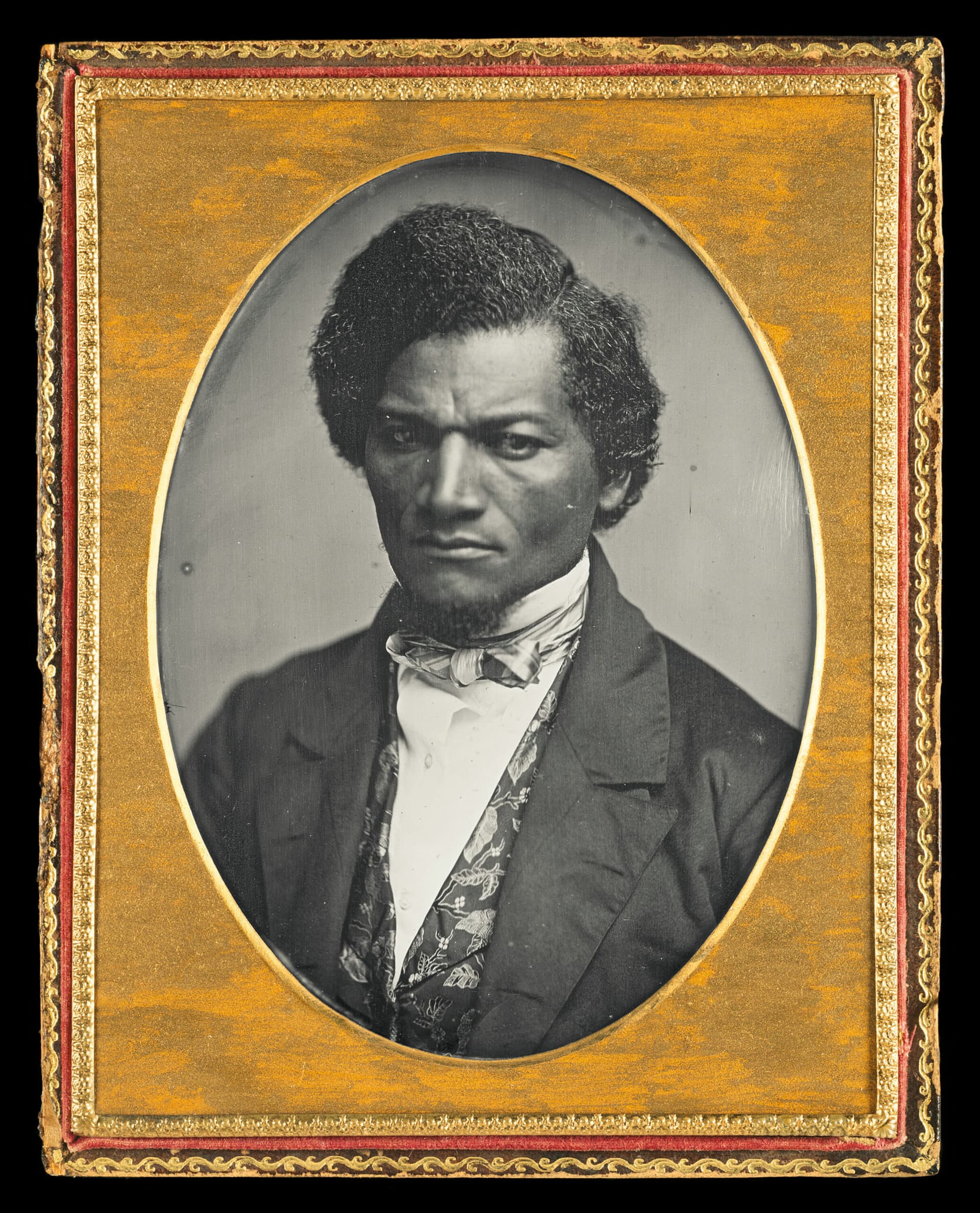
Frederick Douglass understood early on that photographs could do more than preserve a face. Born into slavery in Maryland and later known as an abolitionist, orator, writer and statesman, he used portraits as a deliberate form of public power, building an image of Black dignity at a time when racist caricatures were common and widely circulated. Multiple museum and library sources describe him as the most photographed American of the 19th century, and the National Park Service says he accumulated more than 160 photographs and portraits over his lifetime.
Photography as political strategy
Douglass’s image work was not a side note to his activism. It was part of the activism itself, a way to answer a country that still reduced Black life to stereotype and property. Scholars and institutions have treated his portraits as evidence that he wanted to be seen with the composure, seriousness and equality denied to Black Americans in law and popular culture. The photographs functioned as arguments: if slavery depended on dehumanizing images, then a carefully staged likeness could push back against that logic.
That strategy mattered because Douglass was already a major public figure by the time photography became central to his visual identity. His 1845 Narrative of the Life of Frederick Douglass, an American Slave became one of the most influential abolitionist texts of the era, making his own life story a weapon against slavery. By July 5, 1852, when he delivered “What to the Slave Is the Fourth of July?”, the Smithsonian National Museum of African American History and Culture notes that about 3.5 million African Americans were enslaved, roughly 14% of the U.S. population. Douglass was speaking to a nation in which the moral and political stakes of representation were inseparable from the survival of millions.
A face built for abolition
Douglass’s portraits circulated alongside his speeches and books, reinforcing one another. The Smithsonian National Portrait Gallery says he became the most photographed American of the 19th century, and the Library of Congress notes that he sat for many portraits during his lifetime, likely more than any other American of that century. That level of image-making was unusual even for a prominent public figure, and it gave Douglass a visual presence that matched his force as a speaker.
The effect was cumulative. Each portrait helped define him not simply as a formerly enslaved man who had risen to fame, but as a national intellectual whose authority could not be contained by racist assumptions. The Smithsonian National Portrait Gallery also identifies him as the first African American to receive a federal appointment requiring Senate approval, when he served as U.S. Marshal of the District of Columbia. That appointment mattered because it placed a Black man in a visible office of federal authority, exactly the kind of public standing his photographs had already helped normalize.
Pictures and Progress in Boston
On December 3, 1861, Douglass delivered a lecture in Boston titled “Pictures and Progress” at Tremont Temple as part of the Fraternity Course lectures. The Frederick Douglass Papers preserve the address, and the lecture shows how deliberately he thought about photography as a democratic medium rather than a luxury for the wealthy. He argued that portraits were becoming affordable enough that even a working woman could own a likeness once reserved for elites, a point that linked visual culture to access, class and citizenship.
That idea was radical because it treated the image as a public good. In Douglass’s hands, photography was not just about capturing resemblance. It was about expanding who could be seen, who could afford to be seen, and whose likeness deserved to circulate beyond private parlors and elite collections. The lecture placed him inside the debate over how new media could reshape social life, with the camera serving as a tool for widening, not narrowing, the sphere of recognition.
Why museums and scholars keep returning to the portraits
Modern exhibitions and scholarly projects keep returning to Douglass’s photographs because they reveal how fully he understood the politics of self-representation. Smithsonian’s National Portrait Gallery exhibition “One Life: Frederick Douglass” and the National Museum of African American History and Culture both frame his portraits as central to his public identity and to the struggle for Black citizenship. That framing matters because it shifts the photographs from artifact to evidence of a deliberate public campaign.
Researchers including John W. Stauffer, Laura Wexler, and Ginger Hill have helped deepen that interpretation, treating Douglass’s visual choices as part of a larger fight over Black respectability, autonomy and authority. Their work sits alongside interpretations from the Library of Congress, the National Gallery of Art and the Gilder Lehrman Institute of American History, all of which present Douglass’s image-making as inseparable from his political life. The common thread is clear: he did not simply sit for portraits. He used them to contest the terms on which Black people were allowed to appear in public.
The modern lesson in Douglass’s self-fashioning
Douglass’s photography still lands because the problem he was solving has not disappeared. The struggle over who controls an image, who gets framed as credible, and whose humanity is recognized remains central to public life, especially for Black people whose dignity is still challenged by distortion, surveillance and selective visibility. Douglass responded to that world with intention, using the camera to insist on self-possession.
He grasped something modern media still tests every day: images are never neutral when power is uneven. In the 19th century, that meant refusing the racist visual grammar of slavery and making room for a Black public figure who looked unafraid of the frame. Today, his portraits remain a record of how visual control can become political control, and how dignity can begin with the right to be seen on one’s own terms.
This article was produced by Prism’s automated news system from verified source data, official records, and press releases, then run through automated quality and moderation checks before publishing. The system is built and supervised by the people who set the standards it runs under. Read our full AI policy.
Did this article answer your question?