How gerrymandering and one-party control fuel U.S. political stagnation
America’s gridlock is not just Washington dysfunction. Durable one-party control and lopsided maps keep many statehouses unaccountable and elections safely uncompetitive.

The deeper source of U.S. political stagnation is not only partisan warfare in Washington. In too many states, durable one-party control turns elections into managed contests, then shields lawmakers from the pressure that keeps institutions responsive.
One-party power starts with the map
The House map is already thin on genuine competition. In 2024, only 27 of 435 U.S. House districts were considered toss-ups, and the Brennan Center estimated that post-2020 census gerrymandering gave Republicans about a 16-seat advantage in the 2024 House race compared with fair maps. That kind of structural edge matters because it shrinks the number of districts where either party must actually persuade voters rather than simply defend a safe seat.
The decline of bellwether districts tracks the rise of single-party control over redistricting and the aggressive use of partisan map-drawing. When the map itself narrows the battlefield, elections still happen, but competition becomes highly uneven. The result is a legislature whose most important members often face more risk from a primary than from the general election.
The statehouse is where the real power sits
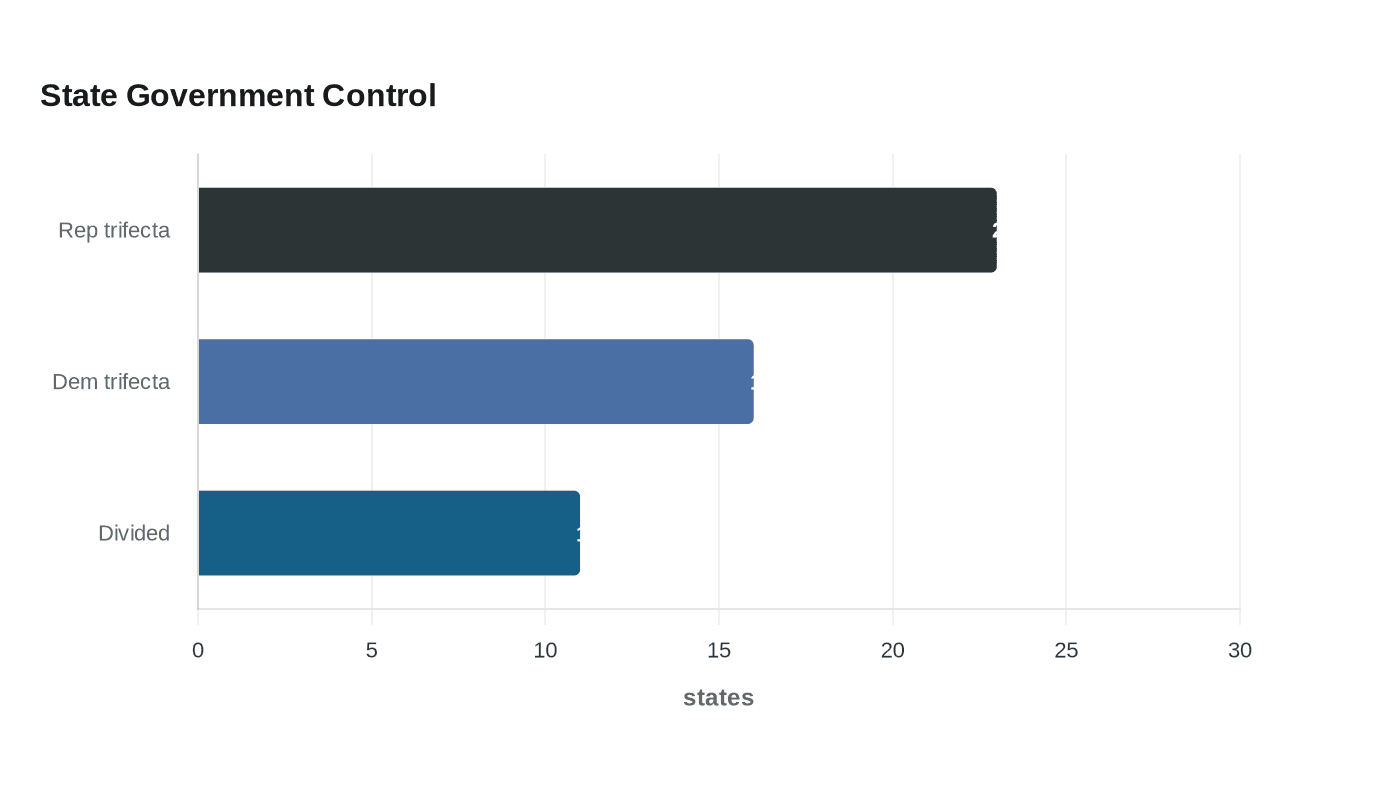
The bigger story is at the state level, where partisan control is often more durable than the national mood suggests. Ballotpedia counted 35 state government trifectas after the 2024 elections, and as of June 23, 2026, it listed 23 Republican trifectas, 16 Democratic trifectas, and 11 divided governments. That means a large share of state policymaking sits inside systems where one party can govern without needing to build broad coalitions.
The scale is enormous. The National Conference of State Legislatures says the nation has 7,386 total legislative seats across 99 state legislative chambers. Extended periods of one-party dominance in the American states are not an anomaly, a State Politics & Policy Quarterly study concluded, but the rule, and they may be increasing. That is a warning sign for accountability because the same party can keep rewriting the rules while controlling the chamber that would be expected to police itself.
Competition changes how voters behave
The case for reform is not abstract. Brennan Center research says competitive elections generally have higher voter participation, which means the design of districts affects not only who wins, but who shows up. If districts are safe, campaigns become narrower, turnout incentives fall, and officeholders can spend more time managing intra-party pressure than answering the broader electorate.
That is why independent redistricting commissions matter. The Brennan Center says congressional districts drawn by commissions and courts tend to be more competitive than those drawn by legislatures, and they also tend to produce fewer incumbent wins. Courts and commissions do not eliminate politics, but they can reduce the incentives that let legislators protect themselves first and voters second. The practical difference is simple: a member who has to face a real contest behaves differently from one who knows the district was built to keep the seat in the same column.
Public anger is reflecting institutional failure
The public mood has caught up with the structural problem. Gallup reported in April 2026 that approval of Congress had fallen to 10 percent, while disapproval reached 86 percent, tying a record high. In December 2025, Gallup found that Americans were ending the year with Republicans in Congress at 29 percent approval and Democrats in Congress at 24 percent, a reminder that distrust has spread across the institution rather than settling on a single party.
That disillusionment helps explain why redistricting keeps returning as a reform target. Reuters/Ipsos polling in 2025 found that most Americans thought partisan redistricting efforts were bad for democracy. When voters see maps as tools of self-protection rather than representation, they are reacting to a real institutional pattern: parties that can insulate themselves from accountability tend to do just that.
The fight has moved back to the states
Mid-decade redistricting is now an active battlefield again, with Texas, California, Missouri, and Utah all involved in efforts or court fights over congressional maps ahead of the 2026 midterms. That matters because redistricting disputes are not only about where lines sit on a map; they are tests of whether the rules can be changed to preserve power before voters get another chance to speak. The state-by-state struggle is exactly where one-party dominance becomes self-reinforcing.
Political scientists have been warning for years that this pattern distorts representation, turnout, and oversight. A 2022 study by Christopher T. Kenny, Kosuke Imai, Janine Parry, and Andrew Dowdle argued that long stretches of one-party rule in the states have been overlooked even though they are common and consequential. Another line of scholarship links party systems and electoral structures to corruption incentives, because monitoring weakens when competition weakens. When the same coalition controls the map, the chamber, and the rules, the risk is not merely stalemate. It is a political system that keeps holding elections while steadily lowering the cost of ignoring them.
The central question is not whether America has parties. It is whether those parties still have to compete for power in enough places to stay honest. On the evidence from the House map, the state trifecta counts, and the record-low approval of Congress, the answer depends less on Washington than on whether state-level democracy is allowed to function as more than a formality.
This article was produced by Prism’s automated news system from verified source data, official records, and press releases, then run through automated quality and moderation checks before publishing. The system is built and supervised by the people who set the standards it runs under. Read our full AI policy.
Did this article answer your question?

