How Myth and Market Power Shield Big Tech From Its Critics
Big Tech's countercultural origin stories and staggering market power have repeatedly blunted regulatory attacks, even as courts confirm monopolistic conduct.
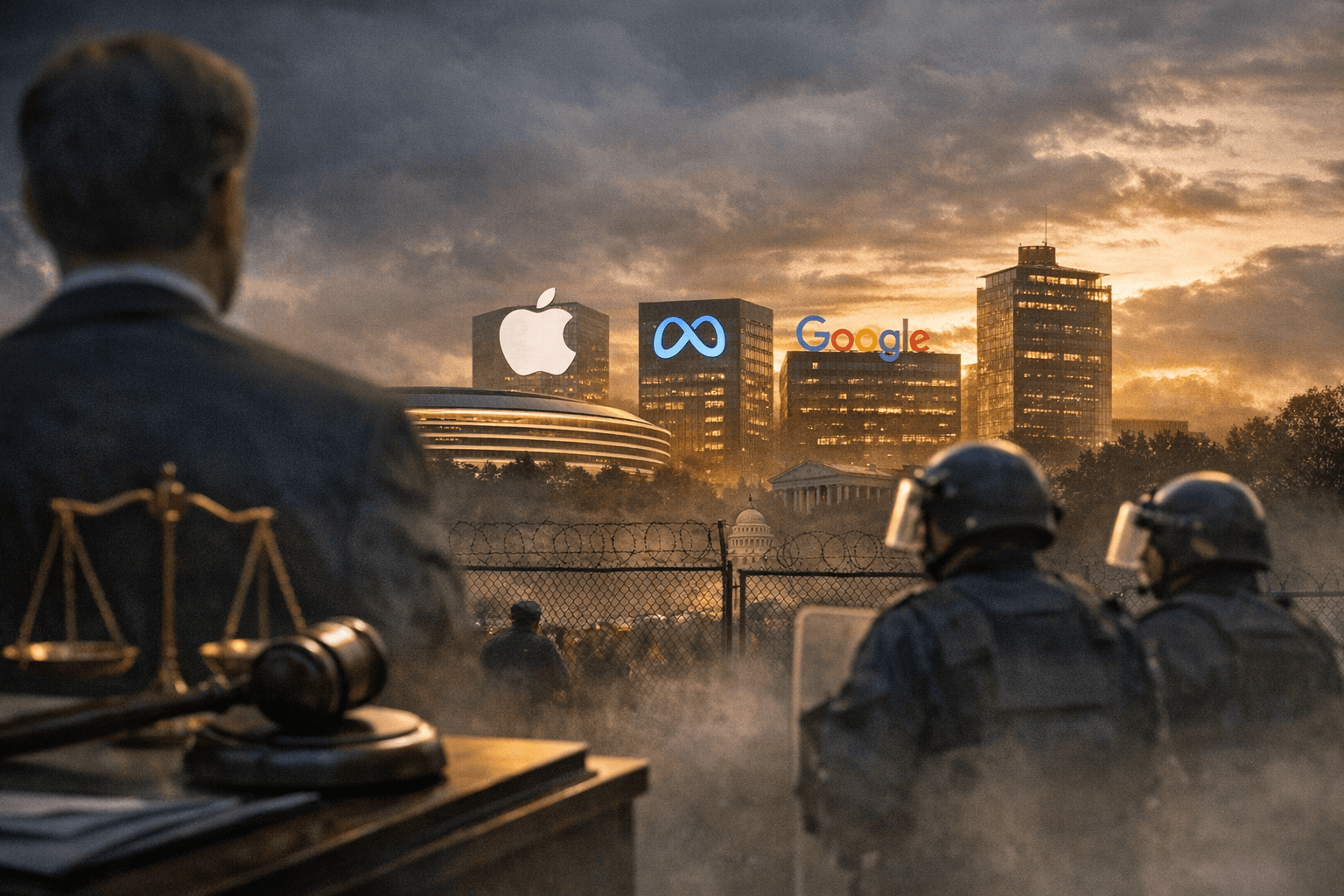
The Rebel Costume and the Corporate Giant Beneath It
Few corporate maneuvers have proven as durable as Silicon Valley's claim to the counterculture. Apple, Google-parent Alphabet, Amazon, Meta, and Microsoft were viewed by antitrust revivalists as "forever companies," vast and unassailable monopolies destined to rule the digital economy indefinitely. Yet these same companies have spent decades carefully cultivating an image that is the mirror opposite of monopoly power: the plucky insurgent, the scrappy rebel, the idealist with a soldering iron. Understanding how that myth was built, and how it still functions as a shield, is essential to understanding why the most aggressive wave of tech regulation in a generation has yielded so little structural change.
Apple's history is the clearest case study. Over the company's four-decade history, Apple has consistently presented itself as an emblem of countercultural ideals, with its leaders insisting that their pursuits of profits and influence are fundamentally altruistic because their ultimate aim is to develop technologies that will empower individuals and serve the cause of social progress. Apple's CEO Tim Cook has continued reinforcing that image: commemorative messages from the company still invoke fragments of the "Think Different" campaign, aimed at "the crazy ones, the rebels and the misfits," even as Apple is now one of the world's largest corporate giants. Steve Jobs remains a central figure in Apple's story, with his influence on the company's internal culture considered undeniable, but over time his stature has been magnified to the point of almost becoming a myth.
Where the Myth Came From
The countercultural DNA running through Big Tech's self-presentation is not purely invented. It traces back to genuine intellectual currents of the 1960s and 1970s. A curious subculture had been developing around the use of computers during the post-Vietnam War years of the 1970s, working off the countercultural energy of the 1960s and challenging "the establishment," the political-corporate interests that had entangled America in the Indochina war. In 1974, Ted Nelson wrote "Computer Lib," a manifesto urging people to claim the power of computers for themselves.
Historian Fred Turner traced the complex intertwining of America's counterculture and the military-industrial research culture through figures like Stewart Brand and the development of the Whole Earth Network. The "New Communalists," a group within the 1960s counterculture movements, "turned away from political action and toward technology and the transformation of consciousness as the primary sources of social change," and that spirit became a foundational current in what would eventually become Silicon Valley's dominant ideology.
The resulting "Californian Ideology" celebrated the hacker, the dropout, and the lone builder, with a profound skepticism of centralized power entailed by those archetypes. Whereas that original ideology captured the liberating power of technology, it has since evolved toward something arguably more focused on building institutional and state capacity at the national level. The ethos shifted; the branding did not. Silicon Valley kept the rebel aesthetic long after its companies became the most centralized concentrations of private power in modern history.
Disruption as a Regulatory Weapon
The mythology did more than shape brand identity. It supplied a rhetorical framework that has proven remarkably effective at blunting regulatory scrutiny. Academic analysis of Silicon Valley's discourse found that disruption is framed as a necessary strategy to prompt technological advancement and dismantle regulatory barriers, often sidelining social and economic implications. Silicon Valley's practices and discourses reflect particular social and economic investments in technology as a tool of empowerment and social change, privileging disruption over sustainability.
That framing has had measurable political consequences. This ideology has been criticized for its hubristic assumption that technology should be allowed to develop without oversight or regulation, regardless of its societal impact. When regulators have attempted to impose that oversight, they have frequently found themselves cast, in the tech industry's preferred narrative, as defenders of the ancien régime trying to suppress innovation. The countercultural myth, in other words, turns every antitrust lawyer into the villain and every monopolist into the maverick.
A Decade of Regulatory Failure
The legal record since 2020 makes the consequences of that dynamic concrete. The FTC and DOJ have been attempting to extinguish Big Tech's market dominance since Google's case was filed in 2020, citing monopolistic practices, but current antitrust laws that focus on consumer harm may not fully address the competitive concerns regulators are targeting, such as control over consumer data and platform self-preferencing.
Google was found to have illegally maintained its search monopoly in 2024, but by 2025 the company received what antitrust experts described as "a slap on the wrist." All three experts cited in subsequent legal analysis disagreed with the outcome of the Meta case as well, though they differed on the appropriate remedy.
The Meta case is perhaps the most striking illustration of how market power ultimately outmaneuvers accountability. In December 2020, the FTC sued Meta alleging it held a monopoly in personal social networking and had illegally maintained it through anticompetitive conduct including the acquisition of Instagram in 2012 and WhatsApp in 2014. On November 18, 2025, following a six-week bench trial, U.S. District Judge James Boasberg found that the FTC had failed to prove that Meta currently holds a monopoly in personal social networking. A federal judge ruled Meta did not break antitrust laws by illegally stifling competition through those purchases, a defining win for the tech giant as it seeks to expand its dominance in the AI era.
Public Opinion Versus Legal Outcomes
There is a striking disconnect between what the public believes and what the courts have delivered. A majority of Americans of both political parties feel Big Tech has too much power and influence. Legal scholar Tim Wu, whose 2018 book "The Curse of Bigness: Antitrust in the New Gilded Age" argued that the rise of populism and strongman politicians can be traced to the rise of concentrated corporate power, concluded that "we've replicated some of the conditions of the Gilded Age" and that "by no coincidence, we've also seen a replication of this sense of unfairness and inequality."
That public frustration, however, has not translated into structural remedies. The myth of the rebel innovator provides cultural cover; the reality of market lock-in provides legal cover. Platform network effects mean that even users who distrust these companies have little practical recourse. Not because there aren't perfectly good alternatives to major platforms, but because a critical mass is required to make any social media platform work, so despite their catalogue of harms, US giants continue to dominate.
The Road Ahead
A Big Tech breakup without a clear vision for post-breakup competition is a recipe for failure; without regulatory foresight, Google, Meta, and others will simply regroup and reassert their dominance, making antitrust efforts all but futile. The deeper problem is that regulators are still largely fighting on terrain the tech industry defined. As long as the countercultural myth holds, every enforcement action risks being portrayed as an attack on the future rather than a defense of fair markets. Dismantling the myth, not just the monopolies, may be the prerequisite for any lasting accountability.
This article was produced by Prism’s automated news system from verified source data, official records, and press releases, then run through automated quality and moderation checks before publishing. The system is built and supervised by the people who set the standards it runs under. Read our full AI policy.
Did this article answer your question?