How Personalization Propels 30 Top Shopify Jewelry Stores in 2026
Personalization is the differentiator: from moon-phase pendants to monthly bracelet clubs, Shopify merchants use bespoke touches to turn products into stories and customers into repeat buyers.
1. Zaivraat
Zaivraat appears as one of Eachspy’s real-world Shopify jewelry stores, offering breadth with 484 products and an average price of 1024.7 PKR. That scale suggests a catalog strategy where personalization can live alongside volume SKUs, letting buyers pick engraved pieces or regional motifs within a large assortment. For merchants operating at this product count, templated customization tools and batch-uploaded engraving options reduce friction while keeping the assortment personal.
2. Farhi Collection
Farhi Collection is listed with 46 products and an average price of 81.79 USD, described alongside premium abayas and modest fashion that imply a culturally specific audience. Small assortments like this benefit from curated personalization: monogramming, birthstones, and selection guided by intent, which reinforces the higher average price with bespoke service and clear product story. The store’s positioning illustrates how modest-fashion merchants can add jewelry lines that deepen customer lifetime value.
3. Wysterly
Wysterly’s 232-product catalog and 81.72 USD average price, as recorded by Eachspy, sits in the sweet spot for mid-market personalized jewelry: enough SKUs to offer choice, small enough to keep customization manageable. Wysterly can use personalization at the product page level—engraving fields, style quizzes, or layered recommendations—to lift conversion without overcomplicating inventory. Product photography and user-generated content, recommended broadly for Shopify jewelers, are an obvious next step for showing bespoke options in context.
4. emilia jewelry (Emilia Lohr)
Emilia Lohr’s Shopify presence lists 47 products with an average price of 29.21 USD, a clear contemporary-accessible price point in Eachspy’s table. At this tier, personalization often means charms, initials, and layered sets that invite repeat purchases; Emilia’s product mix suggests opportunities for add-on engraving or stackable collections. Smaller average prices demand efficient personalization workflows: on-site preview tools and pre-made options keep fulfillment simple.
5. VVS Jewelry Co.
VVS Jewelry Co. stands out in Eachspy’s table with 532 products and an average price of 1741.47 USD, signaling a higher-ticket market that requires provenance and finish detail. Buyers at this price expect clear gemological information, setting descriptions (prong versus bezel), and bespoke options such as custom stones or private engraving. For high-average-price merchants, personalization is as much about transparency and craft notes as it is about initials: rich copy and specifications convert discerning customers.
6. Black Box Aviation Gear
Black Box Aviation Gear appears in Eachspy’s jewelry store list with six products and an average price of 4.74 USD, a curious inclusion that underscores how Shopify’s jewelry category can contain accessory-led shops. Even accessories at this price benefit from micro-personalization: limited-edition colorways, engraved tags, or curated gift packs. The brand’s small catalog shows that personalization does not require large scale; it requires relevance to the customer’s lifestyle.
7. ARAEO JEWELRY
ARAE O JEWELRY lists 22 products and an average price of 1885.23 USD in Eachspy’s data, another example of a boutique, high-ticket assortment. At this level, personalization becomes a service conversation: bespoke sizing, stone selection, and private consultations often live alongside online product pages. Displaying certificate details and a clear customization path justifies the premium and reduces friction for buyers seeking unique pieces.
8. Satya Jewellery
Satya Jewellery blends spirituality with elegance, prioritizing symbolic designs inspired by mindfulness and intention as noted in Skailama’s profile. That creative premise lends itself naturally to personalization that ties meaning to material: engraved mantras, chakra stones, and ritualized packaging. The store’s serene design cues suggest a Shopify build focused on lifestyle imagery and storytelling rather than transactional grids.
9. Evry Jewels
Evry Jewels is described as trendy and bold, capturing Gen Z with colorful visuals and TikTok-ready branding. Personalization here is social: pieces designed to be layered, initialed, or color-matched to influencer trends perform well on short-form video platforms. The brand’s fast, vibrant site demonstrates how immediacy, user-generated styling, and on-page customization presets can convert young shoppers.
10. Moonglow Jewellery
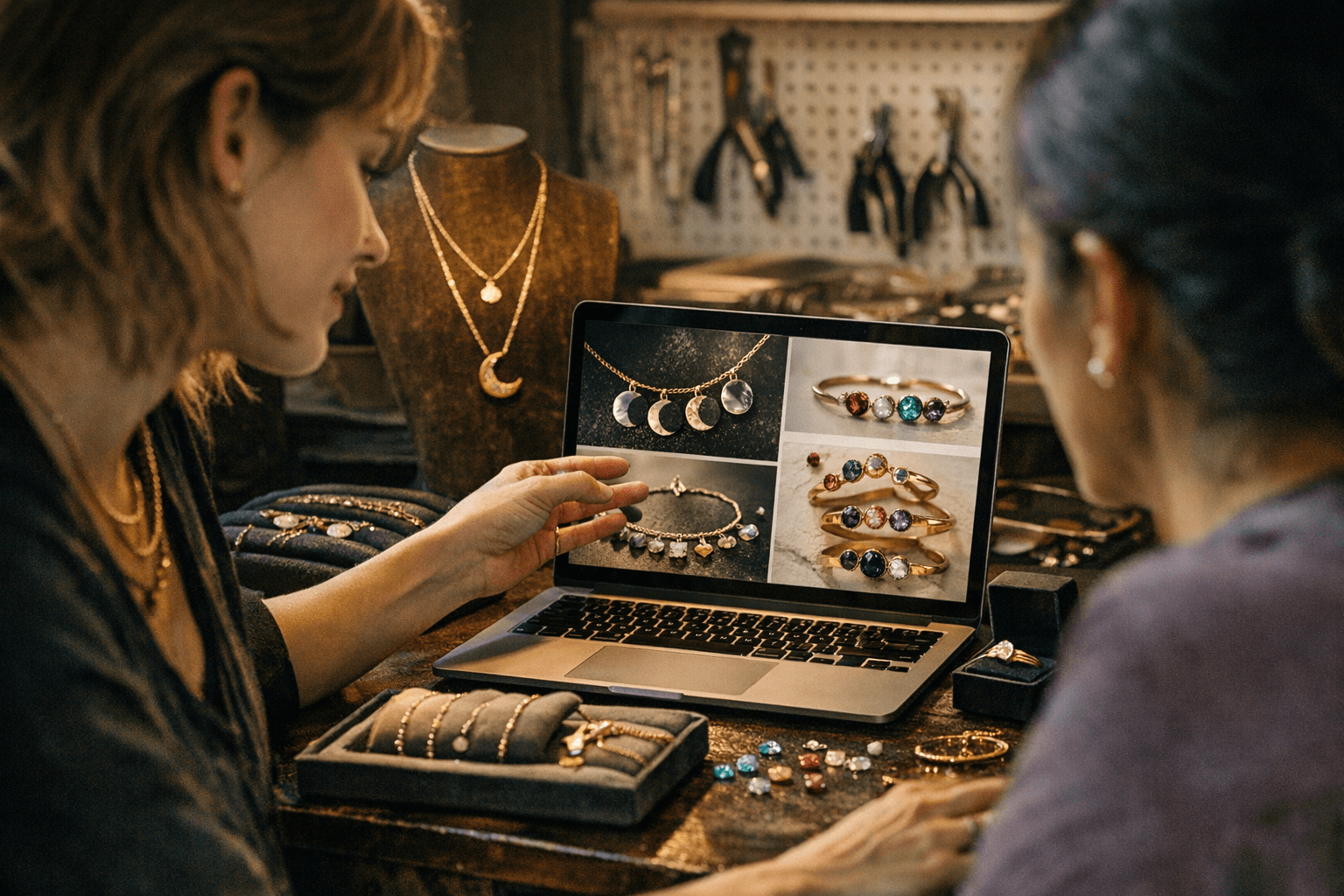
Moonglow’s core offering is explicitly personalized: celestial jewelry based on the phase of the moon from a special day, a product model that Skailama says makes customization “feel magical and personal.” This is a textbook example of experiential personalization where a datum—birth date or anniversary—creates a one-off, emotionally resonant object. Moonglow shows how data-driven personalization (dates, initials) translates to repeatable product logic on Shopify.
11. Solace Jewellery
Solace Jewellery differentiates through hypoallergenic materials and clear allergy-friendly labeling, building trust with testimonials and clean visuals. For sensitive-skin customers, personalization is functional as well as aesthetic: custom metal choices, plating options, and clear material callouts reduce returns and enhance perceived value. Solace’s focus on trust metrics is a reminder that personalization sometimes means tailoring materiality to the customer.
12. Orelia
Orelia brings affordable luxury to everyday jewelry with editorial-style layouts and soft palettes, an approach noted in Skailama’s description. Styling guidance and curated edit pages—both forms of personalization—are effective here, helping customers imagine pieces in outfits or as part of a layered look. The brand’s editorial UX pairs especially well with on-site engraving and monogrammed packaging for gift occasions.
13. Eclectic Collection
This Australian brand showcases artisan-made, boho jewelry with an earthy aesthetic and an intuitive online experience. Personalization for artisan labels often takes the form of made-to-order variations: mixed-metal pairings, stone swaps, and custom lengths that preserve the handmade story. Eclectic Collection’s emphasis on artisan provenance is a personalization asset when communicated through product pages and lookbooks.
14. Monica Vinader
Monica Vinader is positioned as a luxury British jeweler with sustainability claims and personalized gifting options that elevate the shopping experience. Personalized engraving, curated gift sets, and elegant packaging align with the brand’s contemporary-luxury narrative and support higher average order values. The store’s navigation and gifting UX, described as elevated, indicate how personalization can be embedded in checkout and service.
15. Missoma
Missoma is noted for trend-driven jewelry presented with high-end flair; product pages rich in styling tips and influencer looks build contextual personalization. By showing how a piece layers and with whom it has been styled, Missoma effectively personalizes the shopping experience through curated visual guidance rather than direct customization. That visual personalization encourages mixing and matching, which increases basket depth.
16. Mejuri
Mejuri blends luxury and simplicity and is praised for a mobile-first, clean Shopify presence that targets modern women with minimalist fine jewelry. On such a platform, personalization lives in routing customers to collections by occasion, engraving options for milestone pieces, and subscription prompts for maintenance services. Mejuri’s editorial-style, product-rich pages demonstrate how design and personalization converge to create trust.
17. Catbird
Catbird’s handmade, ethically sourced jewelry from NYC uses editorial storytelling and romantic visuals to personalize each piece through provenance and narrative. For Catbird, personalization is layered: ethically minded customers receive material transparency and the option to commission slight variations. The brand shows how narrative personalization—telling the maker’s story—drives premium perception.
18. Camille Brinch
Camille Brinch’s Shopify home page is presented as inviting, with large lifestyle images and video content that introduce the founder’s story and process. That founder-led storytelling personalizes the brand experience, converting browsers into buyers who feel they know the designer. Small brands with a clear origin story can replicate this by prioritizing video and founder notes on high-impact product pages.
19. Velasca
Velasca appears in Shopify’s example roster as a store-level inspiration; while not jewel-specific in the provided excerpt, its inclusion illustrates cross-category UX lessons. These include robust lifestyle photography and product storytelling that jewelry merchants can adapt to show engraved details or bespoke fittings. Velasca’s presence in the excerpt underscores how retailers in other verticals inform jewelry personalization strategies.
20. Pura Vida Bracelets
Pura Vida’s origin story is literal personalization in motion: founded in 2010 when two friends sold 400 handcrafted bracelets in days, the brand’s Bracelets Monthly Club demonstrates subscription-driven CLV. The Wisepops excerpt includes contradictory performance notes—“Despite declining revenues in 2025, Pura Vida is still selling millions of handcrafted items each year” while also stating “According to Shopify, the company is growing 50% in revenue year-over-year”—but both underline the brand’s scale and the power of recurring personalization. Pura Vida’s estimated revenue appears as $60+ million in Shopify’s list, illustrating how a simple personalized product plus a subscription model scales on Shopify.
21. DB Journey
DB Journey, listed with Norway as location, appears in the Shopify/Wisepops snippets with an estimated revenue shown as $25 million, though fragments in the extract also show a $2 million figure nearby. That ambiguity highlights the difficulty of snapshot revenue claims; what is clear is DB Journey ranks among notable accessory merchants and demonstrates how regionally anchored personalization can drive sizeable revenue. For merchants, DB Journey’s example suggests that market-fit personalization—Nordic design cues and localized service—matters as much as product.
22. WP Standard
WP Standard appears in the broader Shopify list as an accessories merchant with estimated revenue near $3 million, showing that small-batch leather and metal goods translate well on Shopify. For jewelry-adjacent accessory brands, personalization through monogramming, bespoke hardware, and custom finishes is a natural extension. WP Standard’s scale is a reminder that personalization can lift average order value in adjacent categories as well.
23. Tattly
Tattly, listed with $6+ million revenue, is a temporary-tattoo brand yet instructive for jewelry merchants: its model uses design variations and limited drops to create urgency. Jewelry stores can borrow that playbook with limited-run personalization: seasonal engravings, numbered editions, and time-limited custom options. Tattly’s performance shows design-led personalization creates collectible demand.
24. Emma Bridgewater
Emma Bridgewater appears among Shopify’s big performers with $30+ million in home accessories revenue; while not jewelry, the brand’s success underscores the role of storytelling and pattern personalization—initialed pieces, bespoke motifs—that jewelry merchants can mirror. Cross-category examples like this reinforce that personalization scales when grounded in craft and repeatable production.
25. Nickey Kehoe
Nickey Kehoe’s $2 million listing in the Shopify excerpt speaks to boutique home brands that use bespoke service; jewelry merchants can emulate that model with appointment-based consultations and custom commissions. The brand’s positioning suggests an audience willing to pay for curated, personalized items, a valuable customer segment for jewelers exploring bespoke work.
26. Made In
Made In’s presence as a $2 million cookware retailer is another cross-category reminder: brands that offer customization options—engraved handles or curated sets—raise perceived value. For jewelry stores, the lesson is operational: personalized add-ons should be easy to select, visible in cart, and supported by clear fulfillment SLA.
27. Soko Glam
Soko Glam, with estimated revenue of $15+ million in beauty, demonstrates how editorial content and curated routines personalize the shopping journey; jewelers can replicate routines with styling guides and “shop the look” flows. Personalization here is content-driven: product pairings, routine pages, and tailored recommendations increase conversion and repeat purchases.
28. Hismile
Hismile appears with an estimated $20 million in beauty revenue; its rapid growth illustrates how a single product category can scale with clarity and repeatable personalization in marketing. For jewelry merchants, product-specific personalization—signature pieces with repeatable variations—creates brand anchors that can expand into monetized collections.
29. Keniluxe
Keniluxe appears in Eachspy’s product database with a single-line price of 10,185.58 USD for a 925 silver engagement ring set with zircon, an outlier price that signals either a luxury custom offering or a data anomaly. Either way, such a high-ticket line needs explicit personalization paths: gem selection, setting choice, and bespoke sizing, plus certificate and return policy clarity. This example highlights the need for detailed product pages when personalization accompanies premium pricing.
30. Loobyzons
Loobyzons is listed in Eachspy’s product rows selling a 4-piece crystal bracelet set priced at 9.5 to 11.5 GBP, an accessible example of how low-ticket jewelry benefits from personalization through packaging, engraving charms, or curated gift sets. Affordable entry points are the gateway to lifetime customers when paired with simple personalization and subscription or refill offers; the personalization economy on Shopify will continue to reward merchants who convert one-off purchasers into repeat buyers.
Final note: across these thirty Shopify merchants, personalization takes many forms—date-based moon jewelry, subscription clubs, engraving, material choices, styling content—and those tactical choices are what separate catalog shops from brands that command premium prices and lifetime loyalty.
Know something we missed? Have a correction or additional information?
Submit a Tip