How "Stand by Me" Reveals What American Kids Lost in 40 Years
A 40-year-old coming-of-age film exposes the dramatic shrinking of childhood freedom — and what that means for the next generation.
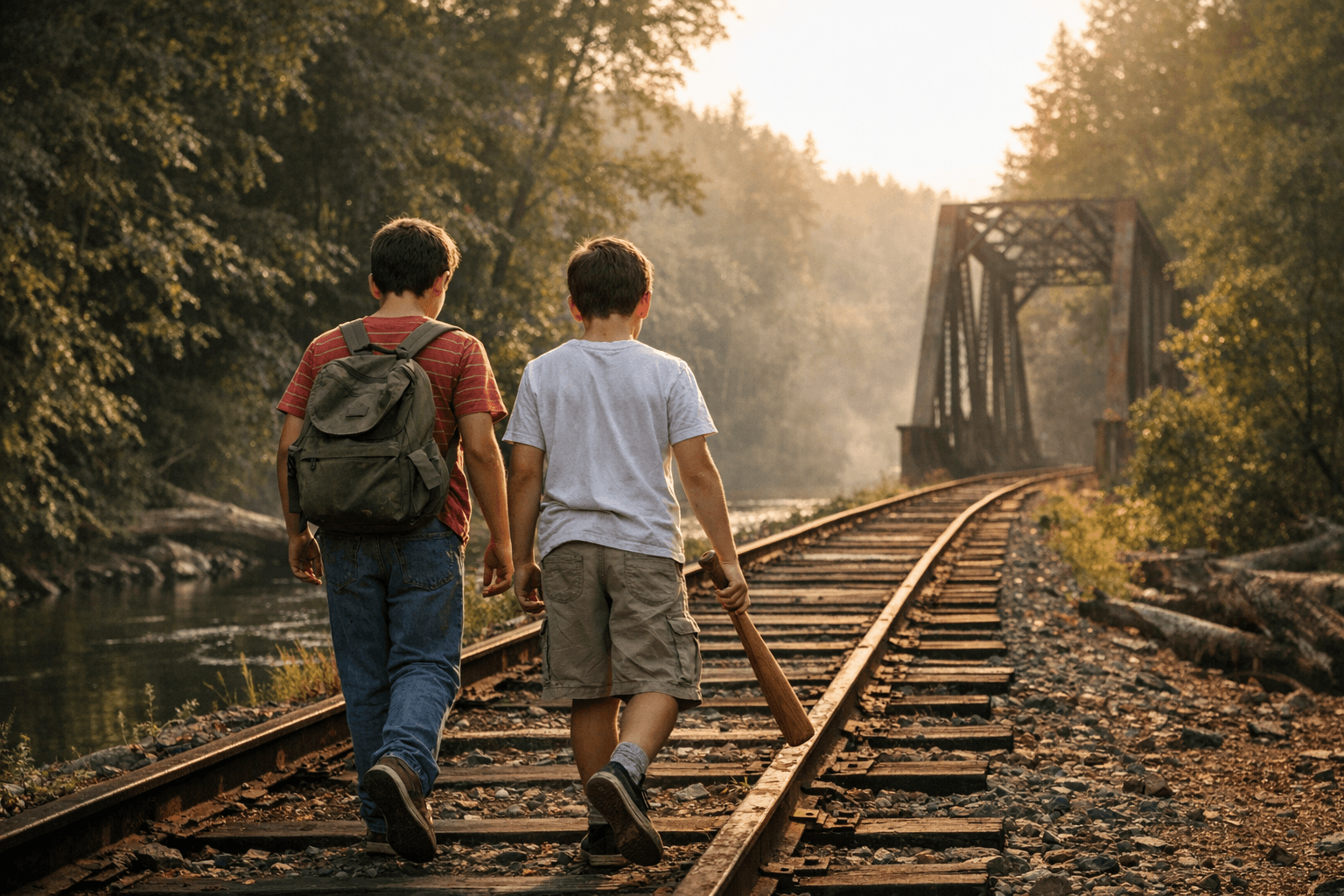
Four twelve-year-olds walked 30 miles alone through the Oregon wilderness in 1986's "Stand by Me," and audiences cheered. Today, that same journey would likely trigger a child protective services call before the boys reached the edge of town.
The film, now four decades old, has become an unlikely cultural mirror — reflecting not just nostalgia for a particular era, but a measurable, documented shift in how American children experience childhood itself. The free-range, largely unsupervised summers that defined the Baby Boomer and early Gen X experience have given way to something fundamentally different: structured, supervised, and increasingly screen-mediated lives. What changed, why it changed, and what it costs children are questions the film forces into uncomfortable focus.
1. The Geography of Freedom Shrank
In the world of "Stand by Me," children commanded real geographic territory. They roamed forests, crossed trestles, camped overnight without adults, and navigated genuine physical risk. Research published in the last decade confirms this wasn't cinematic exaggeration. Studies tracking children's independent mobility in the United Kingdom found that the radius within which children are permitted to roam unsupervised has shrunk by roughly 90 percent since the 1970s. American data tells a comparable story. The average child today has access to a dramatically smaller slice of the physical world than their grandparents did at the same age.
2. Stranger Danger Reshaped Culture
The cultural pivot toward intensive child supervision accelerated sharply in the 1980s, driven by high-profile child abduction cases that received saturation media coverage. The "stranger danger" framework, while well-intentioned, instilled a generalized fear of public space and unsupervised movement that persisted long after crime statistics justified it. Violent crime against children has actually declined significantly since its peak in the early 1990s, yet parental supervision levels have continued to rise. The perception of danger, amplified by 24-hour news cycles and later by social media, decoupled from the statistical reality, producing a generation of children whose physical freedom contracted even as objective safety improved.
3. Helicopter Parenting Became Default
What was once considered overprotective became the cultural norm. The term "helicopter parenting," coined to describe parents who hover constantly over their children's activities and decisions, shifted from pejorative to aspirational in many communities. Parents who allow children to walk to school alone, play in parks unsupervised, or spend unstructured time outdoors now risk social judgment and, in some documented cases, legal scrutiny. Several American parents have faced police visits or child welfare investigations for allowing their children the kind of independence that was unremarkable a generation ago, illustrating how thoroughly the cultural baseline shifted.
4. Structured Activities Replaced Unstructured Time
The childhood of Gordie, Chris, Teddy, and Vern in "Stand by Me" was built on unstructured time, the kind of open-ended summer afternoon with no agenda, no adult oversight, and no scheduled outcome. That resource has become scarce. Research from the American Psychological Association documents a significant decline in children's free play time since the 1980s, replaced by organized sports, academic enrichment programs, and supervised extracurricular activities. While structured activities carry real benefits, developmental psychologists argue that unstructured play, particularly outdoors and with peers rather than adults, builds specific cognitive and social capacities that scheduled programming cannot replicate.
5. Screens Filled the Vacuum
The collapse of outdoor, unsupervised childhood created a vacuum, and screens rushed in to fill it. Children denied the opportunity to roam neighborhoods or forests found alternative frontiers in video games, streaming platforms, and social media. Average daily screen time for American children and adolescents now exceeds seven hours, according to Common Sense Media research, a figure that would have been literally impossible in 1986. The film's central adventure, a physical journey into the unknown, has been replaced for millions of children by digital exploration that carries its own risks and rewards but lacks the embodied, weather-exposed, scraped-knee texture of the original.
6. The Developmental Stakes Are Real
Developmental researchers including Jonathan Haidt, whose work on adolescent mental health has reached wide public audiences, argue that the erosion of unsupervised childhood correlates with measurable increases in anxiety, depression, and reduced resilience among young people. The argument is not that danger was good, but that navigating age-appropriate risk, making decisions without adult supervision, experiencing failure and conflict among peers, builds psychological architecture that structured safety cannot. "Stand by Me" is, at its core, a story about children becoming themselves precisely because adults were not watching. That process, researchers suggest, requires conditions increasingly difficult to replicate.
7. Policy Responses Are Emerging
A small but growing legislative movement is attempting to formally restore childhood independence. Utah passed the first "free-range parenting" law in 2018, explicitly protecting parents' rights to allow children to engage in independent activities without triggering neglect investigations. Several other states have followed with similar legislation. These laws represent an acknowledgment that cultural and legal pressure against childhood independence had reached a point requiring a formal corrective. Whether legislation can meaningfully shift a cultural norm embedded over four decades remains an open and genuinely consequential question for American families navigating it in real time.
The boys in "Stand by Me" didn't find what they were looking for at the end of their journey. They found something better: themselves. Rebuilding the conditions that make that kind of discovery possible may be one of the more consequential policy and cultural challenges of the coming decade.
This article was produced by Prism’s automated news system from verified source data, official records, and press releases, then run through automated quality and moderation checks before publishing. The system is built and supervised by the people who set the standards it runs under. Read our full AI policy.
Did this article answer your question?

