How the MacBook Air Envelope Moment Sent PC Makers Into a Frenzy
A single manila envelope changed the laptop industry forever: Steve Jobs' 2008 MacBook Air reveal sparked a decade-long arms race that gave birth to the ultrabook category.
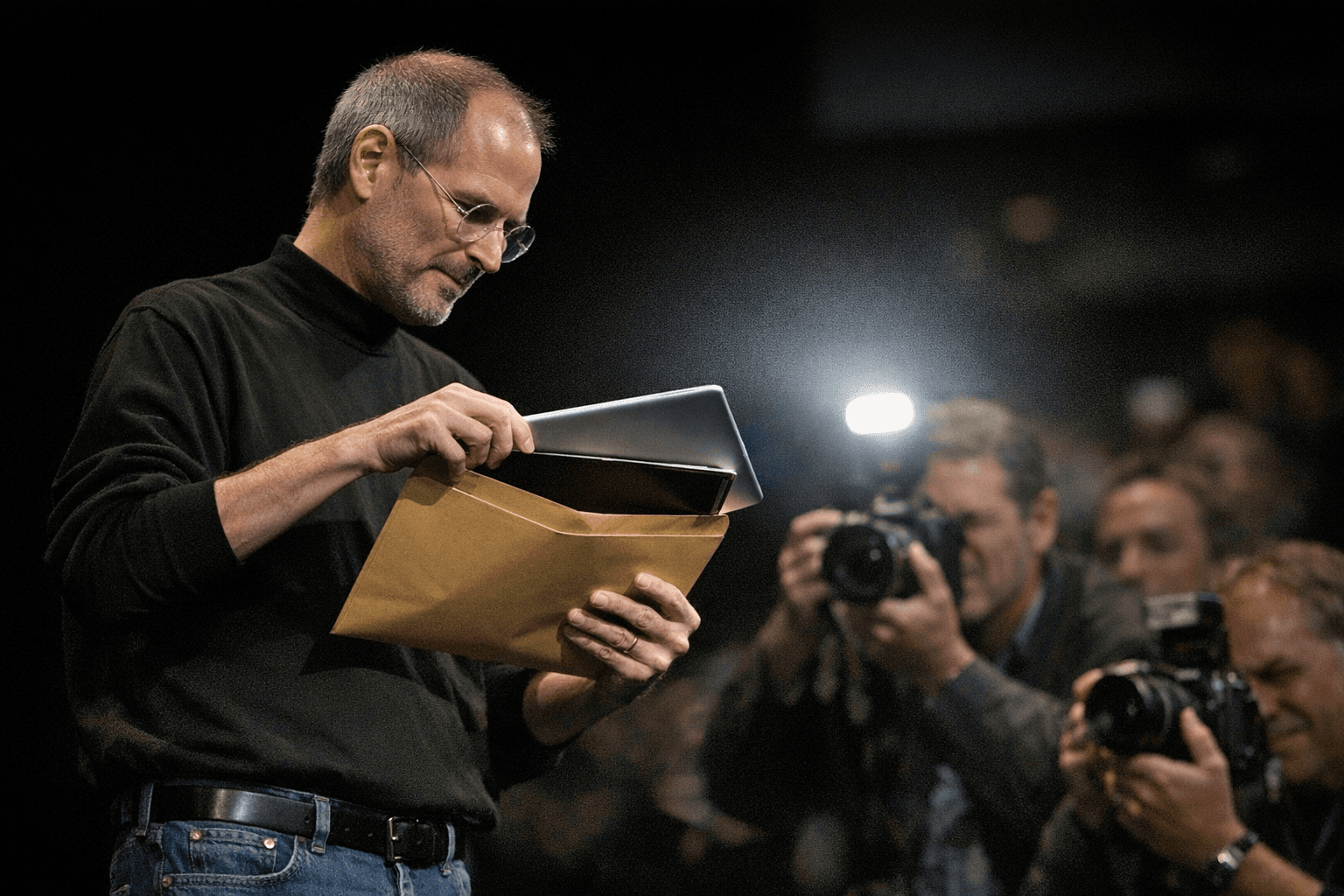
Before Steve Jobs reached for that manila envelope, most laptops were thick plastic slabs built to survive a checked bag, not slip inside one. What happened next in the Moscone Center on January 15, 2008 did not just sell computers; it humiliated an entire industry into reinventing itself.
The Stunt That Changed Everything
The setup was almost too simple. Banners inside Macworld Expo in San Francisco read "There's something in the air," and the crowd had spent the morning guessing what that something might be. Jobs had already unveiled iTunes movie rentals and updates to the Apple TV. Then he reached for a standard manila inter-office envelope sitting on a table beside him and drew out a complete laptop, the new MacBook Air, handing it to the audience's disbelief as proof of its dimensions.
The machine measured just 0.16 inches at its thinnest point and tapered to 0.76 inches at its thickest. It weighed three pounds. At the time, those numbers were not evolutionary; they were a different category of object. Jobs called it "the world's thinnest notebook," and for once the superlative was uncontested. The aluminum unibody construction, solid-state storage option, and a multi-touch trackpad were technologies that would become industry standards within the decade; in January 2008, they looked like science fiction wrapped in metal.
To get there, Apple had pushed Intel to engineer a custom version of its Core 2 Duo processor, reported to be 60 percent smaller than the standard chip, just to make the chassis possible. The MacBook Air was not a product that fit existing supply chains; it forced those supply chains to adapt.
The Frenzy Begins
Within months, every major Windows PC manufacturer was under pressure to answer the obvious question: where is your envelope laptop? The honest answer was that they did not have one, and building one turned out to be far harder than it looked.
HP moved first among the big names. In June 2008, just five months after Macworld, the company released the Voodoo Envy 133, an ultraportable that came in under three pounds with a design clearly aimed at the Air's market. It was thinner than most Windows competitors at the time, but still could not match the Air's signature taper. The product signaled intent more than capability.
Dell took longer and bet bigger. Rumors of a MacBook Air rival circulated inside the company almost immediately after the Macworld keynote. By March 2009, Dell launched the Adamo, a 13.4-inch ultraportable with a starting price of roughly $2,000, the company's formal entry into what it now acknowledged as a luxury laptop market. The Adamo measured 0.65 inches at its slimmest point. It was a serious engineering effort, but it was heavier than the Air, more expensive, and could not quite shake the perception that it had been conjured in reaction to Apple rather than in advance of it.
Dell pushed harder. In September 2009, it previewed the Adamo XPS, a laptop measuring just 9.99 millimeters thick, or 0.39 inches, which would have made it the thinnest laptop in the world at launch. Released in November 2009 at $1,799, it was a genuinely remarkable piece of hardware. But extraordinary battery life had been sacrificed for the dimensions, and the price put it well above the MacBook Air's reach. The Adamo line was eventually discontinued, a footnote in what was becoming a very expensive race.
Toshiba, Samsung, MSI, and Acer all joined the scramble in the same period, each releasing their own takes on the thin-and-light category. The result was a period of intense, occasionally chaotic experimentation across the PC industry, as manufacturers tried to reconcile razor-thin industrial design with the thermal and battery demands of Windows hardware.
Intel Formalized the Category
The clearest measure of the MacBook Air's market impact came not from Apple's sales figures but from Intel's corporate strategy. By 2011, Intel had committed approximately $300 million to a formal initiative to help PC manufacturers build thin, light, and fast Windows laptops. Intel called the category "Ultrabooks," and the specification set concrete requirements: a defined maximum thickness, a minimum battery life, fast resume from sleep, and solid-state storage. The goal was explicit: to give Windows buyers a credible alternative to the MacBook Air.
The Asus Zenbook UX31 was the first Ultrabook to ship, debuting at Computex 2011 alongside the specification itself. Within months, virtually every major Windows OEM had an Ultrabook in development or already on shelves. CES 2012 became a showcase for the category, with dozens of thin-and-light Windows machines arriving at once. The Air suddenly had competition, not from a single rival but from an entire class of products that Intel had essentially subsidized into existence.
It had taken the industry three full years to mount a coordinated response to a manila envelope trick.
What the Envelope Actually Proved
Tim Cook, reflecting on the moment years later, said the envelope reveal "established a characteristic about that device that lives today." That assessment understates the effect on the broader market. Before January 2008, portability in a laptop was measured in degrees: lighter was better, but thinner was considered an engineering curiosity. After the MacBook Air, thinness became a primary design criterion across the entire category.
Apple engineer Michael D. Brown articulated the original brief: "We wanted to see how small, how thin we could make it and still have it be useful. That was the only criteria." That criteria, once demonstrated in public, became every PC maker's criteria whether they chose it or not.
The Lenovo ThinkPad X300, coincidentally released around the same time as the MacBook Air in early 2008, showed that another manufacturer had independently arrived at the thin-and-light concept. But Jobs's theater, the envelope, the auditorium reveal, the "something in the air" banner, gave Apple's version a cultural weight no spec sheet could match. The X300 was admired by enterprise buyers; the MacBook Air was coveted by everyone.
The Lasting Architecture
The MacBook Air was revised significantly in October 2010, gaining an even more tapered chassis, a smaller 11.6-inch sibling, and standard solid-state storage across the line. By 2011, the 13-inch model had dropped to $1,299, forcing the expanding Ultrabook field to compete on price as well as design. Apple had spent three years refining a product the competition was only beginning to understand.
Today, a thin-and-light laptop is the default, not the exception. The Ultrabook category has dissolved into the general laptop market because its defining characteristics became universal. Every major PC manufacturer now builds machines that would have been physically impossible, or at least commercially unthinkable, before January 15, 2008. That is the lasting architecture of the manila envelope moment: not a product, but a permanent revision of what a laptop is supposed to be.
Know something we missed? Have a correction or additional information?
Submit a Tip