How the MacBook Pro evolved from M1 to M5 in five years
Apple’s move from Intel to M1 through M5 fixed battery life and port complaints, but it also cemented the MacBook Pro as a pricier pro-tier machine.
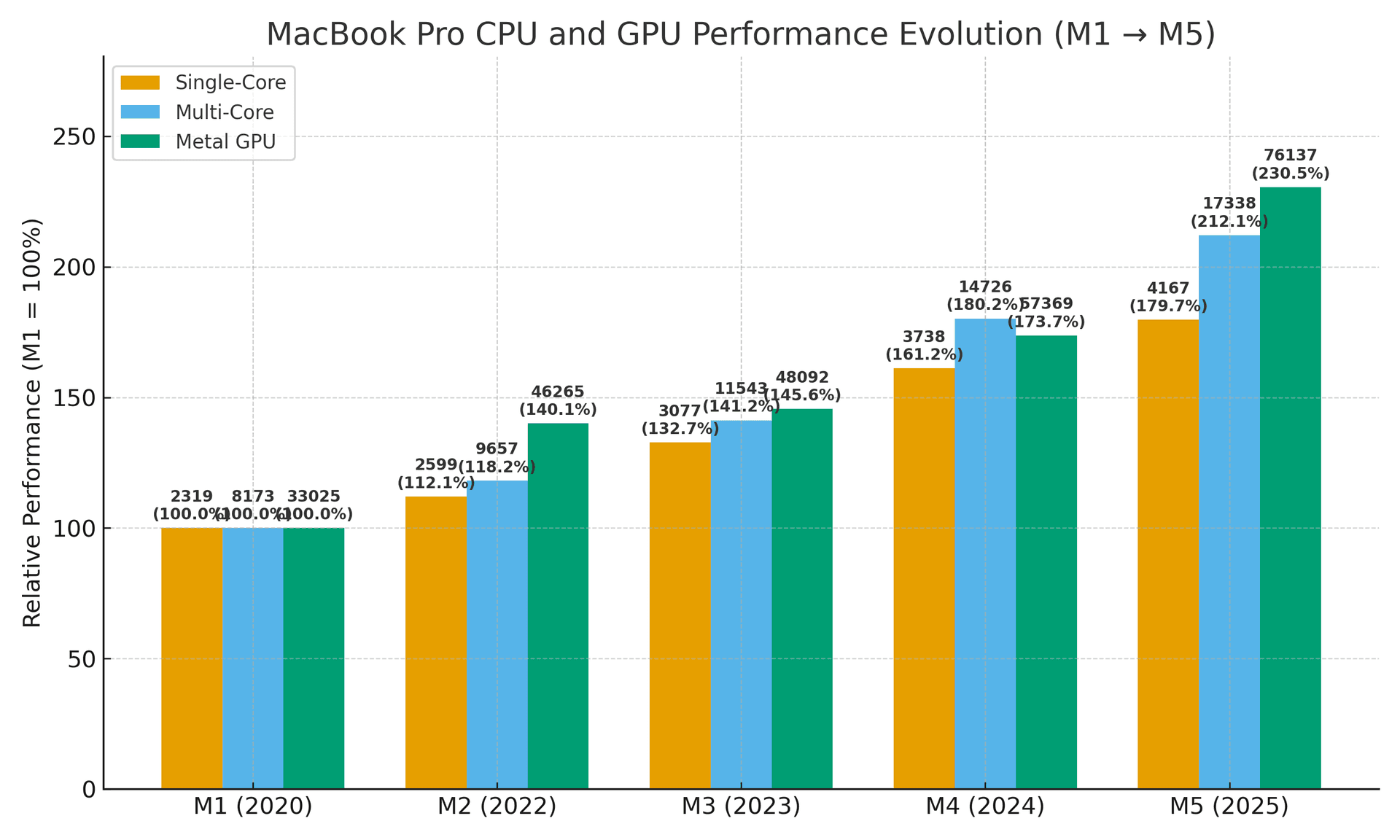
Apple’s shift to Apple silicon changed the MacBook Pro in the ways buyers actually feel: speed, battery life, ports, and serviceability. What it did not change was the machine’s place at the top of Apple’s notebook lineup, where each new gain arrived inside a premium price tier rather than as a cheaper, simpler laptop.
The M1 reset
Apple announced the Mac transition to Apple silicon on June 22, 2020, saying developers could start building apps immediately, the first system would ship by year’s end, and the change would take two years. The first M1-powered 13-inch MacBook Pro followed in November 2020, and it set the tone for the next five years: more efficiency, less fan noise, and battery life that made Intel-era compromises look dated.
That first M1 model mattered because it kept the familiar 13-inch MacBook Pro shape while moving the line to Apple-designed silicon. It was also the moment the old tradeoff became obvious, because the compact design did not solve everything buyers had been asking for, including more ports and easier multi-display support on some M1 configurations.
The redesign that changed daily use
Apple’s biggest hardware rethink arrived on October 18, 2021, when it unveiled new 14-inch and 16-inch MacBook Pro models with M1 Pro and M1 Max chips. Apple called the redesign “game-changing” and said it delivered “extraordinary performance and battery life,” while also describing the screen as the “world’s best notebook display.”
The practical shift was just as important as the chip change. HDMI returned, the SD card slot came back, and MagSafe 3 replaced the all-USB-C approach that had defined the older pro models. For buyers who docked a laptop in studios, offices, or editing suites, that meant fewer dongles and fewer workarounds, which is the kind of utility that shows up every day instead of once in a keynote.

The Touch Bar also disappeared from the high-end redesign. That did not vanish from memory, though, and Apple Community posts in 2023 were still asking whether it would ever come back. The fact that users were debating the Touch Bar at all says something about the transition: Apple was no longer chasing touch-strip novelty, but a more conventional pro machine built around ports, battery life, and sustained performance.
Battery life became a selling point, not an afterthought
Apple kept pushing the battery story after the 2021 redesign. On June 17, 2022, it made the 13-inch MacBook Pro with M2 available to order, and Apple said that model could run for up to 20 hours. That was a concrete user benefit, especially for anyone working away from a desk, because it turned all-day use from a marketing line into a realistic expectation.
Then, on January 17, 2023, Apple unveiled MacBook Pro models with M2 Pro and M2 Max and promoted them as having “the longest battery life ever in a Mac.” That phrasing matters because it shows where the line had moved: the MacBook Pro was no longer just a powerful notebook that also lasted longer than before. Battery life itself had become part of the product’s identity.
From Intel comparison point to Apple silicon benchmark
Apple’s own comparison page draws the cleanest before-and-after picture by placing the 2019 Intel 16-inch MacBook Pro next to the 2023 M2 Pro and M2 Max model. That comparison underscores how far the product line moved away from Intel in just a few years, not only in processor architecture but in the way Apple framed performance, thermals, and workflow efficiency.
By 2024, Apple had introduced MacBook Pro models with the M4 family of chips and Apple Intelligence, extending the line’s role as the showcase for its latest platform features. In October 2025, Apple announced a new 14-inch MacBook Pro powered by the M5 chip, and the product page later showed the lineup expanding to M5, M5 Pro, and M5 Max. The result is a clearer tiering system: a smaller entry point at 14 inches, then faster and more expensive variants built for heavier workloads.
Repairability improved, but only in steps
The pro laptop got better to live with, but not every part of ownership became easier. Apple’s service page for Mac laptops now directs users to get help and arrange repair or replacement, which reflects how central repair and replacement remain to the ownership experience. That matters because the more integrated Apple silicon design can make some repairs more complicated than the old modular fantasies buyers sometimes imagine.
iFixit’s 2021 teardown of the redesigned MacBook Pro called it easier to repair, even as the machine stayed tightly engineered. By 2025, iFixit’s M5 teardown described only subtle changes inside, which suggests that repairability improved incrementally rather than dramatically. In other words, the hardware got faster and more efficient faster than it got truly service-friendly.
What five years of change actually bought
The MacBook Pro did not become a different category of device so much as a more convincing version of the same premium one. Apple silicon solved the old battery anxiety, the 2021 redesign fixed the port problem, and the later M2, M4, and M5 generations kept stacking performance on top of that foundation.
What remained was the price position: Apple kept MacBook Pro as its highest-end notebook, so the gains arrived as a stronger professional tier rather than a more affordable one. That is the real story of the M1-to-M5 era, a machine that shed many of its old compromises while becoming even more clearly the laptop Apple expects serious users to pay for.
This article was produced by Prism’s automated news system from verified source data, official records, and press releases, then run through automated quality and moderation checks before publishing. The system is built and supervised by the people who set the standards it runs under. Read our full AI policy.
Did this article answer your question?