How the modern FCS playoffs work and how to follow
A practical primer on the 24-team FCS playoffs: how teams qualify, key timeline dates, and where to track scores, stats, and news.

The FCS playoff bracket places 24 teams into a seeded tournament where the top eight seeds receive first-round byes. The remaining 16 qualifiers compete in opening-round matchups, with winners advancing to face the bye teams. First-round pairings are regionalized to minimize travel, and the committee avoids matching conference opponents who met during the regular season.
The 2025-26 playoff schedule runs from Selection Show on Sunday, November 23 through the Championship Game on Monday, January 5, 2026 at 7:30 p.m. ET. First Round games are Saturday, November 29. Second Round is Saturday, December 6. Quarterfinals take place December 12-13, and Semifinals on Saturday, December 20. The title game moved to FirstBank Stadium in Nashville, the first championship in Tennessee since 2009 after a 15-year run in Frisco, Texas.
Eleven conferences receive automatic qualifying berths awarded to their champions: the Big Sky, CAA, Missouri Valley, SoCon, Southland, Big South-OVC, Patriot League, NEC, Pioneer, United Athletic, and as of 2025, the Ivy League. The Ivy joined for the first time since 1945, ending an 80-year absence from postseason play. Yale earned the conference's first automatic bid while Harvard received an at-large selection. The MEAC gave up its automatic bid in 2015 to create the Celebration Bowl with the SWAC, though HBCU programs have accepted at-large invitations since. A selection committee fills the remaining 13 at-large spots based on resume quality, strength of schedule, quality wins, and head-to-head results.
Conference tiebreakers vary by league. The Big Sky and Missouri Valley use winning percentage first, with head-to-head taking precedence when two one-loss teams met directly. The CAA uses win-loss percentage against common opponents with point differential capped at 21 points to prevent blowouts from skewing results. The SoCon resolves two-way ties by head-to-head and three-way ties by comparing records among tied teams. The Pioneer League uses head-to-head, then common opponents, then Strength of Victory (the combined record of beaten opponents). The Patriot League and NEC use championship games instead of tiebreaker formulas.
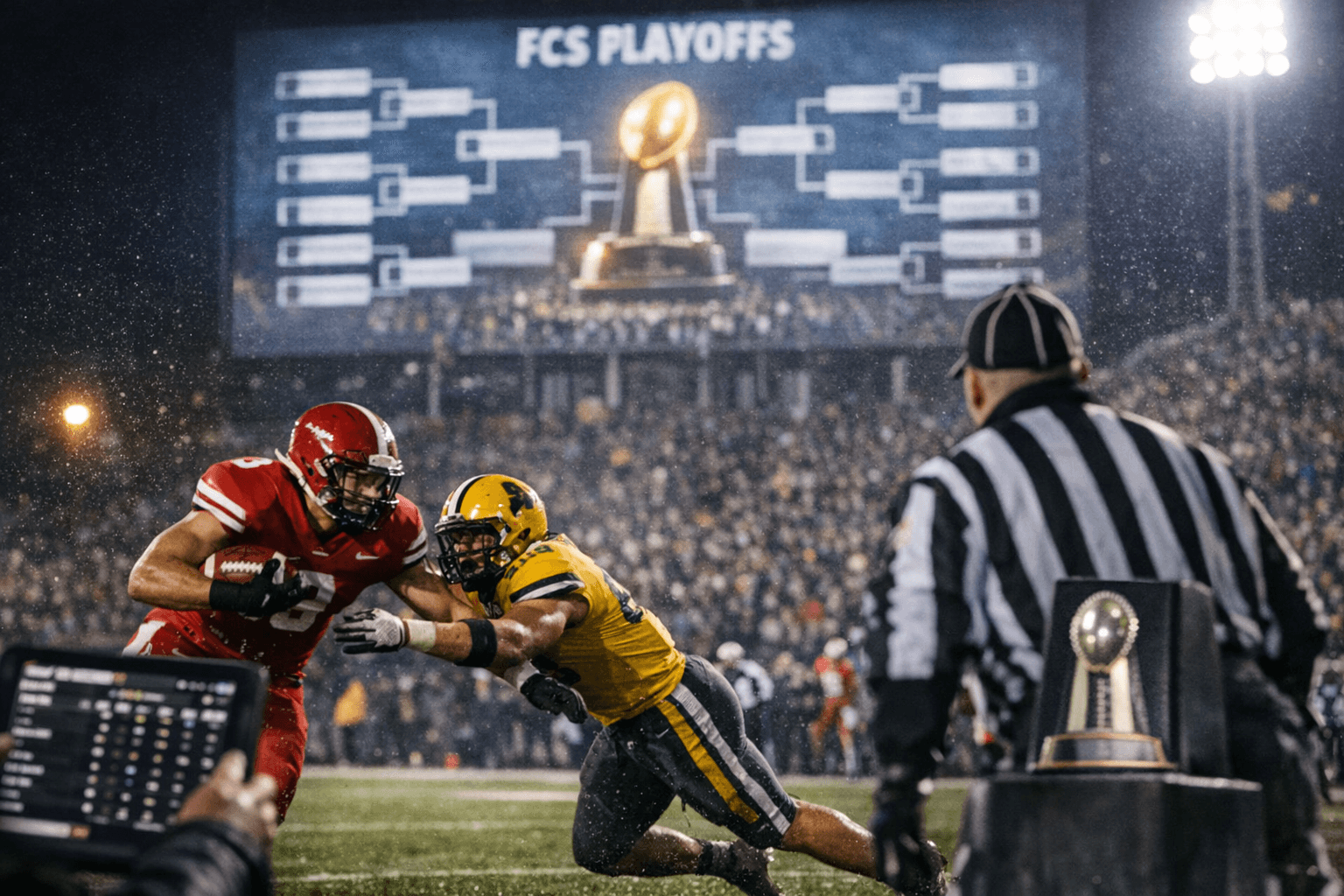
Higher seeds host every round until the championship game. Seeds 9-16 host first-round matchups, seeds 1-8 host after their bye week, and the higher remaining seed hosts quarterfinals and semifinals. Schools must submit minimum bids to host, typically $50,000 to $130,000 depending on the round. Stadium capacity requirements start at 5,000 seats for early rounds.
The playoff economics create challenging dynamics. The NCAA claims roughly 85 percent of ticket revenue from hosted games while providing travel stipends for visiting teams. Even programs averaging nearly 20,000 fans per game have reported net losses after accounting for operational costs and championship game travel expenses.
For following the tournament, ESPN holds exclusive broadcast rights through 2032 as part of its NCAA championships package and televises all playoff games. Conference websites and local beat reporters provide the fastest injury updates and roster news. National outlets like HERO Sports and FloFootball offer deeper statistical analysis. When evaluating matchups, prioritize per-play efficiency and opponent-adjusted statistics over raw yardage totals.
Know something we missed? Have a correction or additional information?
Submit a Tip