How to Choose Foil Wings for Your Weight Skill and Waves
This primer explains how front and rear wing selection, aspect ratio, chord, and materials change surf-foil performance and how to match wings to your weight, skill level, and the waves you ride. Use these specific sizing guidelines, tuning tips, and safety reminders to set up a more forgiving first rig or a sharper high-performance setup as you progress.
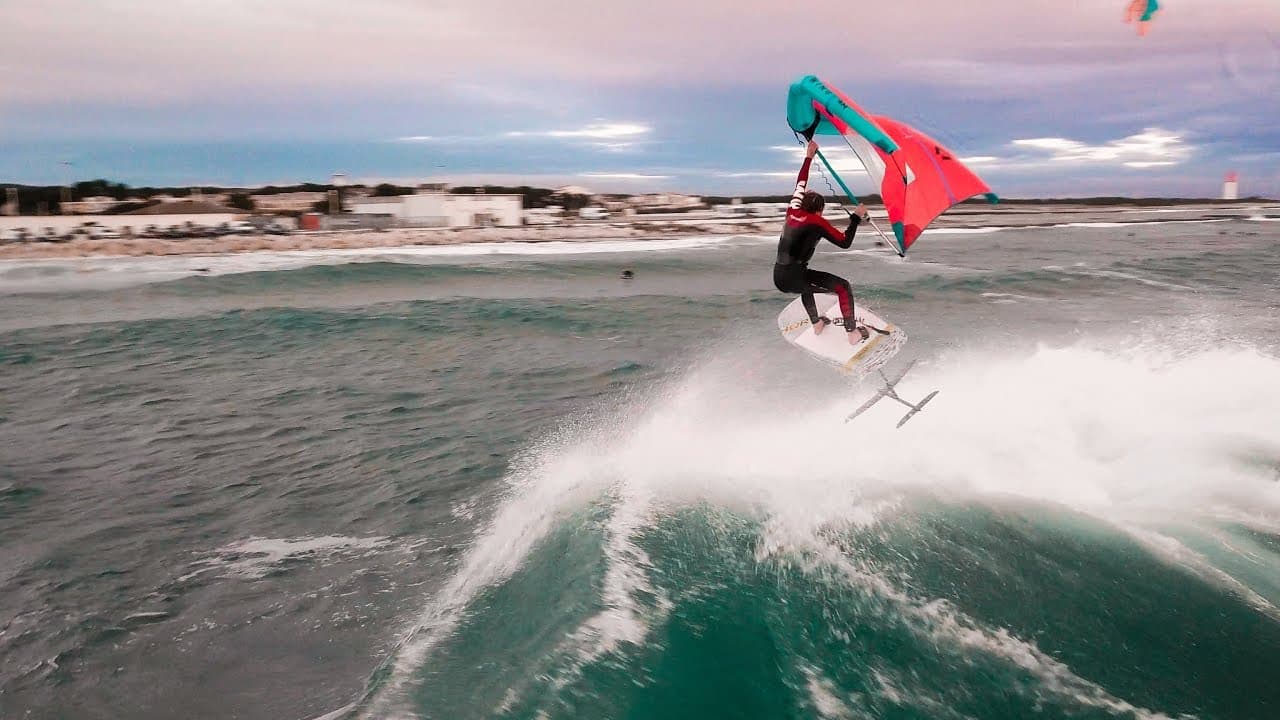
The right foil wing changes everything: early lift or top-end speed, forgiving stability or razor-sharp responsiveness. Front-wing area, aspect ratio, chord, camber, and materials all interact, so the single most useful step you can take is match components to the conditions you ride and to your physical profile.
Start with the key terms. Aspect ratio is span squared divided by planform area; high aspect ratio wings are long and narrow and excel at efficiency and speed, while low aspect ratio wings are short and wide and provide more lift at low speed. Chord is the front-to-back width; wider chord yields stronger low-end lift. Surface area in square centimeters correlates directly with lift at slow speeds. Camber or section determines stall behavior and the lift curve.
Wing choices break down into three practical families. Big, low-aspect wings with large area give early lift, forgiving handling, and are ideal for small, mushy surf, learning flights, or heavier riders, but they sacrifice top speed and quick turning. Small, high-aspect wings reward speed, tighter turns, and quicker rail-to-rail transitions for steep hollow waves, but they require stronger pumping and carry increased stall risk at low speed. Medium aspect mid-area wings are the best compromise for mixed conditions and progressing surfers.
Use the following front-wing sizing as a starting point. For riders under about 70 kg or 155 lb, 950 to 1400 cm² in a low to mid aspect ratio is a sensible range. Intermediate riders around 70 to 85 kg or 155 to 185 lb often find 800 to 1100 cm² in mid aspect ratio suits most days. Advanced or heavier riders over 85 kg or 185 lb, or those surfing very small surf, may use 1000 to 1600 cm² depending on style. High-performance carving and competitive setups typically use 600 to 900 cm² with a high aspect ratio.
Rear wings act as stabilizers. Larger rear wings raise pitch stability and forgiveness; smaller stabilizers reduce drag and enable sharper turns but make pitch stability more sensitive. As a rule of thumb, match rear-wing area proportionally to the front wing to maintain a balanced platform.
Mast length matters too. Short masts of 45 to 60 cm make pop-ups and remounts easier and reduce leverage in crashes but give less clearance. Medium masts of 65 to 80 cm are the most versatile for surf-foiling. Long masts of 90 cm and up are for tow-in or very large swells but increase crash risk, torque on connections, and remount difficulty.
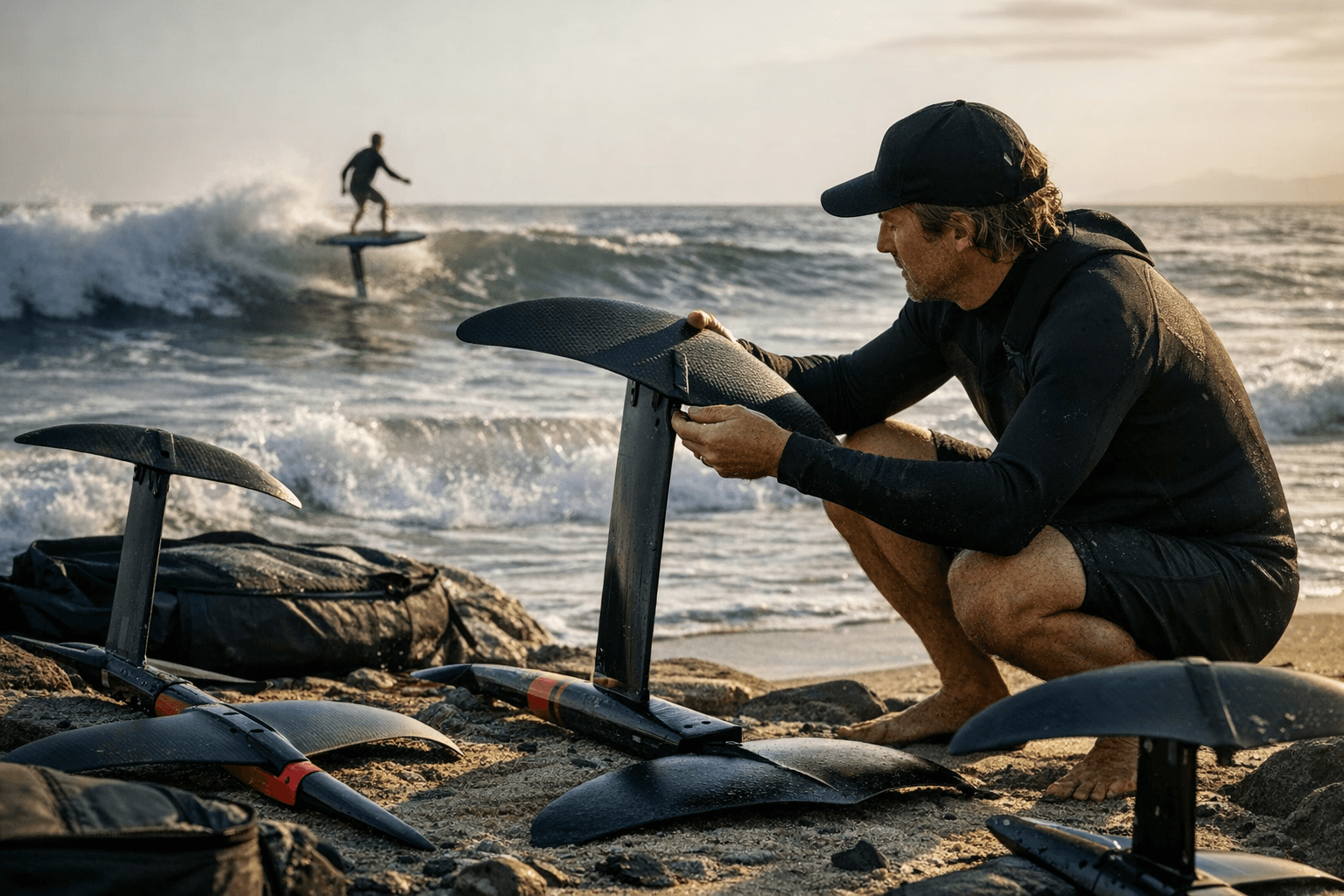
Materials and construction change feel and durability. Carbon fiber offers the best stiffness-to-weight ratio for responsiveness. Hybrid layups that mix carbon and fiberglass or other fibers add toughness and impact resistance. Aluminium remains a durable, cost-effective option at the expense of weight and stiffness; specialty alloys and titanium appear in niche applications.
Small tuning changes have big effects. Slide the mast plate fore for quicker planing and aft for easier takeoffs. Increasing angle of attack gives earlier lift but more drag and pitch sensitivity. Increasing stabilizer incidence steadies nose-up pitch; flatten it for a more responsive but less stable ride.
For pumping and travel, choose wider chord and lower AR for earlier flights, rinse gear after sessions, inspect leading edges for dings, carry epoxy and spare bolts, and use padded cases with internal padding. Safety basics include helmets, impact vests, practicing remounts and safe leash releases, and checking local rules on electric or motorized foils.
If you are starting out, begin with a larger, stable front wing and a larger rear stabilizer, then downsize and raise aspect ratio as your control, pumping efficiency, and wave reading improve.
Know something we missed? Have a correction or additional information?
Submit a Tip