How to Practice Drums Silently: Strategies to Avoid Disturbing Neighbors
Micha Fromm’s Modern Drummer guide lays out practice pads, mesh heads, cymbal mutes, DIY muffling and e-kits so you can keep drumming without disturbing neighbors.
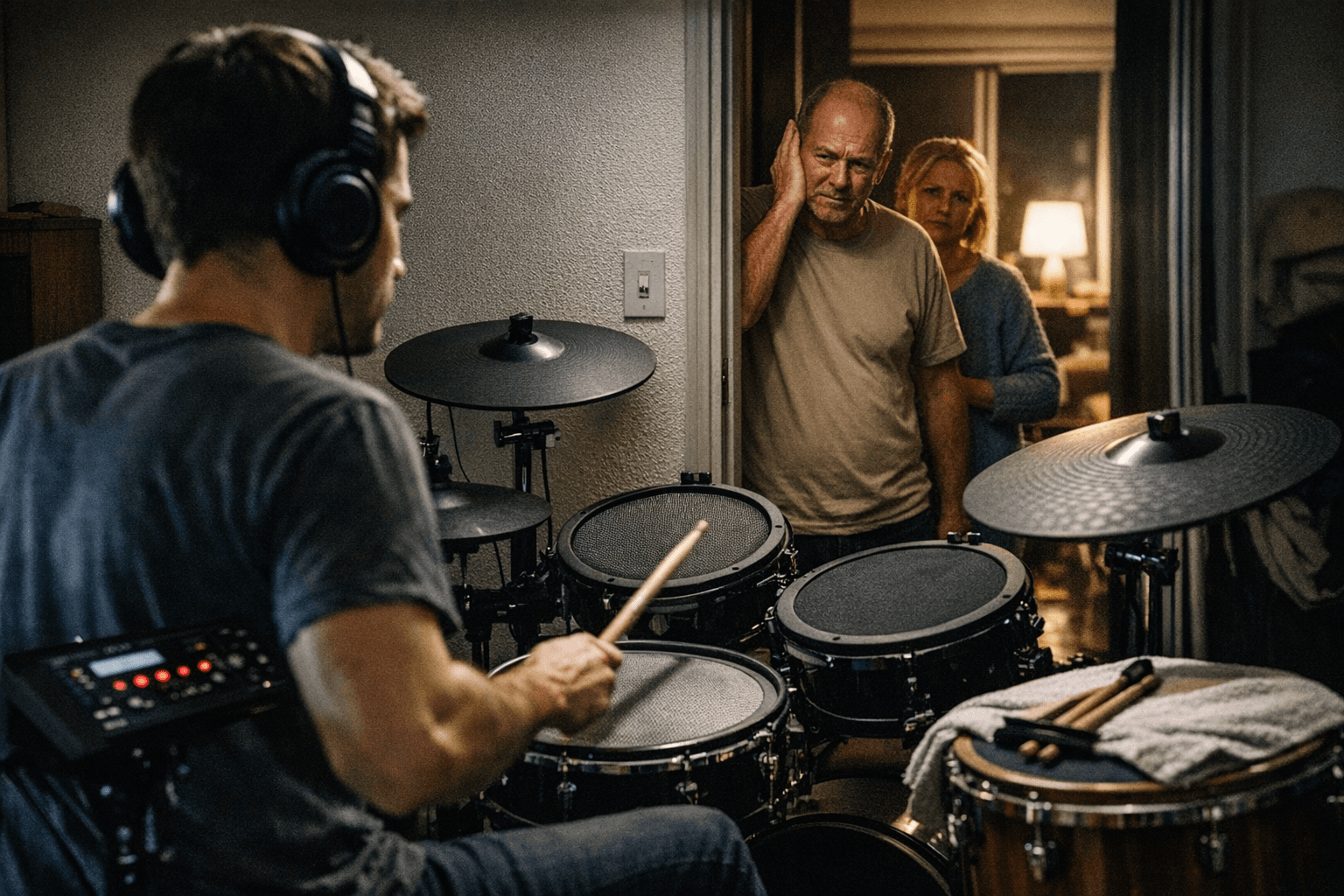
Micha Fromm framed the dilemma bluntly in Modern Drummer’s March 2026 package: “The drum set is a great instrument, but it is also quite loud, which means you can’t play it anywhere and anytime without causing problems. I often hear from students saying that they couldn’t practice, or could only practice for…” That truncated line nails the daily friction every drummer feels when thin walls, late hours, or shared living push practice onto the margins of the day.
The late-night noise problem “Every drummer faces the same struggle: you want to practice late at night, but the sound of your kit carries through walls and floors. Neighbors complain, roommates can’t sleep, and family members beg for quiet,” a Beatello guide puts it, before offering the good-news pivot: there are now “dedicated tools and smart tricks that allow you to keep improving your skills, even in the late hours, without disturbing anyone.” That sentence frames the rest of the toolkit: this is about preserving technique and timing while managing volume and neighborly peace.
Practice pads: how and why to use them The age-old starting point remains the practice pad. As Hub Yamaha’s BY Steve La Cerra notes, “The age-old method for quiet practice is the practice pad, which was initially developed for working on rudiments (though not necessarily beats and fills).” Practice pads come with surfaces “ranging from rubber to real drum heads,” so try several to find the rebound that suits you; La Cerra warns that “the rebound is likely to be stronger than that of an acoustic drum.” He also gives the practical setup tip every teacher repeats: “A practice pad should be placed on a stand at the same height as your snare drum.” Retailers echo this use-case — Long & McQuade points to practice pad sets configured to match your acoustic kit, and calls out the “Go Anywhere Practice Pad Set” as a tool touring drummers use to “warm up before performances with reduced noise.” For coordination work, Long & McQuade emphasizes that these sets help you “build muscle memory and practice sticking patterns around the kit” so spatial awareness carries back to the acoustic kit.
Sound-off pads and cymbal mutes: fast, affordable, imperfect If you want to keep playing on your acoustic setup, Beatello’s clear product advice is to add rubber sound-off pads and cymbal mute discs: “One of the simplest solutions for quiet practice is adding rubber sound-off pads to your drumheads and cymbals. These reduce volume significantly while still letting you play on your real kit.” Their pros are blunt: “Quick setup, low cost, feels close to natural playing.” Their cons are equally candid: “Still some sound left (not 100% silent), cymbals lose their shimmer.” Beatello explains how to apply them: “For cymbals, rubber mute discs fit directly over hi-hats, crash, and ride. For drums, foam or rubber pads sit on top of the heads, lowering volume instantly.” That balance — immediate practicality versus a traded-off cymbal tone — is exactly the choice many working drummers accept.
Mesh drumheads: realism with reduced volume For drummers who want closer-to-real rebound than rubber pads provide, Beatello recommends mesh drumheads: “If you want a more realistic feel than rubber pads, mesh heads are an excellent upgrade. They replace your acoustic heads entirely and drastically reduce volume while keeping rebound natural.” The guidance in the extracts singles out mesh heads as “Best for toms and snare practice.” Drumcenternh reinforces that mesh heads belong on the shortlist of quiet-practice upgrades, pairing nicely with other low-volume choices.
DIY muffling methods: cheap, creative, and surprisingly effective When a quick fix is needed, Hub Yamaha lists homemade remedies that have long circulated in practice rooms: “Homemade remedies have included filling drum shells with packing peanuts or moving blankets, placing towels on top of heads or cymbals, and putting sheets between the bearing edges and the heads.” These are not glamorous, but they work without new purchases and let you test what balance of tone and quiet you can live with. Note that these methods change feel and resonance — they’re stopgaps to keep chops ticking rather than long-term tone solutions.
Electronic kits: the ultimate quiet option (with a budget caveat) For many players, the clearest route to near-silent practice is an electronic kit. Hub Yamaha states plainly, “There’s no question that an electronic drum kit keeps noise levels down, and they also provide a wide range of different sounds and features.” The Yamaha example referenced is the DTX6; Hub Yamaha points readers to “this video of the Yamaha DTX6 being put through its paces” to see how an e-kit behaves. Drumcenternh describes electronic kits as “the ultimate solution for those who require a quiet practice option,” while also reminding readers that “they do require an initial investment” but “offer unparalleled noise reduction and versatility.” If budget allows, an e-kit solves the core problem: you play full kits with headphones and control volume precisely.
Combining tools: hybrid approaches that keep skills honest “You don’t need to pick just one fix,” Beatello advises: “The best solution depends on your goals and budget. Some drummers love combining tools, while others prefer an all-in-one setup like the 518 Series.” Long & McQuade gives practical pairing ideas — “Try drumming setups by pairing low-volume cymbals with drum mutes, or use bamboo multirod sticks with a practice pad set.” Those hybrids are where most drummers land: mesh heads on toms, a muted snare with a practice-pad set for rudiments, low-volume cymbals for timekeeping, and towels or mute discs for late-night groove practice.
Retail options and brand snippets from the marketplace If you’re shopping, the sources name a few concrete products and retail phrases worth noting. Beatello pitches product features like “Quick switch between normal and mute modes, stability-focused design, and stylish color options” and signs off with branding lines such as “Beat Loud. Live Proud.” Their site copy includes a shopping-oriented CTA: “👉 Want to explore more gear for quiet practice? Check out Beatello’s full collection of drummer-friendly solutions.” They also list support@beatello.com and show a company location of “Hong Kong SAR.” Long & McQuade’s product examples include the “Go Anywhere Practice Pad Set.” Beatello mentions an “all-in-one setup like the 518 Series,” while Drumcenternh invites readers to “Order your drum silencing gear from DCP now!”
What the sources don’t tell us The reporting across Modern Drummer, Beatello, Hub Yamaha, Long & McQuade and Drumcenternh converges on the same toolkit, but they share gaps worth flagging: none of the provided extracts include measured decibel reductions, pricing information, or head-to-head test results that quantify how much quieter one solution is compared with another. The Modern Drummer excerpt used at the top is truncated, so Micha Fromm’s full recommendations from the March 2026 issue aren’t in these notes. If you need precise numbers, comparative feel tests, or up-to-the-minute pricing, you’ll need to follow up with manufacturers, run dB tests, or consult full product reviews.
A practical next step Start small and specific: try a practice pad at snare height and a set of sound-off pads for an acoustic kit; that combination reflects what Hub Yamaha, Beatello and Long & McQuade all recommend for balancing feel and volume. If that still isn’t quiet enough, swap the heads for mesh, experiment with towels or moving blankets per Hub Yamaha’s DIY list, and consider an electronic kit when budget and space allow — remember Drumcenternh’s line that e-kits “offer unparalleled noise reduction and versatility.” And when you shop, keep in mind Beatello’s product-choices framing: “The best solution depends on your goals and budget.”
Conclusion The consensus from Modern Drummer, Yamaha’s Hub, retail guides at Beatello and Long & McQuade, and the Drumcenternh roundup is clear: there is no single silver bullet, but a set of proven, layered strategies — practice pads, sound-off pads and cymbal mutes, mesh heads, DIY muffling, and electronic kits — will let you keep the metronome humming and your chops improving without becoming a neighborhood problem. Put the tools together that match your goals and space, and you’ll reclaim hours of practice that were otherwise lost to thin walls and quiet hours.
Know something we missed? Have a correction or additional information?
Submit a Tip
