How to Wear Dainty Jewelry: Defining and Styling Delicate Pieces
Dainty jewelry whispers, not shouts—learn the simple rules for layering, personalizing, and shopping tiny pieces that still carry meaning.

Definition: what "dainty" actually means The definition of dainty, in the clearest terms provided, is "anything that is delicately small and pretty." That succinct line captures the aesthetic: pieces that are subtle, minimal, and intentionally restrained. As another source puts it, dainty is "jewelry that whispers instead of shouts," which explains why wearers prize ease and understatement over visual volume. Although it may be small in size, dainty jewelry can make a huge imp
Why the delicate moment matters Dainty jewelry has become more than a seasonal fad; "Dainty jewelry isn’t just a trend—it’s a lifestyle," writes one observer, and the fashion chatter around "delicate necklaces, whisper-thin rings, and barely-there bracelets" reflects a cultural appetite for accessories that feel effortless. The appeal is practical as well as aesthetic: these pieces are lightweight—you may "forget you’re even wearing them"—yet versatile enough to elevate a little black dress or jeans and a white button-up. And crucially, small scale doesn’t mean small meaning: compact charms and engravings let wearers tell personal stories without theatricality.
- Necklaces: fine chains, small pendants, chokers paired with longer simple chains to create tiers.
- Rings: whisper-thin bands, stacking rings and the resurging midi rings (the ones that sit in the middle of your finger).
- Bracelets: slim, barely-there chains—examples such as the "engraved Mini Fortune Bracelet" are offered as explicitly dainty options.
- Earrings: studs, small hoops and huggies—huggies are described as "aka small hoops that literally hug your ears."
Types and what to look for visually
Dainty jewelry shows up in every traditional category, but with a distinct vocabulary of scale and detail. Expect:
Fortuneandframe supplies concrete product examples that illustrate the story-telling potential of tiny pieces: the "Romantic Heart Charm Ring," "Mini Fortune Cookie Huggie Earrings," and the "Mismatched Mending Heart + Bandaid Earrings, which symbolizes the healing phase of a broken heart." These named pieces demonstrate how motifs—hearts, moons, stars, initials and dates—fit naturally into a small-scale aesthetic.
Design details: materials, construction, and durability Design is defined by restraint: "Elegance, subtlety and modesty are the main design features of dainty pieces," and common construction choices reflect that—fine chains, small parts, and very small classic pendants such as "a pearl or a diamond." Because dainty pieces are small, material choice matters disproportionately: Swagychic emphasizes that "if you’re hunting for everyday pieces, durability is key" and recommends focusing on hard-wearing materials that will last. The practical consequence is simple: when a clasp or jump ring is tiny, the underlying metal and manufacturing quality determine whether a piece becomes an everyday favorite or a one-season disappointment.
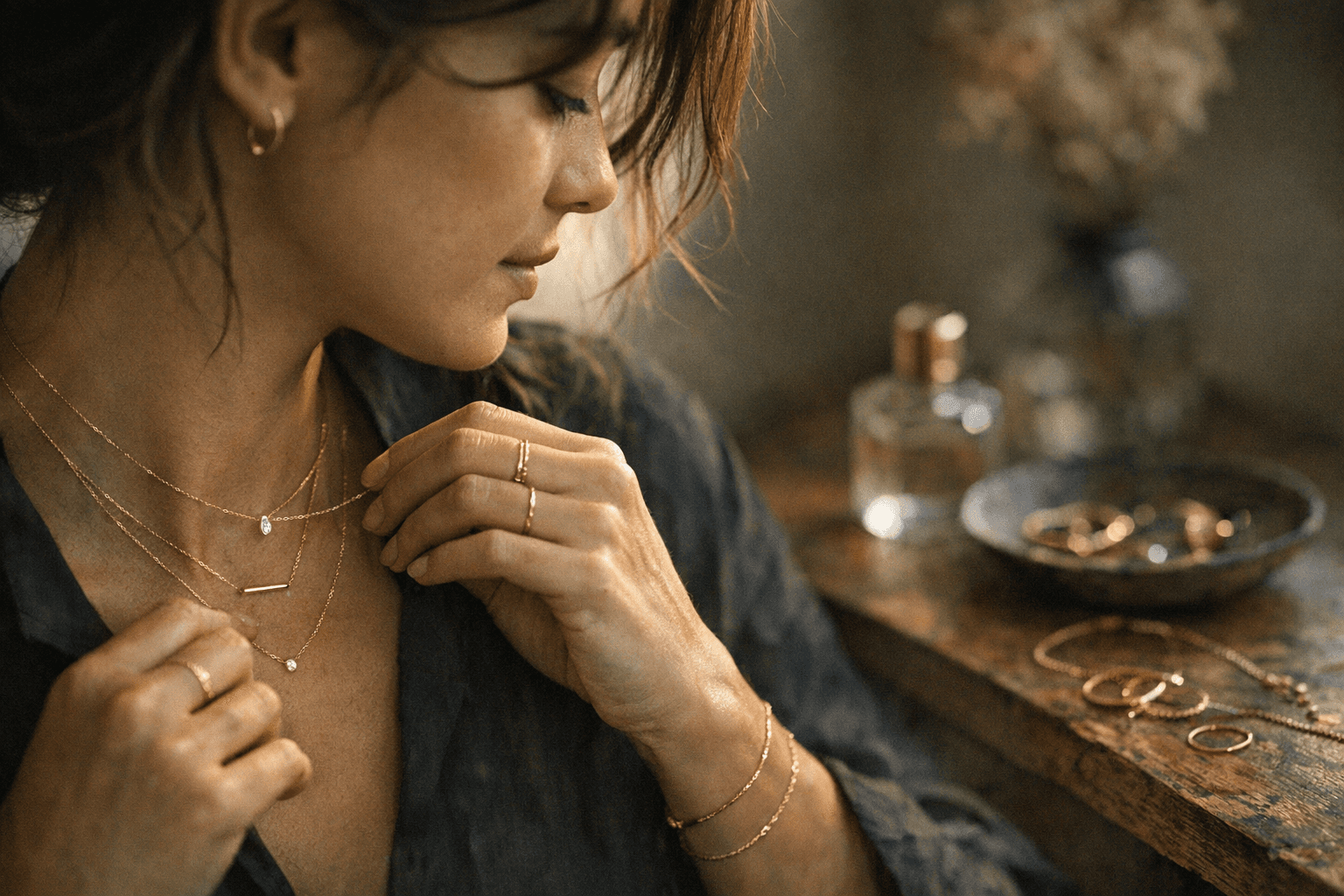
How to wear dainty jewelry: the art of layering and restraint Across sources, the core styling rule is layering with intention. "Dainty jewelry operates on the fact that less is more," and the best approach is to layer in tiers rather than pile on random pieces. A reliable formula is to choose complementary lengths—a choker with a longer simple chain creates a clean vertical progression; as Rellery suggests, "if you are wearing a simple gold chain choker, add a long simple chain necklace to create that tier look." Aim for two to three necklaces for a tiered look; similarly, stack slim rings thoughtfully rather than crowding every finger.
Practical layering cautions come from multiple voices: avoid overlapping lengths that clash, and don’t add so many layers that the delicate feeling is lost. If you wear a watch, Artizanjoyeria recommends pairing it with just one dainty bracelet so your wrist stays balanced; the same restraint applies when mixing earring styles or combining midi rings with full rings.
Mixing minimal with maximal: when contrast works Not every outfit calls for purely dainty adornment. One brand explicitly counsels that you "don’t have to style dainty jewelry only with other dainty jewelry pieces"—pairing a single chunkier piece with several minimalist elements can create contrast and emphasis. At the same time, the rhetorical "move over, chunky statement pieces—there’s a new sheriff in town" captures the current fashion momentum toward smaller scale. The practical takeaway: if you mix a bold cuff or pendant with dainty pieces, let the minimalist elements act as punctuation rather than competing for center stage.
Personalization: how small pieces carry big stories One of the quiet powers of dainty jewelry is narrative compression: Fortuneandframe says "you can express yourself without having to say a word when wearing a dainty piece like our engraved Mini Fortune Bracelet." Small gemstones, initials, dates, and symbolic motifs let a tiny pendant or a pair of mismatched huggies function as wearable shorthand for memory, grief, joy, or private jokes. Use engraving, a distinctive charm, or a deliberately mismatched earring to make a minimalist silhouette intensely personal.
How to shop—steps for thoughtful buying Swagychic offers a clear shopping checklist that maps directly to how dainty jewelry behaves in real life: 1. Browse stores and virtual aisles and galleries to see which styles you love and what will work for different looks and occasions. 2. Think about how you wear jewelry—are you building everyday staples, special-occasion pieces, or items meant to be stacked and mixed? 3. Choose the right materials: for everyday wear, prioritize hard-wearing metals and secure findings. 4. Celebrate your personal style by trying different pieces to see what suits you and how you want to style them.
As you browse, ask for specific material and construction details—metal type, plating, hallmarking and clasp design—because the tiny scale hides vulnerabilities. Brands frequently advertise motifs and personalization but supply fewer specifics on provenance or metal grade; make those questions part of your purchase checklist.
Practical care, maintenance and final considerations Because dainty pieces rely on small connections—thin chains, tiny jump rings—inspect soldered joins, clasp quality and finish before buying. Treat layering as choreography: plan lengths, test movement (you should be able to turn your neck without a necklace tangling), and avoid mixing too many textures in one cluster. If you prize meaning, choose engraving or motif work that you can wear daily; if durability matters, prioritize sturdier metals and ask the seller for care guidance.
Conclusion: why size shouldn't dictate significance The cultural moment around dainty jewelry proves a simple point: small scale and deep meaning are not mutually exclusive. Pieces that are "small and fine" can become signature items precisely because they are worn constantly and layered with intention. When you shop, prioritize material durability, thoughtful design, and personal storytelling—then wear your stack with the confidence of someone who knows that the quietest jewelry often makes the most persuasive statement.
Know something we missed? Have a correction or additional information?
Submit a Tip