HTA Draft Kauai Tourism Plan Identifies Three Priority Hotspots
HTA’s draft Kaua‘i DMAP singles out Kapaʻa–Wailua Corridor, Hoʻopiʻi Falls and Kōkee/Waimea Canyon as the island’s top three hotspots, while broader lists and implementation questions remain unsettled.
Kapaʻa–Wailua Corridor
The Hawai‘i Tourism Authority’s draft Destination Management Action Plan for Kaua‘i identifies the Kapaʻa–Wailua Corridor as one of three priority hotspots needing active management. HTA materials and local reporting note Kapaʻa’s chronic traffic pressures and concentrated visitor activity: HTA’s list flags Kapaʻa specifically for traffic, and a photo published alongside coverage shows “a large crowd is walking along Kapahi Road, generating foot traffic on the narrow, one‑lane street.” That visual and the corridor designation reflect the pattern HTA’s 2026–2028 draft seeks to address after months of community engagement in 2025.
The draft situates Kapaʻa–Wailua within a wider set of concerns — Wailua River State Park is separately included on HTA’s list of locations “to be managed more intentionally” — and the plan’s stated actions give a menu of tools relevant to the corridor: “Address visitor safety,” inspection of tour operators, and increasing group‑tour offerings are all explicit HTA actions. At the same time, Files Hawaii highlights a broader challenge for HTA: the agency’s earlier three‑year DMAPs pledged site limits and rest days under Action D.1 — “Assess and set specific site visitor limits, and create site management plans/develop and implement tourism capacity management models at ‘hotspot’ areas. Allot rest days for hotspot areas.” Files Hawaii also reports that the target status for that action on Kaua‘i “was not started and project was on pause,” a status that raises questions about how quickly concrete traffic and access controls could be deployed in the Kapaʻa–Wailua Corridor if the draft is adopted.
Practical management tools listed in HTA excerpts — monitoring helicopter noise, tour‑operator inspections, and marketing shifts toward “regenerative tourism” — could reduce friction in Kapaʻa if matched to enforcement and interagency coordination. The draft points to community‑identified priorities for the corridor in Kauai Now’s reporting, but those specific lists were not reproduced in the public excerpts; HTA’s final draft or supporting appendices will need to show the precise measures and assignment of responsibility to Kaua‘i County, state parks, law enforcement and commercial operators.
Hoʻopiʻi Falls
Hoʻopiʻi Falls appears on the HTA draft’s short list of priority hotspots, a recognition that access‑driven hotspots — waterfalls, informal trails and roadside pullouts — concentrate both visitor impacts and safety risks. Kauai Now’s draft coverage explicitly lists Hoʻopiʻi Falls as a priority, and HTA’s broader site lists emphasize access and safety as recurring themes across trail‑ and shore‑adjacent hotspots; those themes are directly relevant to Hoʻopiʻi, where unmanaged foot traffic and informal parking create environmental damage and public‑safety incidents.
HTA’s action palette — from addressing visitor safety to inspecting tour operators and promoting group tours — targets the kinds of operational changes that can be tailored to a single site like Hoʻopiʻi Falls. The DMAPs are intentionally narrower than the 2021–2023 plans, with the goal of producing three‑year actions that can actually be implemented; Kauai Now notes these new drafts were “narrowed” to be more achievable. But Files Hawaii’s critique and the Action D.1 language underscore a central implementation test: the draft proposes assessing and setting visitor limits and even “allot[ting] rest days for hotspot areas,” yet Files Hawaii reports the Kaua‘i DMAP’s capacity‑management project was previously “not started and project was on pause.” For a site such as Hoʻopiʻi Falls, a credible plan needs measurable steps — parking management, clear access routes, posted capacity or timed entry, and defined enforcement roles — and the draft excerpts do not yet show the operational details needed to move from intention to action.
Kōke‘e and Waimea Canyon
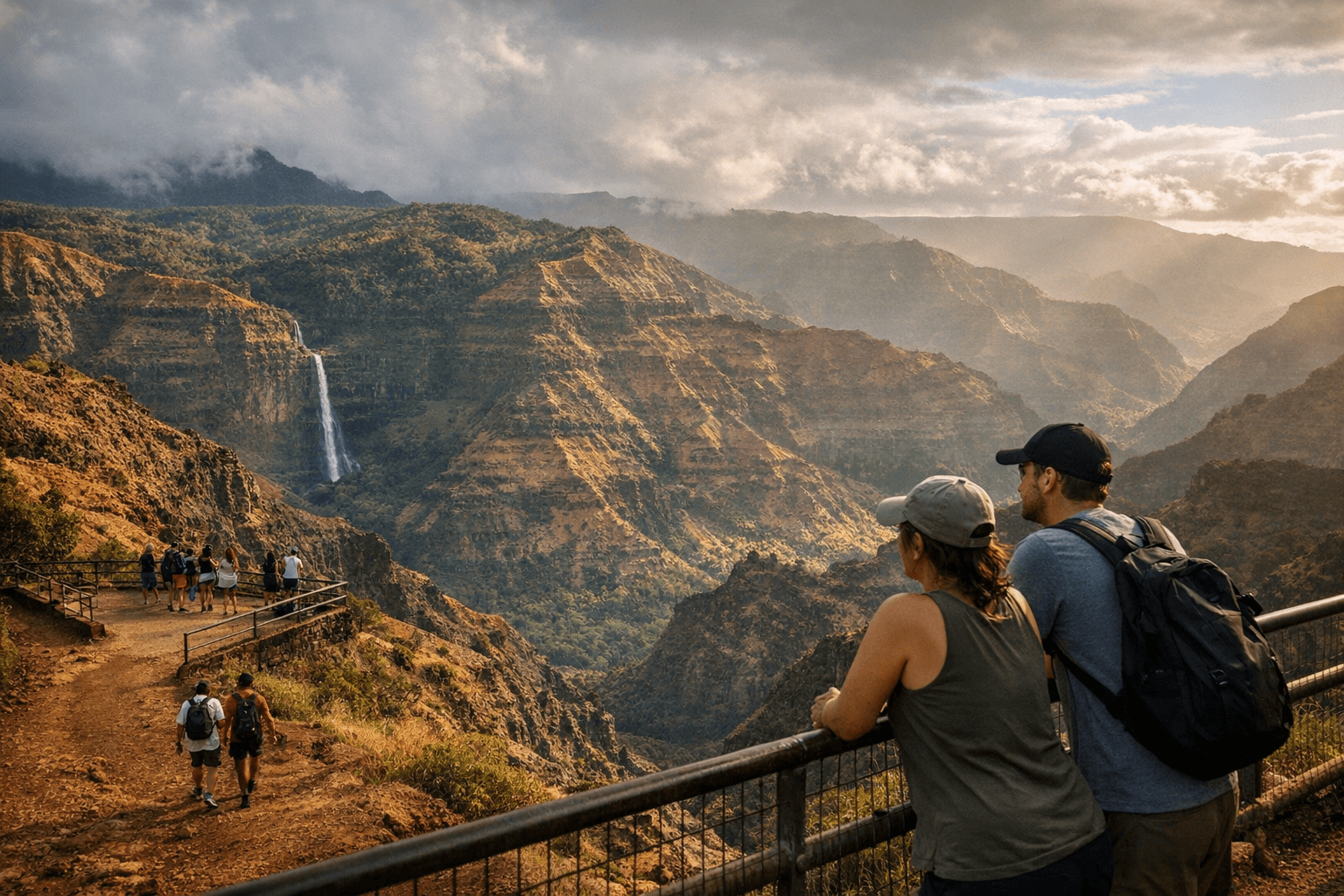
Kōke‘e and Waimea Canyon are listed both among the three priority hotspots in the Kaua‘i draft and in HTA’s broader roster of sites “of utmost concern,” reflecting their ecological sensitivity and popularity. The draft’s inclusion of Kōke‘e/Waimea elevates an area where recreational pressure can rapidly degrade trails, native vegetation and culturally significant sites; HTA’s list of proposed actions includes items that are tailored to this scale and setting, such as promoting “regenerative tourism” and performing inspections or operational oversight of guided services.
The HTA materials and Files Hawaii place this hotspot in the longer arc of HTA’s strategic shift: “Clearly, Hawai‘i has reached a point where the impacts of tourism need to be actively managed.” That sentence — quoted in Files Hawaii from HTA’s strategic plan — frames why Kōke‘e and Waimea Canyon are being singled out now. The Kaua‘i DMAP reportedly identifies 15 hotspots in total, of which the three named sites are presented as top priorities; the relationship between the three priority selections and the broader list of 15 — and the criteria used for prioritization — should be evident in HTA’s full draft. Files Hawaii also cites the Kaua‘i DMAP’s Action D.1 commitment to “Assess and set specific site visitor limits” and questions HTA’s progress on implementing such site‑level capacity controls. For high‑value landscapes like Waimea Canyon, the difference between a plan that “identifies” limits and one that enforces them is the difference between sustained preservation and continued degradation.
Cross‑cutting context and next steps
HTA’s 2026–2028 draft DMAPs are presented as the product of months of in‑person and virtual engagement in 2025 and are deliberately narrower than the sweeping 2021–2023 DMAPs in order to focus on achievable, three‑year actions. The draft lists a range of other Kaua‘i locations “to be managed more intentionally,” from Polihale to the Nāpali and Kalalau Trail, underscoring that the three priority hotspots sit inside a far larger inventory of strained sites. HTA explicit actions — “Address visitor safety,” “Monitor to address helicopter noise pollution,” and “Redefne brand to promote ‘regenerative tourism’ (i.e. ecotourism, voluntourism, agritourism)” — offer a coherent policy toolkit but depend on resources and interagency enforcement to succeed.
The procedural picture is incomplete in public excerpts. One source states “Public comments were accepted until March 2,” while other reporting tied to the broader DMAP rollout used language such as “Public comment on the draft plans are welcome until 11:59 p.m. today” and mentions finalization and HTA review dates of March 16 and the end of the month. Those date references are explicit in the reporting but not reconciled in the excerpts; HTA’s final draft, board materials and the DMAP PDF should clarify comment windows, finalization timing, and timelines for implementing concrete actions such as Action D.1. Files Hawaii’s assessment — that HTA’s destination‑management emphasis “is not materially different from its prior efforts” and that certain capacity controls were left “not started” or “on pause” — is an accountability flag HTA will need to answer as it moves from draft to final plan.
HTA has placed three Kaua‘i hotspots at the center of its current destination‑management effort; whether the draft becomes a turning point depends on two things: whether the unknown implementation details are added and resourced, and whether HTA and county partners translate site‑level proposals into enforceable management measures. The draft narrows the focus and provides a policy menu, but the next steps — clarified public‑comment deadlines, published operational plans for each hotspot, and a demonstrable start on actions such as visitor‑limit assessments — will determine if the plan protects Kaua‘i’s natural and cultural resources or remains an aspirational blueprint.
Sources:
Know something we missed? Have a correction or additional information?
Submit a Tip