Hybrid Volumetric and Two‑Photon 3D Printing Enables Hobbyist Multiscale Fabrication
Researchers combined high-speed tomographic volumetric AM with two-photon polymerization to print multiscale parts faster, opening practical paths for hobbyist hierarchical fabrication.
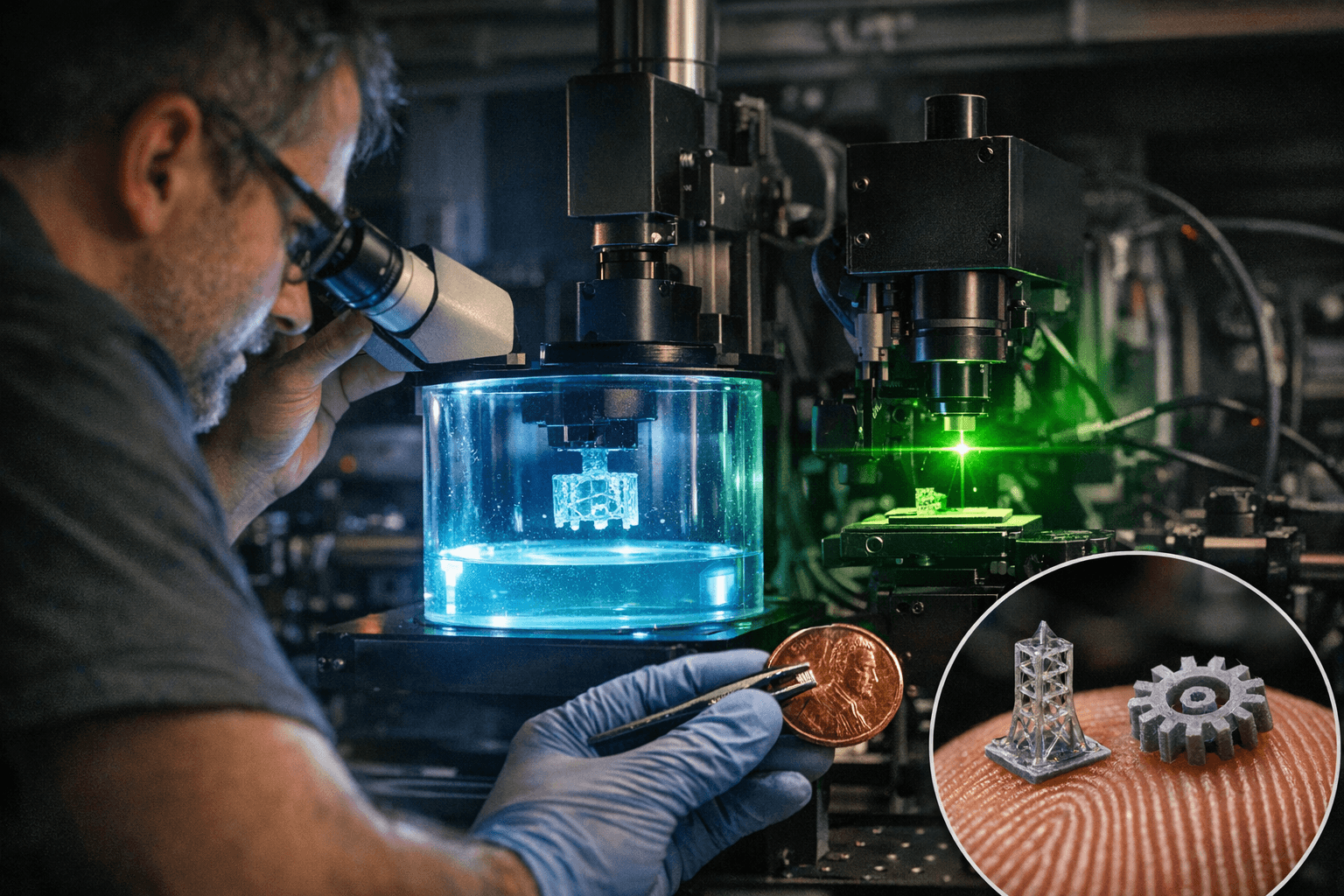
A new hybrid 3D printing approach promises to shrink the time and technical gap between building centimeter-scale parts and adding sub-micrometer detail. Researchers demonstrated a unified printer that first produces millimeter-to-centimeter volumetric structures using single-photon tomographic volumetric additive manufacturing (TVAM) and then applies localized two-photon polymerization (2PP) overprints to add the finest features. The result is a workflow that leverages TVAM’s speed and 2PP’s resolution to bridge the long-standing speed-resolution tradeoff in photopolymer additive manufacturing.
The team’s system architecture arranges TVAM prints on structures attached to a glass rod and then repositions or re-registers the part for targeted 2PP writing. TVAM in their tests produced centimeter-scale geometries with tens-of-micrometer feature size, while 2PP delivered sub-micrometer features where optical precision or microfluidic geometry demanded it. The paper presents the control strategy and sample demonstrations that combine the two modalities in a single build sequence, and it includes experimental results that validate multiscale alignment and feature fidelity across scales.
Practical value for the maker community is immediate. Pure 2PP can be prohibitively slow for larger functional parts; combining a rapid volumetric backbone with selective high-resolution overprints yields far shorter total build times than pure 2PP for the same multiscale parts. That makes hierarchical fabrication viable for hobbyist labs with access to multi-modal rigs or for those who work with service bureaus. Applications called out by the authors include optics, microfluidics, and biomedical microstructures — fields where a centimetric scaffold with micrometer or sub-micrometer finishing touches unlocks new functional devices without stacking long 2PP sessions.
The paper is careful to note current limits. Registration between the volumetric and two-photon stages remains a bottleneck, and materials compatibility across the two photopolymerization modes requires more work. The authors suggest future efforts on improved alignment workflows and resin chemistries that bridge single-photon and two-photon cure windows. Those areas will determine how easily makers can reproduce hybrid builds on retrofit systems or shared lab equipment.
For hobbyists this development points to concrete next steps: evaluate local service bureaus for combined workflows, experiment with parts designed for hierarchical printing, and watch for community toolchains that add registration utilities and compatible resins. As hybrid multimodal hardware and open workflows mature, expect to move from "print small fast" to "print big, finish fine" without paying the full time penalty of exclusive two-photon fabrication.
Know something we missed? Have a correction or additional information?
Submit a Tip