IMF trims Russia’s 2026 GDP growth to 0.8%
IMF cuts Russia’s 2026 growth forecast to 0.8%, nudging down global risks and highlighting data gaps; this piece breaks down numbers, drivers, and policy implications.
1. IMF downgrade explained
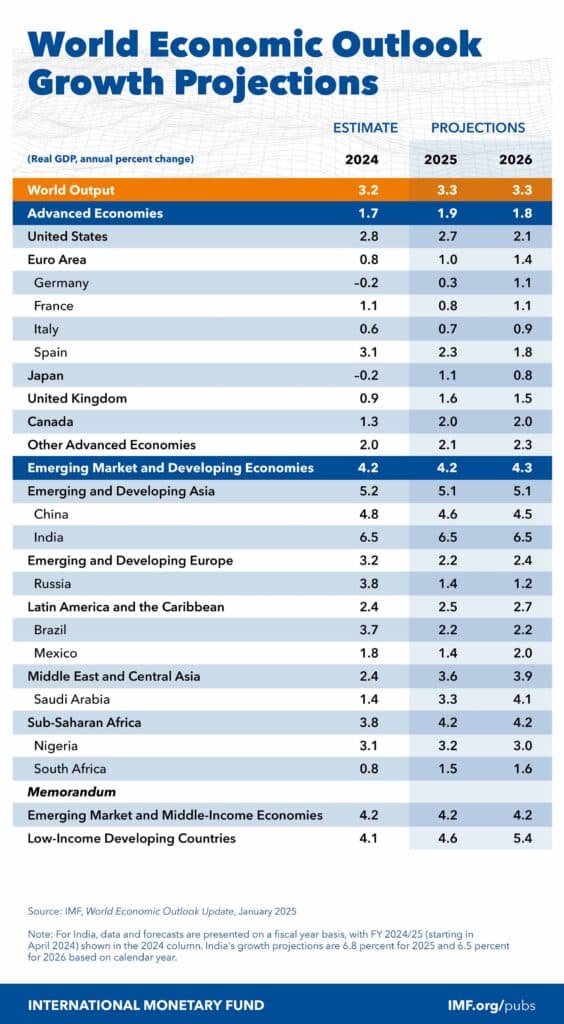
The IMF lowered its 2026 real GDP forecast for Russia by 0.2 percentage points to 0.8% from the 1.0% projected in October’s WEO update. The cut is modest in isolation but notable because it follows a volatile growth profile, a strong 4.3% expansion in 2024 followed by a sharp deceleration to an IMF-estimated 0.6% in 2025, underscoring a shift from one-off boosts toward subdued baseline momentum.
2. Limited in-country access
The IMF has not sent monitoring missions to Russia since November 2019, a fact the WEO reporting explicitly notes and that constrains the Fund’s granular, on-the-ground intelligence. That lack of recent missions helps explain why the IMF provided few public specifics for the downgrade and why its baseline rests more on indirect indicators than fresh in‑country verification.
3. 2025 hold and 2027 outlook
While trimming 2026, the IMF left its 2025 estimate for Russia unchanged at 0.6% and projects a modest rebound to 1.0% in 2027. These multi-year projections imply a prolonged period of subdued growth relative to the post‑2024 spike and suggest the Fund expects only gradual normalization rather than a rapid recovery.
4. Domestic forecasts diverge
Russian official forecasts sit modestly above the IMF baseline: the Central Bank of Russia projects 2026 GDP growth between 0.5% and 1.5%, while the Economic Development Ministry projects 1.3% for 2026. Those ranges reflect differing institutional models and incentives, monetary authorities stress downside risks, ministries often incorporate fiscal policy levers, and create a range of plausible outcomes for markets and policymakers.
5. 2024 surge and drivers
Russia’s 4.3% GDP growth in 2024 was unusually strong, driven in part by surging defense spending, which boosted demand and output. The 2025 slowdown to roughly 0.6% in IMF estimates signals that much of 2024’s strength was a temporary fiscal and demand spike rather than a durable productivity-driven expansion.
6. Global WEO upgrade context
The IMF raised its global growth forecast for 2026 by 0.2 percentage points to 3.3%, the same figure it reports for 2025, citing stronger-than-expected performances in major economies. That divergence between global upgrades and Russia’s downgrade matters: global momentum reduces external drag on Russia but does not offset domestic constraints or structural limitations in the near term.
7. AI and major-economy drivers
The WEO attributes much of the upward global revision to stronger U.S. and Chinese growth and to an investment boost from AI-related spending (data centers, chips, power infrastructure). The IMF raised its 2026 U.S. growth estimate to 2.4% (up 0.3 points from October), highlighting how concentrated technological investment can lift aggregate demand even as other sectors slow.
8. Regional and country moves
The WEO’s country-level adjustments included a slight upgrade for the euro area to 1.3% in 2026 (up 0.1 point) with 2027 unchanged at 1.4%; a small Japan upgrade tied to fiscal stimulus; Brazil’s 2026 forecast cut by 0.3 points to 1.6% amid tighter monetary policy; Spain’s 2026 forecast rose 0.3 points to 2.3%; and Britain’s 2026 forecast was left at 1.3%. These adjustments show the uneven, policy-driven nature of the IMF’s cross-country revisions.

9. Trade vulnerabilities flagged
The IMF warned that global goods and services trade volume growth is projected to slow to 2.6% in 2026 from 4.1% in 2025 before recovering to 3.1% in 2027, reflecting tariff and policy uncertainty under a policies‑in‑place assumption. For Russia, whose exports and trade channels remain central to fiscal revenues and external balances, a weaker trade growth environment increases downside risk, particularly if sanctions and trade frictions persist.
10. Russia versus peers
The Moscow Times highlighted that the IMF’s 0.8% forecast for Russia sits well below the emerging-market average projection of 4.2% and below the advanced-economy average of 1.8% for 2026. This gap signals long-term competitiveness and structural concerns for Russia: slow growth relative to peers will constrain investment, labor market resilience, and fiscal room over the medium term.
11. Reporting and source transparency
The WEO update is the IMF’s product; reporting outlets, including Reuters, The Moscow Times, SadaNews and AFP, summarized the WEO and emphasized different angles such as AI investment and country comparisons. That layered reporting underscores the value of triangulating IMF headline numbers with independent domestic data and commentary when interpreting country outlooks.
12. Limitations and open questions
Key open questions remain: the IMF provided few detailed public reasons for Russia’s downgrade, and the absence of recent missions constrains verification. Reconciling divergences between IMF and Russian official forecasts will require IMF technical notes, Russia’s formal reactions, and updated domestic releases (for example, the Federal Customs Service resuming trade statistics) to clarify trade flows, fiscal trajectories, and the durability of 2024’s spending-led expansion.
13. Market and policy implications
For markets, the downgrade likely translates into continued investor caution: slower growth dampens equity prospects, limits credit expansion, and sustains risk premia on external debt and redenominated exposures. Policy-wise, Russian authorities face a trade-off between stimulative fiscal measures to support growth and the long-term fiscal cost of sustaining elevated defense and public spending; the constrained baseline suggests structural reforms and private investment incentives will be critical to lift medium-term potential.
Conclusion: The IMF’s 0.8% 2026 forecast for Russia crystallizes a broader story, strong but temporary 2024 growth followed by subdued prospects, limited IMF in-country intelligence, and a wider global backdrop buoyed by AI-driven investment. Closing the data gaps and aligning policy choices will determine whether Russia can escape the slow-growth path implied by current forecasts.
This article was produced by Prism’s automated news system from verified source data, official records, and press releases, then run through automated quality and moderation checks before publishing. The system is built and supervised by the people who set the standards it runs under. Read our full AI policy.
Did this article answer your question?