India overtakes Germany and France as fifth most digitalised economy
India climbed from eighth to fifth in a 71-economy digital ranking, but the AI boom still lacks the capital and compute needed to spread gains.

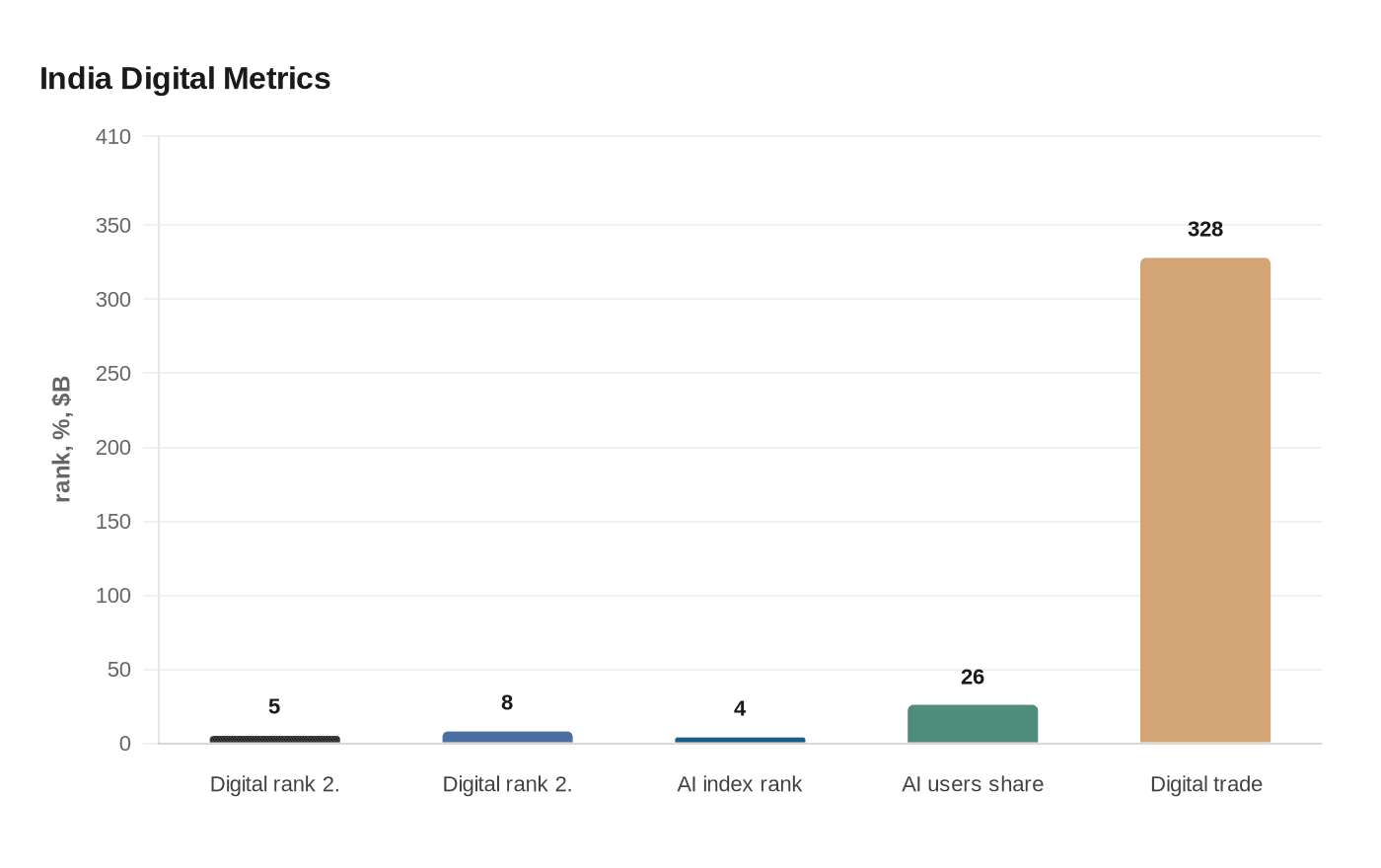
India’s rise to fifth place in a CHIPS-based global digitalisation ranking is a sharp signal of momentum, but it is not a verdict on broad-based progress. The report placed India ahead of Germany, France, Japan and Canada among 71 economies, while also ranking it fourth on a separate AI index behind the United States, China and Singapore. That combination points to a country that is adopting digital tools quickly, yet still has not built the private investment base and computing capacity needed to turn scale into durable leadership.
The numbers underline both the advance and the limits. India moved up from eighth place in 2025 to fifth in 2026. The report said India has the world’s second-largest AI talent pool, accounts for about 26 percent of global AI users and generated $328 billion in digitally delivered trade. It also said 72 percent of AI users are now in developing countries, with India and China together accounting for nearly two-fifths of worldwide AI adoption. The center of gravity in digital activity is shifting, but the report’s own findings suggest that usage is running ahead of the infrastructure, finance and commercialization systems that would make the gains stick.

That gap is what makes the ranking politically meaningful. The report says long-term competitiveness will depend on mobilizing risk capital, expanding access to compute, strengthening university-startup links and building better pathways to commercialize research. In other words, India’s digital story is no longer just about connectivity or consumer adoption. It is now about whether the country can support advanced AI research, startup scaling and domestic hardware capacity without leaving too much of the value chain to foreign capital and imported compute.
The report was launched on May 29 at the ICRIER Prosus Centre for Internet and Digital Economy annual conference in New Delhi, where the agenda brought together Pramod Bhasin, Abhishek Singh, Deepak Mishra, Helani Galpaya, Nitin Pai, Sanjeev Bikhchandani and David Tudor. Bhasin said India’s next digital phase depends on leveraging AI, deepening innovation capabilities and strengthening digital trust. That warning matters because the national scorecard still masks uneven regional access and capacity, with earlier state-level analysis from the same centre showing Delhi, Kerala, Karnataka, Maharashtra and Haryana ahead while Jharkhand lagged. A top-line ranking can celebrate scale; it cannot by itself guarantee that workers, small firms and public services will share the gains.
This article was produced by Prism’s automated news system from verified source data, official records, and press releases, then run through automated quality and moderation checks before publishing. The system is built and supervised by the people who set the standards it runs under. Read our full AI policy.
Did this article answer your question?


