Inside Ovtcharov’s Upset Over Calderano at WTT Doha
This guide breaks down Dimitrij Ovtcharov’s five-set upset of Hugo Calderano at WTT Champions Doha, walking through the match point-by-point and highlighting the tactical battles that decided it. You’ll also get quick notes on other early winners and practical takeaways for club players and community coaches about play-style matchups and momentum management.
1. Match overview and significance
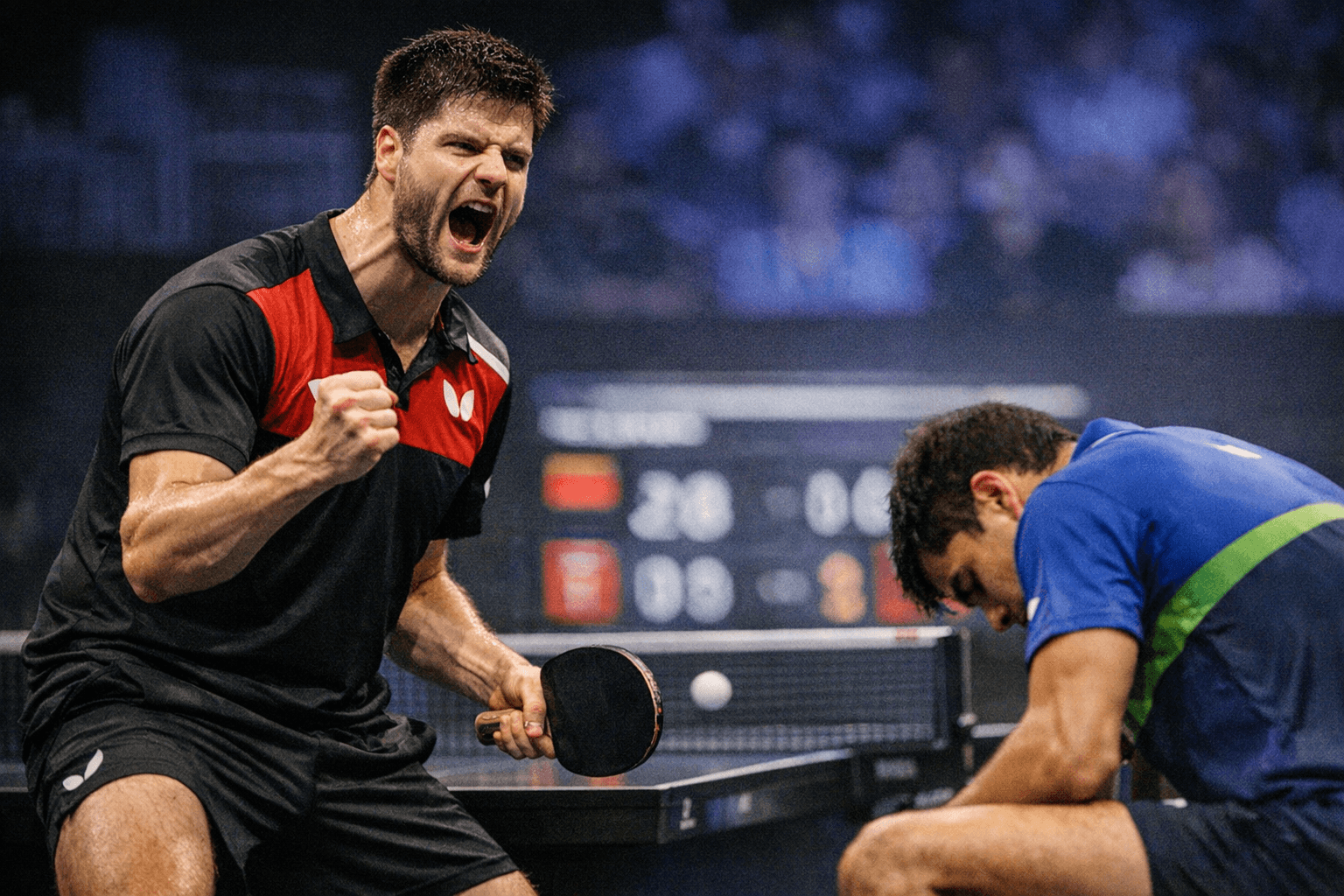
Dimitrij Ovtcharov beat Hugo Calderano in a five-set match on day one of WTT Champions Doha (Jan 8, 2026), a result that jolted the draw and showcased veteran craft against raw power. The match mattered because it demonstrated how placement and opening control can disrupt even the most aggressive attackers, and it set the tone for several storylines emerging from the tournament’s opening day.
2. Set 1, opening pattern and key points
Ovtcharov opened the match by controlling the table with short, precise serves and angled opening shots that pulled Calderano off the center line. Those early points were short but decisive: Ovtcharov’s placement forced Calderano into stepping around on his forehand, which reduced the Brazilian’s ability to unleash full-power strokes. The set ended with Ovtcharov maintaining a steady first-attack percentage, showing the immediate payoff of controlled openings against heavy hitters.
3. Set 2, Calderano’s power responses and momentum swing
Calderano adjusted in the second set by increasing the pace and committing more to wide, heavy loops to Ovtcharov’s backhand and transition zones. Those power-based responses won him extended rallies and momentum, as Ovtcharov was occasionally pushed into defensive reads rather than dictating points. The set highlighted how an aggressive change of rhythm can reclaim initiative, especially when the heavy hitter targets transitional positions.
4. Set 3, tactical counter-adjustments and rally construction
In the third set Ovtcharov mixed deeper serves and more varied placement, stretching Calderano laterally and opening angles for his own counter-attacks. Key rallies were longer, with Ovtcharov showing patience and waiting for the short ball to exploit, rather than simply blocking pace. That construction turned several pivotal exchanges and gave Ovtcharov the edge by forcing Calderano out of his ideal hitting zones.
5. Set 4, Calderano responds with raw aggression
Calderano pushed the match to a fourth set by returning to higher-risk, higher-reward strokes, trying to shorten points and capitalize on aggressive returns. The set featured several quick exchanges where Calderano’s power either produced outright winners or induced weak returns that he could finish. This swing back to aggression underlined the match’s tug-of-war nature: tactical precision versus explosive offense.
6. Set 5, decisive points and closing sequence
The final set distilled the match’s themes: Ovtcharov’s placement and timing versus Calderano’s power attempts to force errors. In the decisive sequence Ovtcharov combined a controlled opening serve, a well-placed third-ball attack, and then a patient rally that left Calderano out of position for the finishing shot. Those last points illustrated how composure and smart point construction can overcome brute force in pressure moments.
7. Tactical theme, Ovtcharov’s placement and controlled opening play
Ovtcharov’s most effective tools were his serve placement and measured first attacks, which prioritized angle and depth over pure speed. By repeatedly targeting transition areas and using short serves to draw drives, he forced Calderano to create his own power, often out of position. For players at club level, this shows that disciplined serve variation and placement can neutralize a faster opponent’s rhythm.
8. Tactical theme, Calderano’s power-based responses and risks
Calderano’s responses relied on tempo and heavy forehand loops that seek to finish points quickly, and when executed they often shifted momentum immediately. The trade-off is a higher error rate when his timing is off or when he’s pushed wide by placement; those errors were decisive in this match. Community players should recognize when to commit to aggressive play and when to reset, overcommitment against placement can be costly.
9. Critical rallies and momentum shifts
Several extended rallies in the middle sets served as momentum fulcrums: when Ovtcharov could extend rallies and return to placement, he recovered initiative; when Calderano could force short, explosive exchanges, he won quick points. Momentum here wasn’t a single run but a series of tactical wins, each successful placement or forced error compounded into psychological and scoreboard advantage. Clubs should practice sequences that replicate these momentum swings to train recovery and situational responses.
10. Quick notes on other early winners and storylines from day one
Day one produced a mix of expected wins and storyline developments: veterans showing tactical sharpness, younger players testing aggression, and a few surprise results that reshaped early expectations. The overall theme was adaptability, players who mixed pace and placement tended to advance, while those relying purely on one strength sometimes faltered. For local communities, this tournament underlines the growing need to prepare for hybrid opponents who can alternate between power and placement.
- Emphasize serve placement and third-ball planning in practices; a short, well-placed serve followed by a prepared third-ball can swing matches.
- Drill transition-zone targeting: practice forcing opponents to step wide or off-balance so you can exploit the next shot.
- Train both explosive attacking and controlled rallying; the ability to change tempo under pressure is a winning skill.
11. Practical takeaways for club players and community coaches
These takeaways are immediately applicable in club sessions and match preparation and help players anticipate the strategic choices they’ll face.
- Serve-and-third-ball sequence: Have one player serve short to the forehand or backhand three times, and the receiver must return controlled; server practices opening loop or angle attack on the third ball. Repeat for 10 minutes, focusing on placement rather than speed.
- Transition-zone footwork drill: Feed alternating wide pushes and midline drives; the player practices stepping and resetting to hit consistent counter-attacks. This builds the ability to handle placement and recover to offensive positions.
- Momentum-swing sim: Play best-of-five mini-games where each player must win a point after losing a two-point run to simulate recovery under pressure. This conditions players to manage score swings and stay composed.
12. Practice drills and coaching suggestions
Closing note: Ovtcharov’s win over Calderano is a practical reminder to communities that tactical nuance and composure matter as much as raw power. Use the specific sequences and drills above to bring those lessons into your club practice and match play.
Know something we missed? Have a correction or additional information?
Submit a Tip