Intel Plans $15 Million SambaNova Investment, Boosting Stake to 9%
Intel's CEO chairs SambaNova while Intel plans a $15M investment in it, raising conflict-of-interest alarms as the chipmaker's stake nears 9%.
Intel's deepening financial relationship with SambaNova Systems sits at the center of a governance controversy that goes beyond a single startup bet: the AI chip company Intel is preparing to fund is chaired by Intel's own CEO.
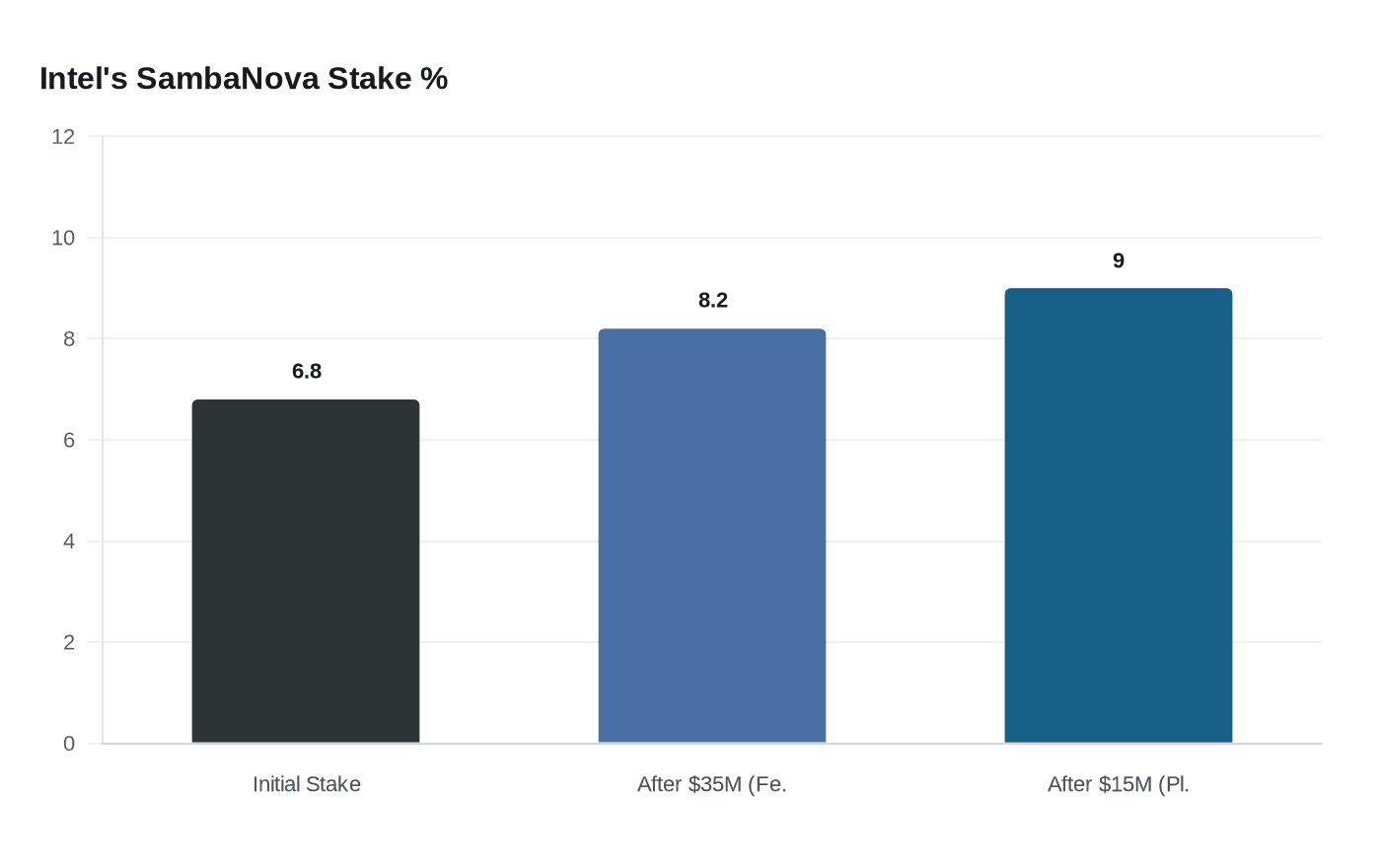
Corporate records showed Intel planned to invest an additional $15 million in SambaNova, a California-based artificial intelligence accelerator startup, a move that would lift Intel's ownership stake to roughly 9% pending regulatory approval. The planned infusion follows a $35 million investment Intel made in February, which had already pushed its stake from 6.8% to 8.2% alongside a separately announced strategic collaboration between the two companies.
At the center of the arrangement is Lip-Bu Tan, Intel's chief executive and a wealthy venture capitalist the chipmaker hired roughly a year ago to engineer its turnaround. Tan simultaneously chairs SambaNova's board, a dual role that concentrates significant influence over a transaction Intel's own shareholders must ultimately judge as arm's-length. Venture funds affiliated with Tan, including Walden and FactoryHQ Fund, also hold stakes in SambaNova, meaning a successful outcome for the startup would benefit Tan personally.

Intel disclosed in a late March securities filing that four companies had financing arrangements material enough to report specifically because of their size and their benefit to Tan. A review of corporate records identified those four as EPIC Microsystems, 3D Glass Solutions, OPAQUE Systems and SambaNova. Intel also invested $2.3 million in OPAQUE Systems in January, acquiring a 14% stake valued at approximately $41 million, with Tan-affiliated funds holding 17% of that company as well.
In response to questions about the SambaNova transactions, Intel said it "maintains rigorous, well-established governance and conflict-of-interest policies, with active Board oversight to ensure all decisions are made in the best interests of the company and its shareholders." The company added that it was already a shareholder in three of the four Tan-affiliated companies before Tan took the CEO role, and offered that "in specialized industries like semiconductors and advanced computing, overlap among long-time investors is expected." Intel declined to comment specifically on the SambaNova financing.
SambaNova, for its part, said 2025 was its strongest and most profitable year on record and that it has repositioned around inference computing, the processing required to respond to queries in large language model applications. The company said it introduced a new chip to support that transition and secured new financing around the shift.
The strategic rationale for Intel is legible if contested. SambaNova builds purpose-built accelerators for AI inference workloads, a segment where Nvidia holds dominant market share. By combining capital investment with a commercial distribution agreement, Intel can offer enterprise and cloud customers SambaNova-based inference hardware through Intel's established sales channels without designing the accelerators internally. That approach shortens time to market but also raises the question of whether Intel's board can independently assess a deal in which its own CEO has a direct financial interest on both sides of the table.
The $15 million figure is modest relative to SambaNova's broader fundraising, which included a reported $350 million Series E round earlier in 2026. But the pattern it reinforces, repeated injections into a startup where Tan holds a leadership role, is precisely what governance watchdogs and shareholder advocates are likely to scrutinize. For Intel, which is simultaneously trying to reclaim credibility in AI hardware and restore investor confidence after years of competitive setbacks, the optics of a CEO personally positioned to gain from his own company's investment decisions carry risks that no governance boilerplate fully neutralizes.
This article was produced by Prism’s automated news system from verified source data, official records, and press releases, then run through automated quality and moderation checks before publishing. The system is built and supervised by the people who set the standards it runs under. Read our full AI policy.
Did this article answer your question?

