Intel's Panther Lake chip signals a possible comeback for the company
Panther Lake is Intel’s clearest comeback test yet, with the real stakes resting on whether it can regain influence in PCs, handheld gaming, and chip manufacturing.
Intel’s comeback bet starts with Panther Lake
Intel is asking the market to look past a bruising stretch and focus on one chip: Panther Lake, its first client platform built on Intel 18A. That matters because this is not just another laptop launch. It is Intel’s chance to prove it can still set the pace in consumer hardware after losing ground to rivals in PCs, gaming, and mobile computing.
The pressure behind that effort has been severe. In August 2024, Intel announced roughly 15,000 job cuts, about 15% of its workforce, and said it aimed to save $10 billion in 2025. Pat Gelsinger then left the company effective December 1, 2024 after the board lost confidence in his turnaround plan, leaving David Zinsner and Michelle Johnston Holthaus to run Intel as interim co-CEOs while it searched for a permanent leader. That leadership reset underlined how little room Intel had left for error.
Why the credibility gap matters
Intel’s challenge was not only financial, it was reputational. The company reported 2024 revenue of $53.1 billion, down 2% from 2023, with fourth-quarter revenue of $14.3 billion, down 7% year over year. At the same time, Intel publicly acknowledged the 13th- and 14th-gen Core desktop instability problem in July 2024, saying elevated operating voltage was the root cause and that it would deliver a microcode patch and BIOS updates. It later said the Vmin Shift Instability issue had been localized to a clock tree circuit vulnerable to reliability aging under elevated voltage and temperature.
That episode cut directly into confidence among desktop buyers, especially gamers and enthusiasts who depend on stability under sustained load. It also gave AMD a cleaner opening in the desktop market, while Intel was trying to convince the market that its next generation would be different. For a company built on reliability and scale, that kind of trust problem can linger long after the technical fix is shipped.
The PC market no longer waits for Intel
The bigger competitive picture has shifted around Intel. Qualcomm’s Snapdragon-based Copilot+ systems helped redefine premium Windows laptops in 2024, showing that Intel no longer had an automatic claim on the high end of the notebook market. Microsoft added to that pressure in 2025 by introducing lower-priced Qualcomm-powered Surface devices, a move that pushed Arm-based Windows hardware farther into the mainstream.
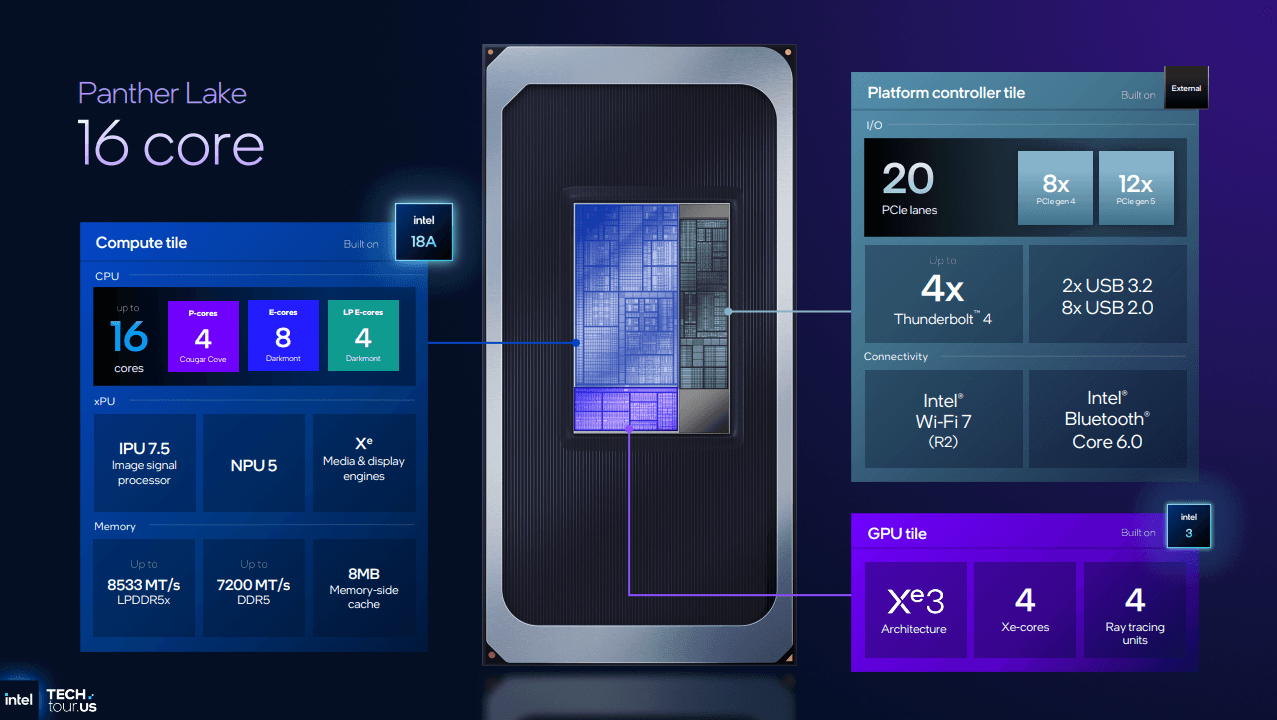
That matters because Intel’s core business has long depended on the idea that consumers and PC makers would default to x86 chips for performance, compatibility, and battery life. Panther Lake is Intel’s answer to a market where those assumptions are no longer safe. By the time Intel presented Panther Lake as Core Ultra Series 3 on October 9, 2025, it was positioning the chip not just as a processor, but as proof that its next platform could compete across performance, efficiency, and AI features.
Intel later said that by CES 2026, Panther Lake chips were in market as a broad AI PC family. That framing tells the real story. Intel is no longer selling only raw CPU speed. It is trying to sell an integrated platform story that can hold its own against Qualcomm, Apple, and AMD at the same time.
What Panther Lake represents inside Intel
Panther Lake is also a manufacturing test. Intel said it was being manufactured at Fab 52 in Chandler, Arizona, alongside Clearwater Forest, making the chip part of a broader domestic expansion worth more than $100 billion. That makes the platform more than a product launch. It is a public proof point for Intel’s 18A manufacturing comeback, the kind of milestone that carries weight with investors, customers, and policymakers watching American semiconductor capacity.
The location matters because Intel’s future in consumer hardware is tied to whether it can execute at both the design and fabrication levels. A chip can look strong on paper, but if manufacturing slips, the larger turnaround story collapses. Panther Lake therefore sits at the center of a larger institutional question: can Intel turn process technology into durable competitive advantage again, or will it remain one step behind the companies reshaping the PC market around it?
Why the handheld push matters more than it looks
The handheld gaming move is easy to dismiss as a niche launch, but it is one of Intel’s clearest signs of strategic adaptation. On May 28, 2026, Intel launched Arc G-Series handheld processors for Windows 11 handheld gaming devices. Acer followed by announcing the Predator Atlas 8 handheld, powered by up to the new Intel Arc G3 Extreme processor.
That matters because handhelds sit at the intersection of several problems Intel needs to solve: power efficiency, thermals, integrated graphics, and system-level tuning. The category is smaller than laptops, but it is also a proving ground for the kinds of chips consumers increasingly want, compact devices that can handle modern gaming without the compromises of a traditional desktop. If Intel can perform there, it strengthens the case that the company is learning where mobile computing is headed, not where it used to be.
The bigger graphics question is still unsettled
Intel’s discrete graphics ambitions remain less certain. Its next flagship Battlemage desktop GPU had been widely rumored, but it had not firmly established itself in the market. Instead, Intel spent 2025 and 2026 showing progress on integrated graphics and using Arc to build credibility in more targeted categories.
That makes the handheld launch strategically important. Intel is not trying to win every graphics battle at once. It is testing where its silicon can actually land, and whether it can build a believable path from integrated graphics to broader consumer acceptance. In that sense, the handhelds are not a side project. They are a pressure test for Intel’s ability to re-enter the most demanding parts of the consumer hardware conversation.
What Panther Lake really says about Intel
Panther Lake is important because it compresses Intel’s entire turnaround into one product cycle. It follows layoffs, a CEO exit, a revenue decline, a public defect crisis, and years of pressure from Qualcomm, Apple, Microsoft, and AMD. It also arrives alongside a renewed manufacturing push in Arizona and a handheld gaming strategy that suggests Intel is looking for fresh ground where it can still shape what comes next.
If Panther Lake performs as Intel says it should, the company will have more than a stronger laptop chip. It will have evidence that its 18A strategy, its manufacturing investment, and its product roadmap can still matter in the market that built its reputation. If it does not, the comeback narrative weakens fast. For Intel, Panther Lake is not just a chip launch. It is a test of whether the company can still define the next wave of consumer hardware.
This article was produced by Prism’s automated news system from verified source data, official records, and press releases, then run through automated quality and moderation checks before publishing. The system is built and supervised by the people who set the standards it runs under. Read our full AI policy.
Know something we missed? Have a correction or additional information?
Submit a Tip

