Interstate Stream Commission Seeks Hidalgo Input on New Mexico Unit Fund
The Interstate Stream Commission released a draft policy for New Mexico’s $66 million Unit Fund and will hold listening sessions; locals can email input to nm.awsa@ose.nm.gov by Feb. 28.
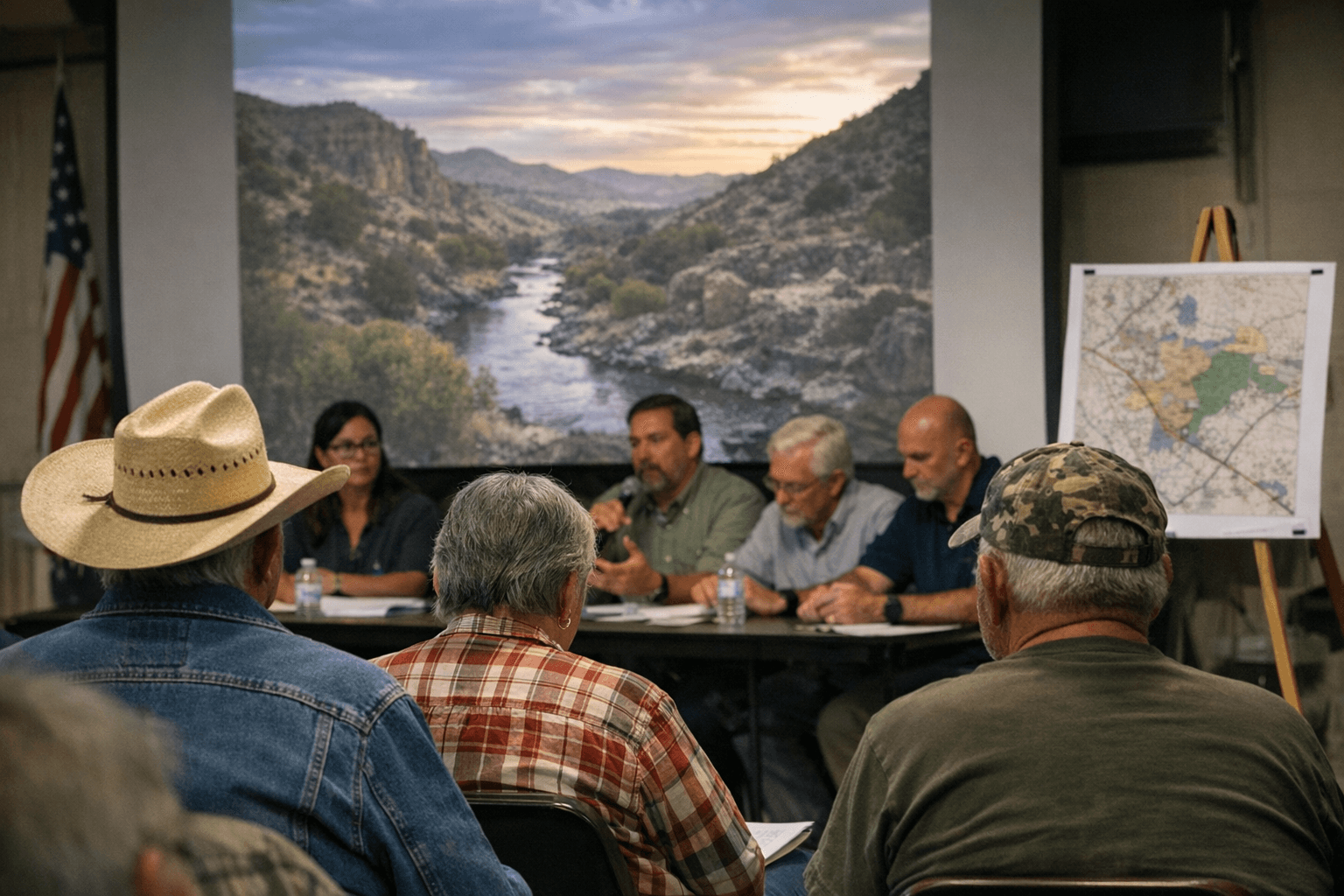
The Interstate Stream Commission has posted a draft policy for the New Mexico Unit Fund and scheduled public listening sessions in Catron, Grant, Hidalgo and Luna counties to gather local input on how the money should be spent. The Unit Fund was established from New Mexico’s $66 million share of the 2004 Arizona Water Settlements Act and by law must be used for water projects in those four counties.
The NMISC is proposing a Pilot Funding Cycle designed “to create, test, and refine an application process for future funding cycles.” Pilot funds are intended to support planning or design of water utilization projects that promote conservation and efficient use of limited water supplies and establish and support water delivery systems or treatment systems that are sustainable. Proposed projects must demonstrate they meet water supply demands in the four-county region. Selection considerations include contributions to regional development, water system resiliency, water security, economic health, protection or enhancement of cultural lifeways or resources, and sufficient local community engagement and participation.
At a minimum, the following information is required: A description of the project/scope of work; Evidence that the project meets water supply demands; The amount of funds requested and disclosure of any available matching funds; Information regarding land ownership, easements, and water rights; Information showing the applicant is an eligible entity; A resolution enacted at public meeting, authorizing the application. To the greatest extent possible, the NMISC will seek to fund efforts that represent project phases that can be completed within 12-24 months.
Interstate Stream Commission staff will take public comment by email at nm.awsa@ose.nm.gov through Feb. 28. Listening sessions are scheduled as follows: Deming — Feb. 17, 1:00 p.m., Marshall Memorial Library; Lordsburg — Feb. 17, 5:30 p.m., Lordsburg High School; Silver City — Feb. 18, 5:30 p.m., Grant County Veterans Memorial Business and Conference Center; Reserve — Feb. 19, 5:30 p.m., Chuck Ellis Gym at Reserve High School. A virtual session is scheduled for Feb. 24.
Jesse Shapiro, manager of the Arizona Water Settlements Act, said during a meeting of the ISC last week, “All of this is leading us to trying to bring a final draft to the commission for approval in March, all leading to what we hope will be an opening for a call for proposals in early June.” Priscilla Lucero, executive director of the Southwest New Mexico Council of Governments, said it is important for stakeholders in the four counties to give their feedback on the proposed policy.
The NMISC and the Office of the State Engineer are also pursuing related technical capacity and data projects. The OSE Hydrology Bureau received a NASA Western Water Applications Office award of $200,000 over an estimated two-year period to work with the Mountain Hydrology Group at INSTAAR, University of Colorado–Boulder, on a snow-water equivalent analysis tool. The ISC and OSE have expanded staffing with 27 new recurring positions to support water data and planning work.
One document excerpt indicates a Pilot Cycle “to open in 2024,” a detail that is not reconciled in ISC’s current March/early June timeline. Hidalgo County residents, irrigation districts, municipalities, water managers and conservation groups should consider attending a session or emailing the ISC by Feb. 28 to shape which planning and design projects are prioritized and to ensure local needs and cultural lifeways are reflected in the Pilot Cycle.
Know something we missed? Have a correction or additional information?
Submit a Tip