Israel and Hezbollah agree to US-brokered ceasefire in Lebanon
The ceasefire talk is converging around a U.S.-backed pause, but the terms still hinge on Hezbollah pullbacks, Israeli restraint and a U.S.-run monitor.
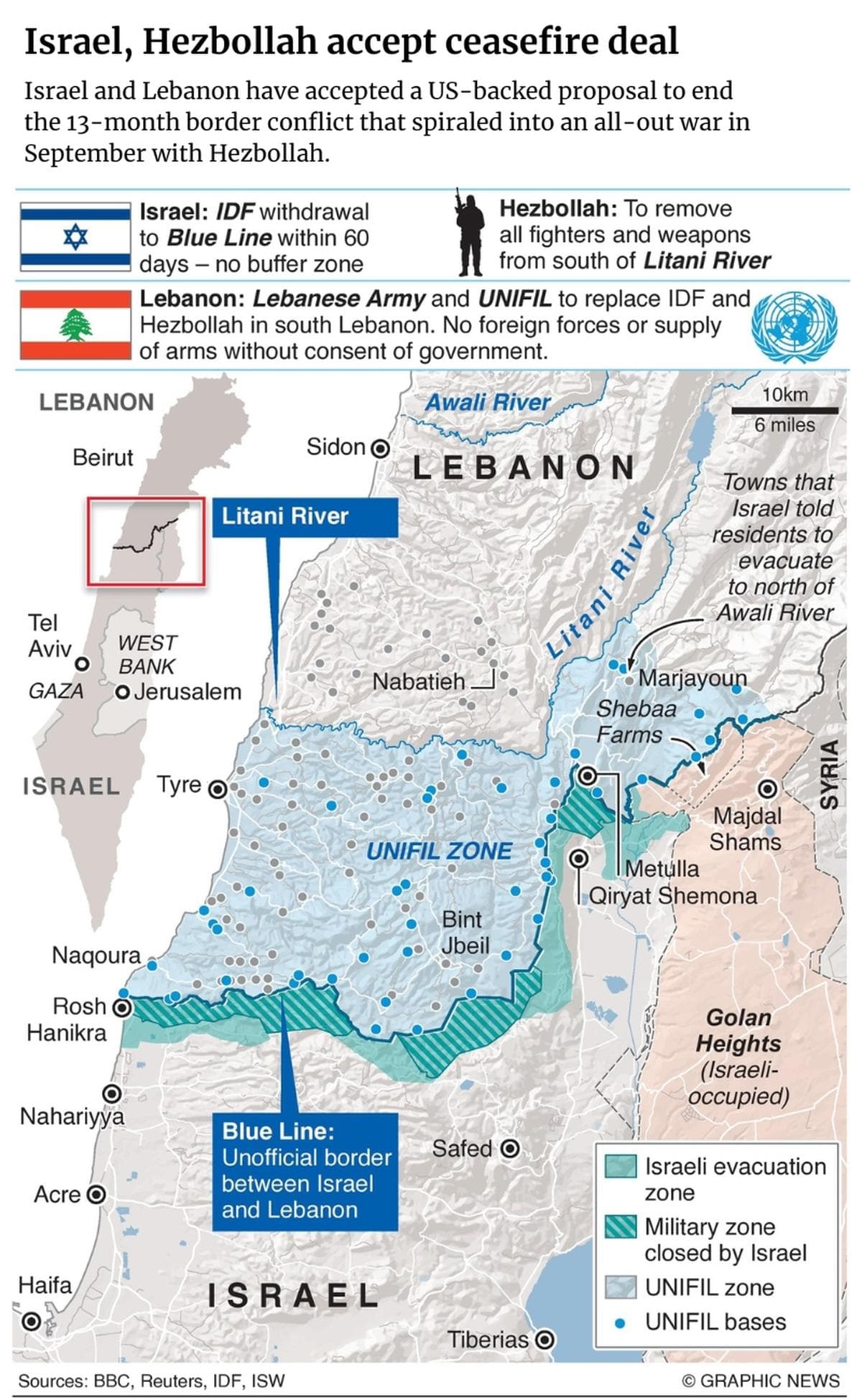
The ceasefire language now coming from Washington, Beirut and Jerusalem points to a narrow bargain, not a final peace. Public statements describe a reciprocal halt in fighting, but the real test is whether Hezbollah moves back from the frontier, Israel stops striking Lebanon, and a U.S.-led mechanism can enforce the terms.
The conflict that made this deal necessary began on October 8, 2023, when Hezbollah opened cross-border attacks a day after the Hamas-led assault on Israel. The fighting ran in parallel with the Gaza war and drove a sharp escalation along the Blue Line, with civilians on both sides forced from their homes and Lebanon’s southern border becoming one of the region’s most dangerous flashpoints.
The framework behind the talks is not new. United Nations Security Council Resolution 1701, adopted in 2006 after the 34-day Israel-Hezbollah war, called for an end to hostilities, Israeli withdrawal behind the Blue Line and Hezbollah’s pullback north of the Litani River. Israel’s cabinet approved a U.S.- and French-brokered ceasefire on November 26, 2024, setting it to take effect at 4 a.m. the next day and framing it as a 60-day halt to hostilities. A monitoring mechanism led by the United States was built into the arrangement.
What has changed is the language used by each side. Lebanon’s U.S. embassy described Hezbollah as having agreed to a reciprocal ceasefire under a U.S. proposal. U.S. officials later cast the Lebanon track as an extended ceasefire and a broader security process, not a one-off truce. In 2026, the State Department said Israel and Lebanon would begin a cessation of hostilities on April 16 at 5 p.m. Eastern for an initial 10-day period, with direct talks continuing in Washington. Israeli officials have tied any deal to Hezbollah’s removal from the border and the return of displaced Israelis, while U.S. officials have said the burden rests on Hezbollah to stop the fighting.
The policy stakes reach far beyond the frontier. Washington says it has provided Israel more than $130 billion in bilateral assistance since 1948 and Lebanon’s armed forces more than $3 billion since 2006, part of a strategy that treats the Lebanese Armed Forces as the country’s legitimate stabilizing force. That approach sits beside a harsher reality: more than 1.4 million people were displaced in the war phase, and Lebanese health authorities counted thousands killed in Israeli actions since October 8, 2023. For now, the ceasefire looks less like an end state than a managed pause, with enforcement and sovereignty still unresolved.
This article was produced by Prism’s automated news system from verified source data, official records, and press releases, then run through automated quality and moderation checks before publishing. The system is built and supervised by the people who set the standards it runs under. Read our full AI policy.
Did this article answer your question?