Jackson Warns Supreme Court Emergency Docket Corrodes Judicial System
Jackson said the emergency docket has a corrosive effect, warning that lower-court cases turn into zombie proceedings as the justices move too fast.
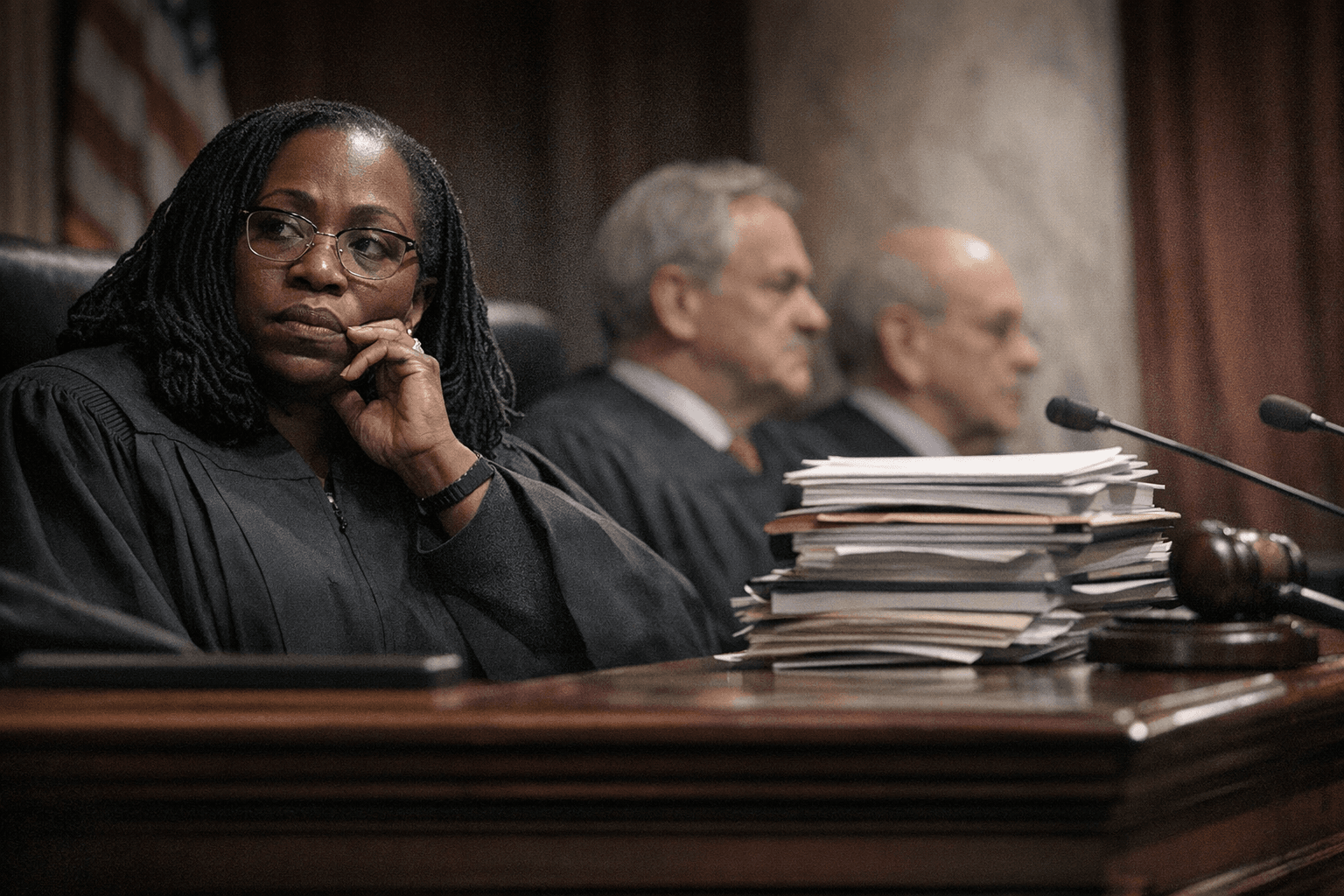
The Supreme Court’s emergency docket is the fast lane of American law, letting justices act on urgent applications with limited briefing, no full oral argument and, often, no explanation. Justice Ketanji Brown Jackson says that shortcut is now doing more than deciding cases quickly. It is, in her view, corroding the judicial system.
Jackson made that argument on April 13 at Yale Law School’s Battell Chapel in New Haven, Connecticut, where she delivered the 2025-26 James A. Thomas Lecture, “Equity and Exigency: A First-Principles Solution for the Supreme Court’s Emergency Docket.” Yale said the event drew a capacity crowd of students, faculty and staff, and it posted video of the lecture two days later, on April 15. In its introduction, the school highlighted Jackson’s upbringing as the daughter of public school teachers and her early speech-and-debate background.
Her critique landed as the emergency docket has become one of the most consequential tools at the court’s disposal. The docket, sometimes called the shadow docket, is used for interim relief requests that need immediate action. SCOTUSblog describes it as an expedited process with limited briefing and typically no oral argument, usually resolved in unsigned orders. Jackson argued that the court’s conservative majority is stepping in too quickly, before lower courts have fully developed the facts and legal questions, leaving behind what she called “zombie proceedings” that continue in a weakened and unsettled state.
The stakes are not abstract. Since Donald Trump returned to office in January 2025, the court has repeatedly used emergency rulings to let his administration move ahead on immigration, a ban on transgender people serving in the military, removals of certain federal officials, mass federal layoffs and foreign aid cuts. A later analysis cited in related reporting said Trump had won 21 of 23 emergency-docket actions since returning to office, with one case declared moot. Ballotpedia said that as of March 17, 2026, the court had issued 35 emergency orders in Trump-administration-related cases, with four applications pending and three withdrawn.
Jackson’s warning goes beyond an internal dispute over procedure. When major policy fights are decided on an emergency basis, communities affected by immigration enforcement, military restrictions, job cuts and aid reductions can feel the impact before the public sees the court’s reasoning. Lower courts lose room to do their work, litigants lose predictability, and the public is left to infer sweeping law from short-form orders that often explain little. Jackson’s speech framed that shift as a structural problem, not a temporary inconvenience, and a growing share of the court’s most important decisions now seems to be happening in the dark.
This article was produced by Prism’s automated news system from verified source data, official records, and press releases, then run through automated quality and moderation checks before publishing. The system is built and supervised by the people who set the standards it runs under. Read our full AI policy.
Did this article answer your question?

