Japan's Office Chair Racing Circuit Is a Quirky Endurance Spectacle
Teams of three race stock office chairs around a 200-meter loop for two hours; Japan's ISU-1 GP has quietly built a cult following for over a decade.
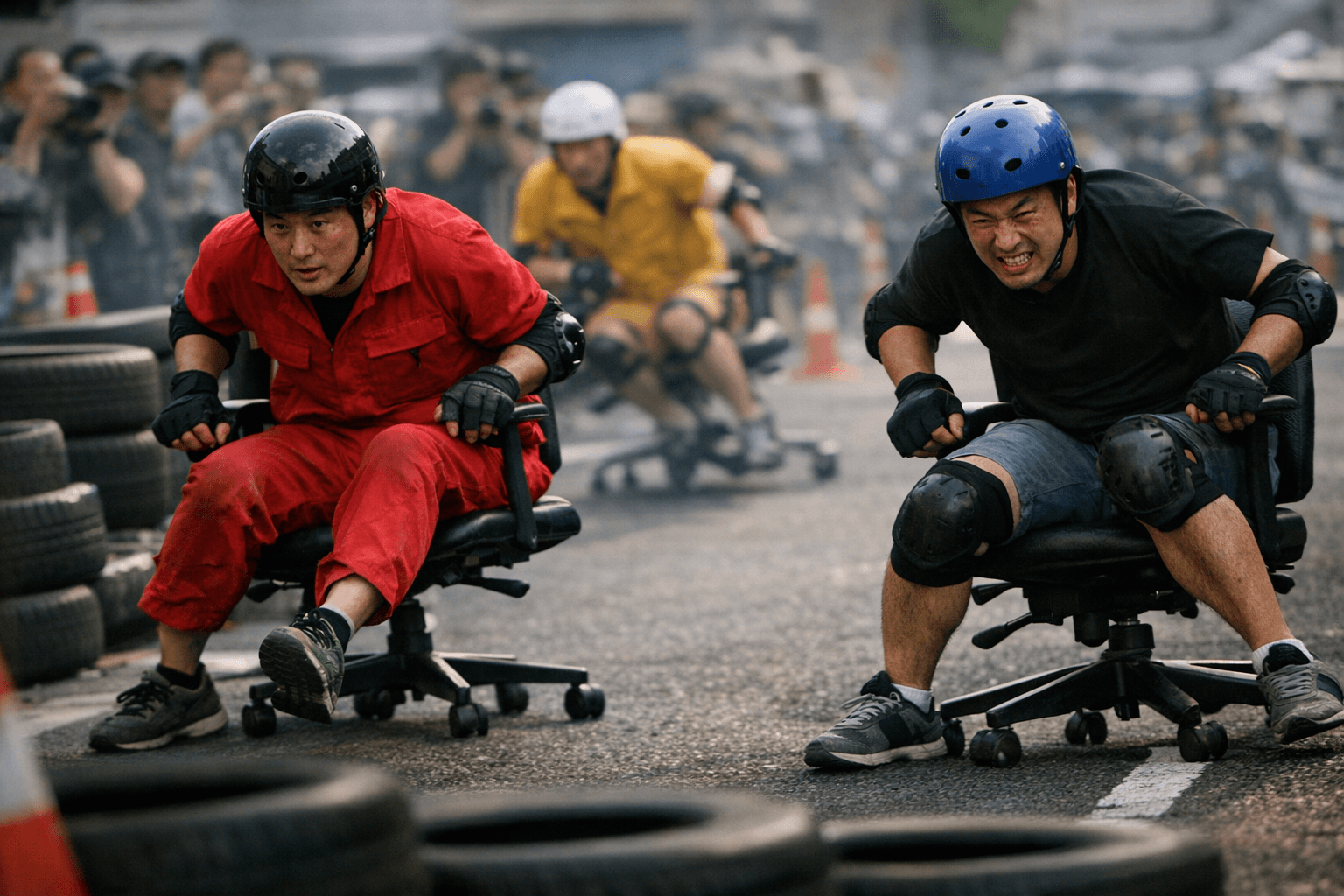
Three people wearing helmets, elbow pads and gloves take turns shoving a stock office chair around a 200-meter loop. The prize, if they outlast the competition: a sack of rice.
That is the ISU-1 Grand Prix, Japan's decade-old office-chair racing circuit, which drew international attention after CNN broadcast a feature on the event. Known colloquially as "Japan's F1 for office chairs," the competition is organized by the Japan Office Chair Racing Association (JORA) and runs a multi-city season through winter and spring, with recent rounds held in Kumamoto and other regional host cities.
The format borrows deliberately from endurance motorsport. Teams of three race on off-the-shelf chairs, no mechanical modifications permitted, propelling themselves with their legs around the 200-meter loop for a fixed duration of often two hours. Rider changes follow a Le Mans-style rotation, with teammates swapping in and out to manage fatigue. Helmets, gloves, and elbow and knee pads are mandatory. The no-modifications rule strips away any engineering advantage and turns the contest into a pure test of human endurance, strategy, and team coordination.
JORA sets rules and safety standards across all rounds. The deliberate simplicity of the format, cheap and widely available chairs with minimal gear requirements beyond safety equipment, keeps the barrier to entry low and the field open. Prizes have historically stayed local and modest; sacks of rice have featured as awards, a detail that underscores the event's grassroots character more than any official statement could.
Kumamoto and other host towns have found that staging a round generates a reliable spike in local media attention and visitor foot traffic. The spectacle also travels well on social video platforms, where footage of helmeted adults sprinting on rolling desk chairs draws consistent engagement. That combination of physical absurdity and genuine athletic effort has helped the ISU-1 GP grow from a single quirky local contest into a recurring circuit with national name recognition and, now, an international audience.
Core77 and other outlets that covered earlier editions described the race as both amusing and surprisingly taxing. That characterization has stuck as the sport's profile has risen, with the CNN package giving the event its widest platform yet and introducing the founder and a racer to viewers well outside Japan.
For small regional cities competing for experiential tourism, an ISU-1 GP round offers something a conventional festival cannot: a participatory spectacle with its own rulebook, safety culture, and a returning fan base built over more than a decade. The winning team takes home their rice, packs up their unmodified chair, and the loop stays exactly where it was.
Know something we missed? Have a correction or additional information?
Submit a Tip