JetBrains Traces Async Rust Evolution from Tokio to High-Level Applications
JetBrains’ Rust team published a Feb 17 long-form recap that maps async Rust’s shift from Tokio runtime work to building high-level applications, summarizing a recorded panel the company hosted.
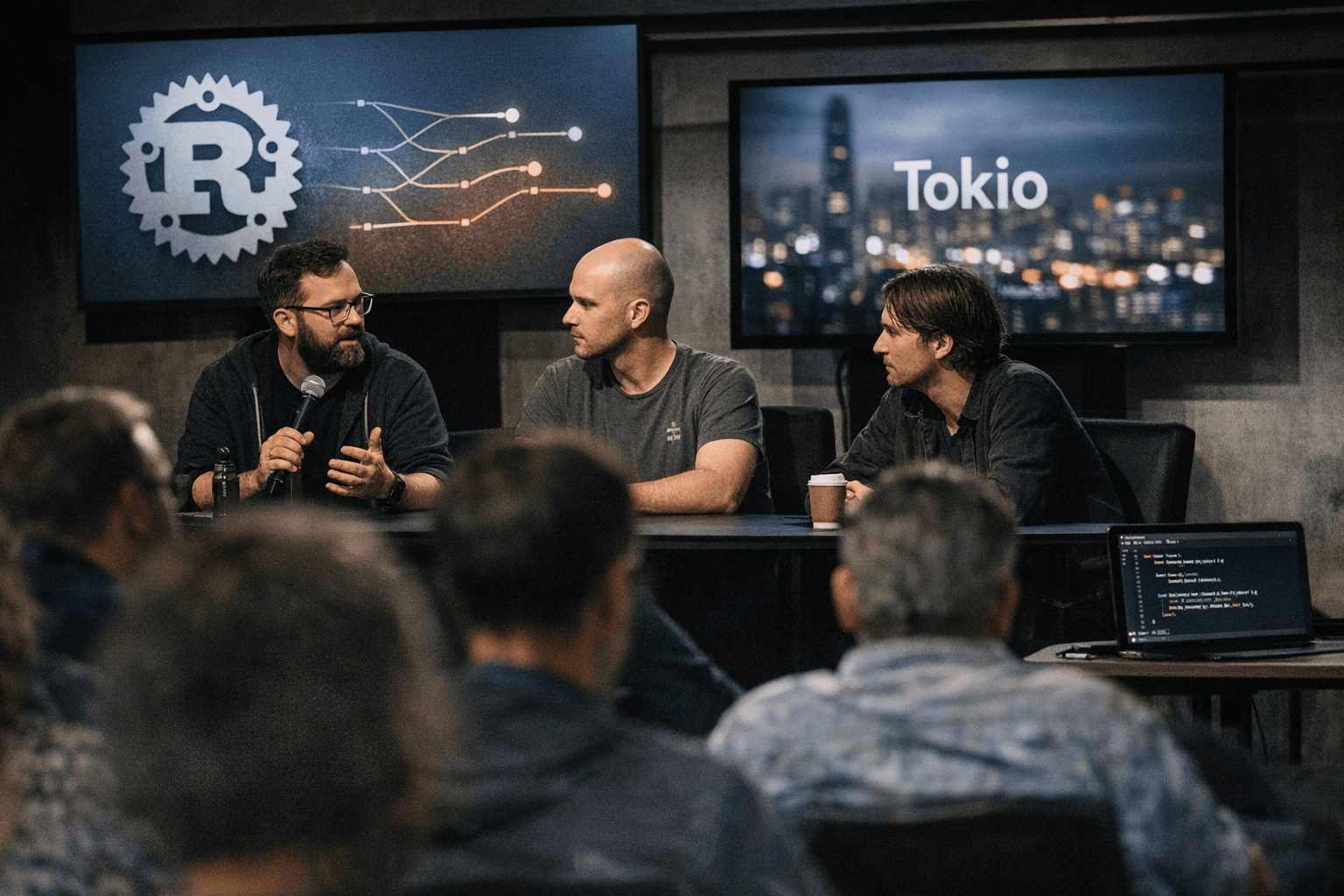
JetBrains’ Rust team published a long-form piece titled "The Evolution of Async Rust: From Tokio to High-level Applications" on February 17, 2026, offering a structured recap and analysis that follows a recorded panel the company hosted. The post frames the conversation around how async Rust practices have matured, using Tokio and the move toward application-level abstractions as the spine of the narrative.
The write-up is explicitly billed as both a report and a teaching piece for Rust developers, and the text reflects that dual purpose. JetBrains compiled the recorded panel/discussion into a narrative that highlights stepping stones in async design, positioning Tokio as the foundational runtime while tracing later patterns that lift concerns out of the runtime and into higher-level libraries and frameworks.
The recorded panel the company hosted is the primary source material for the piece. JetBrains’ Rust team used that session to assemble a long-form analysis rather than a short announcement, which means readers get more than headlines: they get sequence and context. The February 17 publication stitches together the panel’s remarks into a coherent chronology that emphasizes practical transitions developers face when moving from Tokio-centric code toward composable, higher-level application structures.
Practical takeaways in the JetBrains recap emphasize concrete evolution rather than abstract promises. The piece tracks changes in architecture and developer ergonomics as projects scale beyond single-service prototypes, showing why teams shift responsibilities from explicit Tokio task and reactor management to libraries that encapsulate common async patterns. Because the article grew out of a recorded discussion the company hosted, JetBrains’ Rust team was able to preserve the panel’s technical detail and use it to teach specific migration considerations.
For Rust developers focused on async systems, the Feb 17 long-form recap functions as both a reference and a map. JetBrains’ presentation of the recorded panel/discussion and the resulting analysis supplies a documented path from low-level Tokio concerns to higher-level application design, and it makes clear that the conversation is advancing inside an organized community effort led by the JetBrains Rust team. The piece closes by reinforcing the practical arc of the evolution and by laying out why this trajectory matters for teams writing async Rust today.
Know something we missed? Have a correction or additional information?
Submit a Tip