June skywatching peaks with Venus-Jupiter conjunction and Strawberry Moon
Venus and Jupiter open June with the month’s best naked-eye show, then the Strawberry Micro Full Moon closes it out. Mercury and the Arietids are the tougher bets.
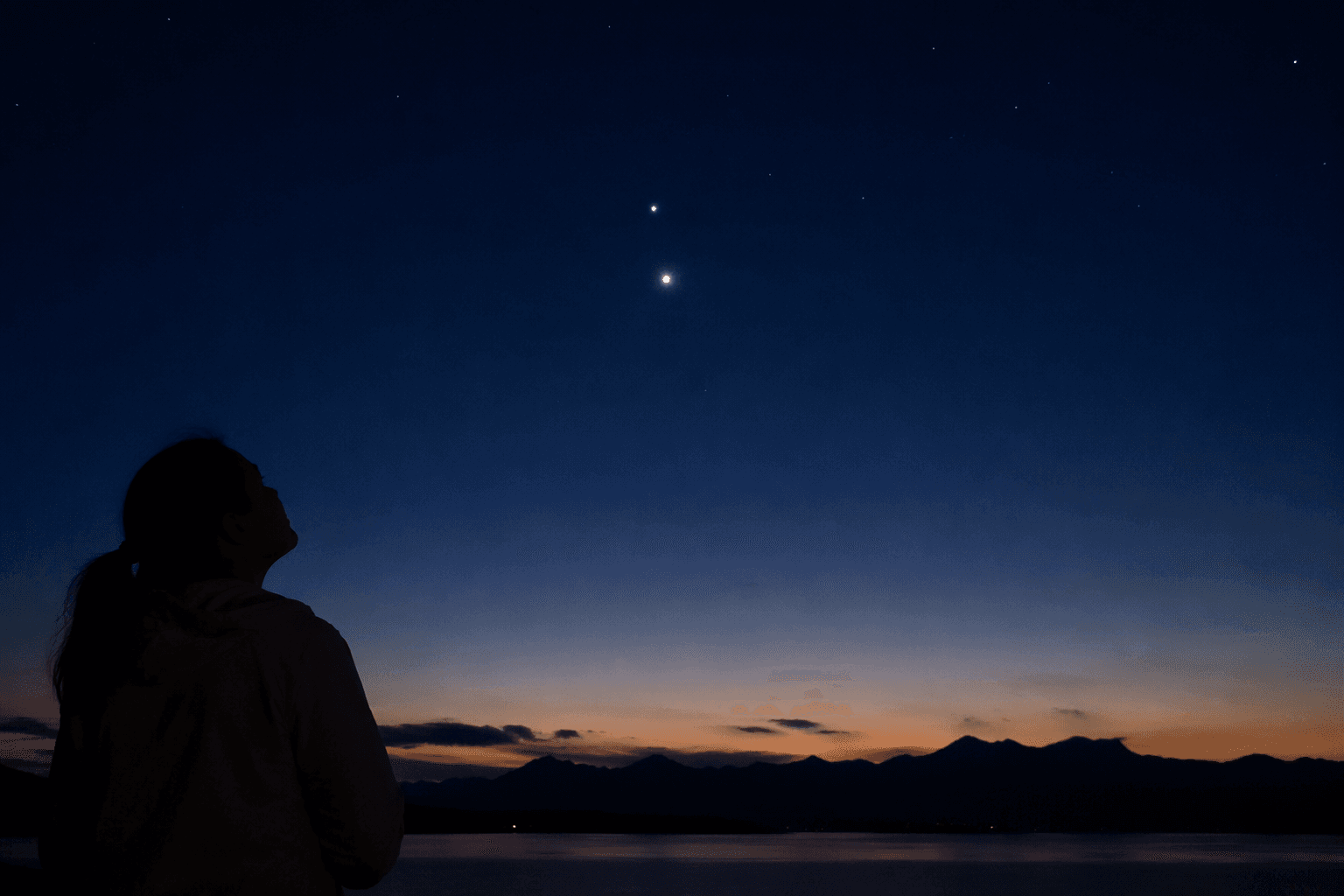
Venus and Jupiter deliver June’s cleanest naked-eye sky show, and the Strawberry Moon gives the month a bright finish. In between, Mercury joins the lineup, the moon darkens the sky for fainter stars, and the solstice shifts the Northern Hemisphere into astronomical summer.
The nights worth circling
- June 8-9: Venus and Jupiter are about 1.5 degrees apart, roughly three moon-widths
- June 11-15: Mercury joins Venus and Jupiter after sunset
- June 17: The Moon passes in front of Venus, with a close Moon-Venus pairing
- June 21: June solstice at 8:25 UTC, or 3:25 a.m. CDT
- June 29: Strawberry Micro Full Moon, peaking at 23:56 UTC
Venus and Jupiter are the month’s easiest win
If you go out for only one skywatching moment in June, make it the Venus-Jupiter conjunction on June 8 and 9. EarthSky says the two brightest planets visible from Earth will sit about 1.5 degrees apart, close enough to fit in the same binocular field and close enough to stand out clearly with the unaided eye. NASA lists June 9 as the conjunction date, and the pairing is one of the year’s notable celestial events.
This is the rare June sight that feels generous to casual observers. You do not need a telescope, and you do not need to know much about the sky to enjoy it. Binoculars will sharpen the view, but they are a bonus rather than a requirement, which makes this the most accessible event on the calendar.
Mercury joins the scene, but it is the tricky planet
The middle of the month adds Mercury to the same after-sunset grouping, from June 11 to June 15. That sounds dramatic on paper, and it is useful for experienced planet-watchers, but Mercury is the least forgiving of the three. It is the event most likely to disappoint if your horizon is hazy, if buildings block your view, or if you wait too long after sunset.
Treat Mercury as an extra, not the main attraction. If you catch it, the sight of three planets gathering after sunset is a real payoff. If you miss it, you have not missed June’s best show, because Venus and Jupiter already delivered that.
The Moon gives you two very different kinds of help
The June New Moon arrives as a Super New Moon on June 15, when the Moon is about 357,218 kilometers from Earth. You will not see the Moon itself that night, but the dark sky matters. Timeanddate says June is strong for planet spotters, and this is also the month’s best window for fainter star fields and deeper-sky views.

NASA says the Moon passes in front of Venus on June 17, and it also flags a close Moon-Venus pairing that day. That combination is one of the month’s prettiest naked-eye moments, especially if you enjoy watching bright objects gather and separate over successive nights. It is the sort of scene that rewards a quick check outside after sunset without requiring gear or perfect conditions.
The solstice changes the season, not the sky
June 21 brings the June solstice, which marks the start of astronomical summer in the Northern Hemisphere. EarthSky gives the exact moment as 8:25 UTC, which is 3:25 a.m. CDT. NASA says the month also brings the Summer Triangle and deep-sky treasures into better view as June goes on, so the solstice is less about a one-minute spectacle and more about the sky settling into its summer pattern.
For skywatchers, that shift matters. The later June nights carry the familiar feel of summer observing, with brighter seasonal stars and better opportunities to pick out wide-field patterns once the Moon is out of the way. If you are planning around natural light, the dark stretch around mid-month is the friendliest part of the calendar.
The month ends with the Strawberry Moon, not a super-sized one
The full Moon peaks at 23:56 UTC on June 29, and this year it is the Strawberry Moon. Timeanddate says it will be a Micro Full Moon, appearing about 6 to 7 percent smaller than average because it is near apogee, the farthest part of its orbit. That means the Moon will still look full and bright to the naked eye, but it will not have the exaggerated size that sometimes makes headlines.
Timeanddate also notes that the Moon appears full in the days before and after the peak, so June 28 and June 30 will still look plenty lunar. For families, commuters, and anyone who wants an easy evening sky check, this is the month’s simplest final show. It is bright, familiar, and forgiving, which is exactly what many people need from a summer night sky.
Do not overpromise yourself on the Arietids
EarthSky says the daytime Arietid meteor shower has a predicted peak around the mornings of June 10, but the viewing outlook is poor. A third-quarter Moon on June 8 and a waxing crescent near the peak will interfere, and the shower’s daytime nature makes it especially hard to catch. This is the June event most likely to disappoint without equipment, ideal timing, and a lot of luck.
That does not make it meaningless, but it does mean expectations matter. The sky rewards patience in June, but not every highlight is equally generous. Venus and Jupiter are the clear public-friendly spectacle, the Strawberry Moon is a reliable close, and the rest of the month asks for more effort than many casual observers will want to give.
This article was produced by Prism’s automated news system from verified source data, official records, and press releases, then run through automated quality and moderation checks before publishing. The system is built and supervised by the people who set the standards it runs under. Read our full AI policy.
Did this article answer your question?


