King Charles Hails Special US-UK Bond in Historic Congress Address
King Charles used Congress to cast the U.S.-UK alliance as indispensable, while Britain’s papers also tracked Starmer’s shrinking authority after a bruising welfare revolt.
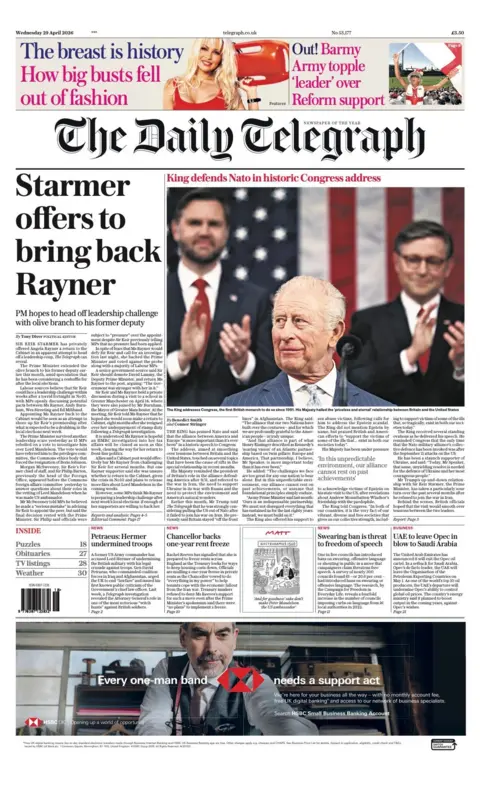
Britain’s front pages split cleanly between two versions of stability: a monarch selling continuity abroad and a prime minister fighting for it at home. King Charles III’s address to a joint meeting of the US Congress, and Sir Keir Starmer’s effort to steady Labour after a welfare rebellion, together defined the morning mood in London.
Charles spoke in Washington on April 28, 2026, during his first U.S. visit as monarch and the centrepiece of a four-day state visit that also included a White House meeting with President Donald Trump and a state dinner. It was only the second time a British monarch had addressed a joint meeting of Congress, after Queen Elizabeth II did so on May 16, 1991. The timing, in the 250th anniversary year of the Declaration of Independence, gave the speech added symbolism, with the King pressing the case that the United Kingdom and the United States remain bound by a relationship unlike any other.
The message was straightforward and deliberate. Charles described the alliance as “truly unique” and said the two nations’ destinies had been interlinked. Coverage of the address emphasized shared democratic values, international cooperation and a notably warm reception from lawmakers, with multiple standing ovations reported inside the chamber. In a year when allies are being asked to demonstrate reliability as much as rhetoric, the optics mattered almost as much as the words.
The historical comparison sharpened the scene. When Queen Elizabeth II addressed Congress in 1991, roughly 800 people attended and protesters outside the Capitol raised objections tied to Northern Ireland. That memory lingered in the background as Charles returned to the same institutional stage three and a half decades later, this time in a Washington climate shaped less by constitutional protest than by an effort to reaffirm democratic kinship in public.
On the domestic side of the split screen, Starmer’s problem was not ceremony but arithmetic. In 2025, 49 Labour MPs voted against his welfare bill after the government heavily watered down reforms that had originally been expected to save about £5bn. The rebellion cut the government’s working majority from 165 to 75 and was the largest in a prime minister’s first year since Tony Blair faced 47 Labour rebels in 1997 over lone-parent benefit changes. Starmer won the vote, but only after major concessions that exposed the limits of party discipline.
Taken together, the two stories explain why editors put royal diplomacy and Labour management side by side. One projected Britain’s identity abroad through the monarchy, the other tested the government’s authority at home. In both cases, the morning’s news was about whether institutions could still command loyalty without assuming it.
Know something we missed? Have a correction or additional information?
Submit a Tip