KPMG: Enterprises Rapidly Move Agentic AI to Production Amid Challenges
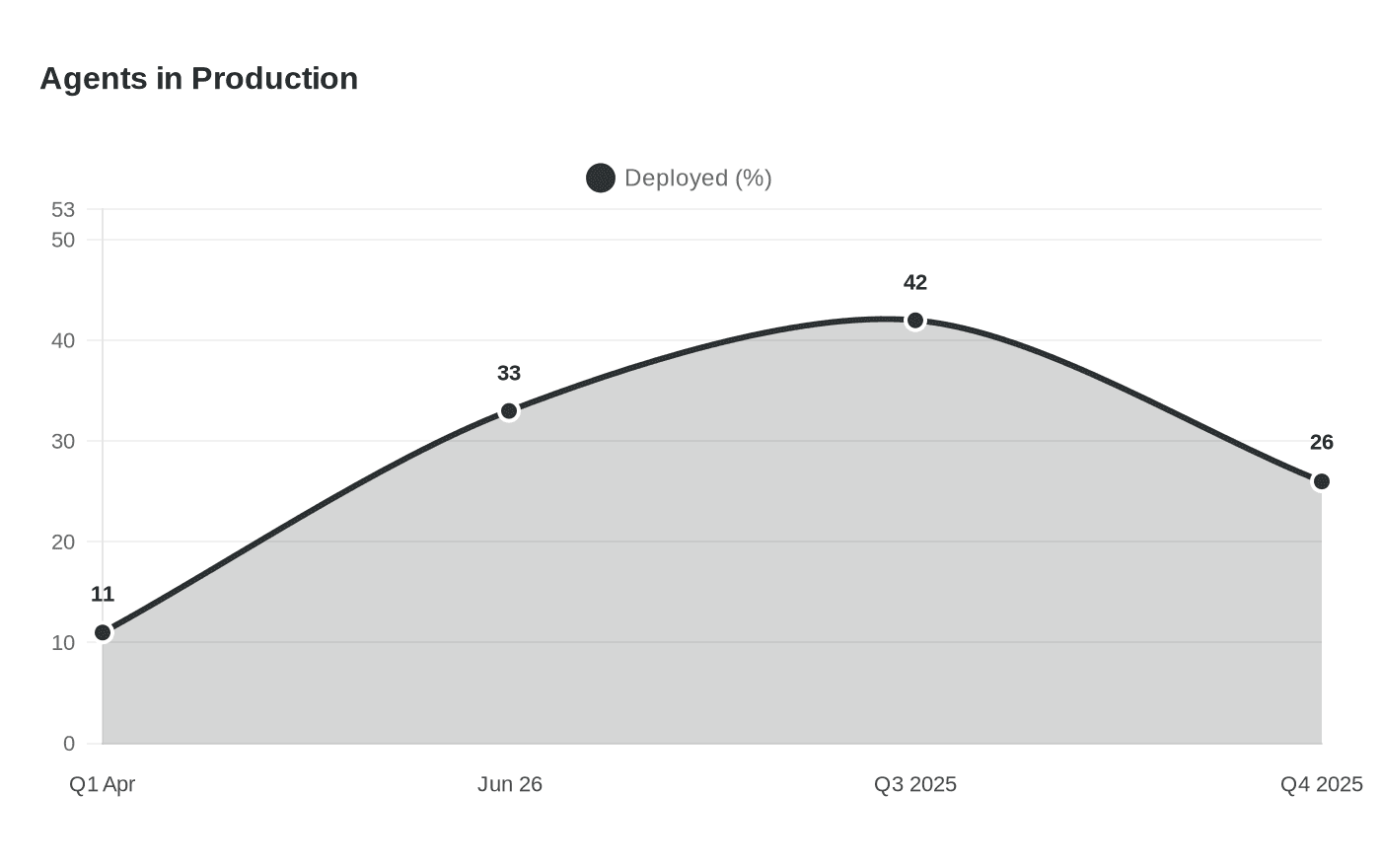
KPMG’s Quarterly AI Pulse shows large firms moving agents into production — KPMG reported 11% in production early 2025, 33% by June 26, 2025 and a later poll cited 42% in Q3 2025.

KPMG’s Quarterly AI Pulse captures a rapid shift: large enterprises that were largely experimenting with agentic AI this spring are increasingly running agents in production. KPMG’s April 2025 Q1 pulse put production at 11 percent while reporting 65 percent of firms piloting agents, and a June 26, 2025 KPMG release said 33 percent of organizations had deployed at least some agents — roughly three times the earlier 11 percent — with a later Q3 poll reported at 42 percent.
That movement varies by quarter and sample. KPMG’s Q1 April 2025 slides show pilots surged from 37 percent the prior quarter to 65 percent, and that 99 percent of surveyed organizations planned to put agents into production. A separate Q4 summary noted agent deployment more than doubled year over year to 26 percent in Q4 2025 from 11 percent in Q1 2025, underscoring that different Pulse editions capture different slices of a fast-moving market.
Enterprises are explicit about use cases and objectives. KPMG’s Q1 data shows 78 percent of respondents plan to use agents to analyze complex data sets and 66 percent plan to employ agents for routine administrative tasks, while KPMG-compiled findings report 46 percent of leaders are prioritizing efficiency and revenue growth in their agent strategies. KPMG’s June 26, 2025 text also records that 82 percent of leaders expect their industry’s competitive landscape to look different within 24 months.
Those ambitions collide with technical and governance hurdles. KPMG’s Q3 polling indicated complexity as a top obstacle, jumping from 39 percent to 71 percent as organizations confront the intricacies of scaling agentic systems. Concerns about data privacy, regulatory issues and data quality hit their highest level in three quarters, and KPMG warned of widespread “agent washing” as vendors rebrand chatbots, RPA and assistants without true agentic capability.
Analysts and clients are tempering hype with caution. Anushree Verma, senior director analyst at Gartner, said, “Most agentic AI projects right now are early stage experiments or proof of concepts that are mostly driven by hype and are often misapplied. This can blind organizations to the real cost and complexity of deploying AI agents at scale. They need to cut through the hype to make careful, strategic decisions about where and how they apply this emerging technology.”
Workforce and operating-model friction persists. KPMG’s Q1 pulse recorded 45 percent of respondents reporting employee resistance to change, and KPMG materials recommend codifying subject-matter experts’ tacit knowledge and establishing robust change-management programs so agents augment rather than displace human teams. Major enterprise vendors such as Microsoft, Salesforce, Oracle, SAP and Workday have launched agent offerings, and KPMG and Deloitte are among professional services firms packaging agentic solutions for clients.
KPMG’s vice chair of AI and digital innovation, Steve Chase, framed the moment bluntly: “The data shows just how quickly AI agents are moving out of pilots and into production — and that momentum will only accelerate. What makes this moment unique is that leaders increasingly see agents not just as a way to cut costs, but as a way to rethink growth and create new value. But we’ve seen firsthand, both in our own journey and with clients, how transformation at this pace puts real pressure on the foundations of AI: trust, governance, data, leadership alignment, and workforce readiness. The organizations that invested early in these areas are now scaling with confidence and positioning themselves to lead in this next phase.” As KPMG and its clients push agents into business-critical roles, the firm signals that orchestration, governance and people practices will determine who leads the next wave.
Know something we missed? Have a correction or additional information?
Submit a Tip