Lane County backs Crossing the Bridge monument honoring Ferry Street Village families
Lane County supports a bronze monument, Crossing the Bridge, honoring Ferry Street Village's five founding Black families and restoring erased local history in Alton Baker Park.

A bronze sculpture honoring the families displaced from Ferry Street Village will be installed in Alton Baker Park to recognize an erased chapter of Eugene and Lane County history. The Eugene Black Cultural Initiative is leading the project with backing from the City of Eugene and Lane County to put a public memorial on the land where the neighborhood once stood.
Ferry Street Village was Eugene’s first Black settlement and was home to Black families in the 1940s. Lane County ordered evictions in 1948 and bulldozed the community on Aug. 24, 1949, destroying every structure within a year — “even those outside the approved demolition zone.” Many families left Oregon after the demolition, and some who stayed were forced into areas such as West 11th with limited services. Residents at times had no running water or toilets and faced taunts and threats; as Ron Stockman put it, “If you were black, you better not let the sunset and you be in those towns, or else you might not make it out of there.”
The monument, titled Crossing the Bridge, will depict a husband and wife, two children and an infant and is meant to honor the five founding Black families: the Reynolds, the Johnsons, the Washingtons, the Nettles and the Mims (Mimms appears as a variant in records). Talacia/Talicia Brown-Crowell, founder and executive director of the Eugene Black Cultural Initiative, said, “The families are the Reynolds, the Johnsons, the Washingtons, the Nettles, and the Mimms, so the monument is in honor of their families.” Brown-Crowell has tied the work to broader patterns of displacement, saying, “And also how eminent domain has impacted Black and brown families across the country,” and noting that forced moves erased a continuous Black neighborhood in Lane County: “Which is why there’s currently no Black neighborhood in Lane County.”
Design input came from relatives of the five families. Ms. Lyllye Reynolds-Parker wanted a mother who had a baby in her arms, and Mr. Mims wanted a joyful little boy. Organizers say the finished statue will be cast in bronze and that smaller versions will be given to families. EBCI has said the finished bronze will be installed “in September” at a special celebration, though organizers have not specified a year; a descendant, William (Billy) Delrio Johnson Jr., came to see the monument on Feb. 13, 2026, and urged a message of resilience: “I like to take a more positive stand on it, to show through their perseverance, love conquers hate.”
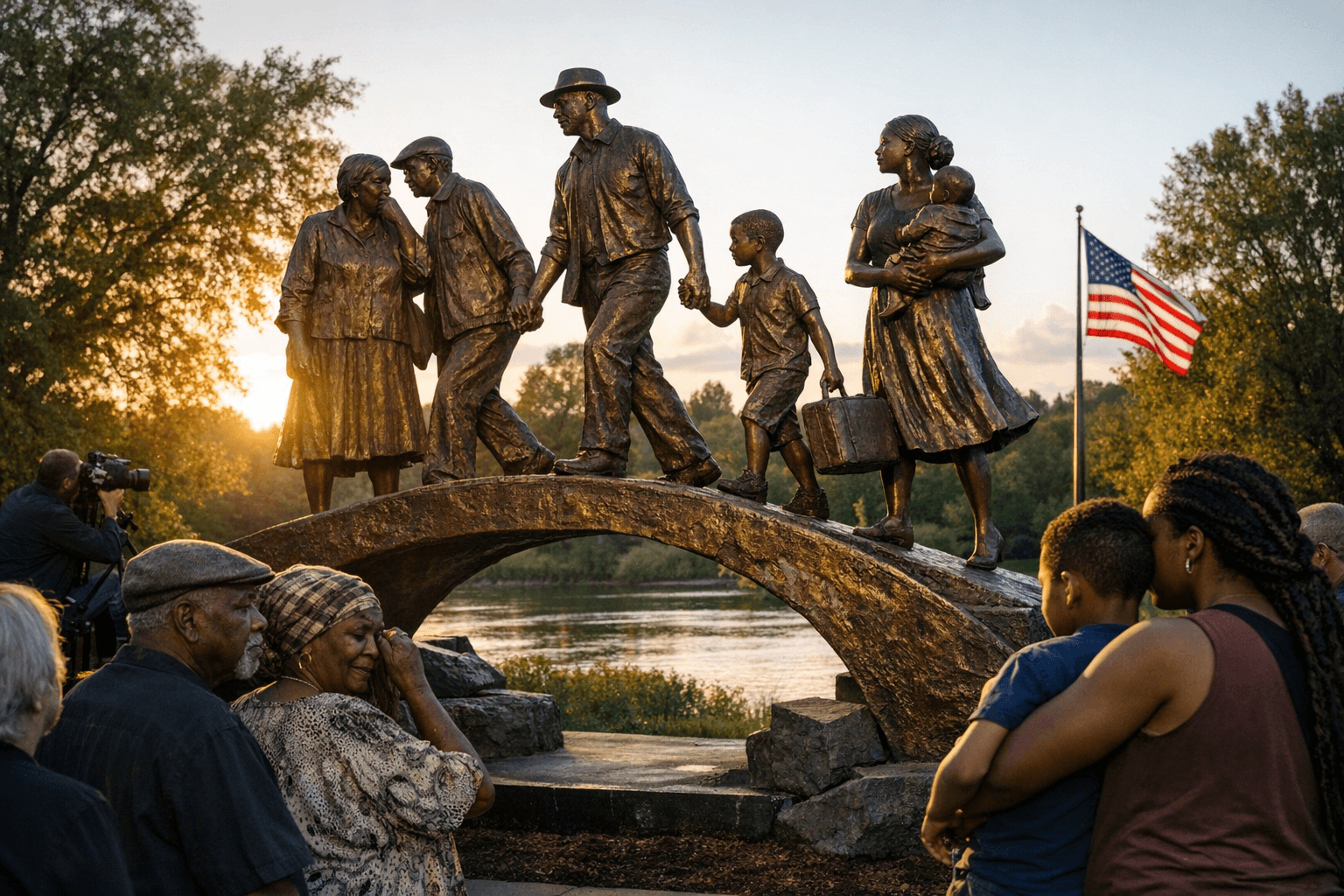
Community reaction at Alton Baker Park has been largely supportive. Karysa Peacock said the monument will help the community grow together: “We’re working to be one community and not just individuals that are living their lives but people that understand and love each other in the community.” Brenda Thompson called the recognition “not a giant leap but a leap forward, moving forward,” while Benita Johnson questioned the humanity of past relocation decisions: “How would you take someone where it was already inhumane... and move them somewhere worse and not try to help.”
The project follows a 2024 75th-anniversary commemoration at which Lane County apologized for the displacement and called for learning the role of people of color in local history. Residents can expect the sculpture to greet visitors near the picnic shelters in Alton Baker Park when installed; organizers say they want the work finished soon so survivors and descendants can see it. Remaining details to be confirmed include the sculptor, funding and final installation timeline.
Know something we missed? Have a correction or additional information?
Submit a Tip