LANL Advances Machine Learning NQR Detection of Fentanyl Through Sealed Packages
Los Alamos National Laboratory says a prototype handheld NQR scanner, aided by neural networks, produced the first NQR reading for a fentanyl analog in March 2024 through sealed packaging.
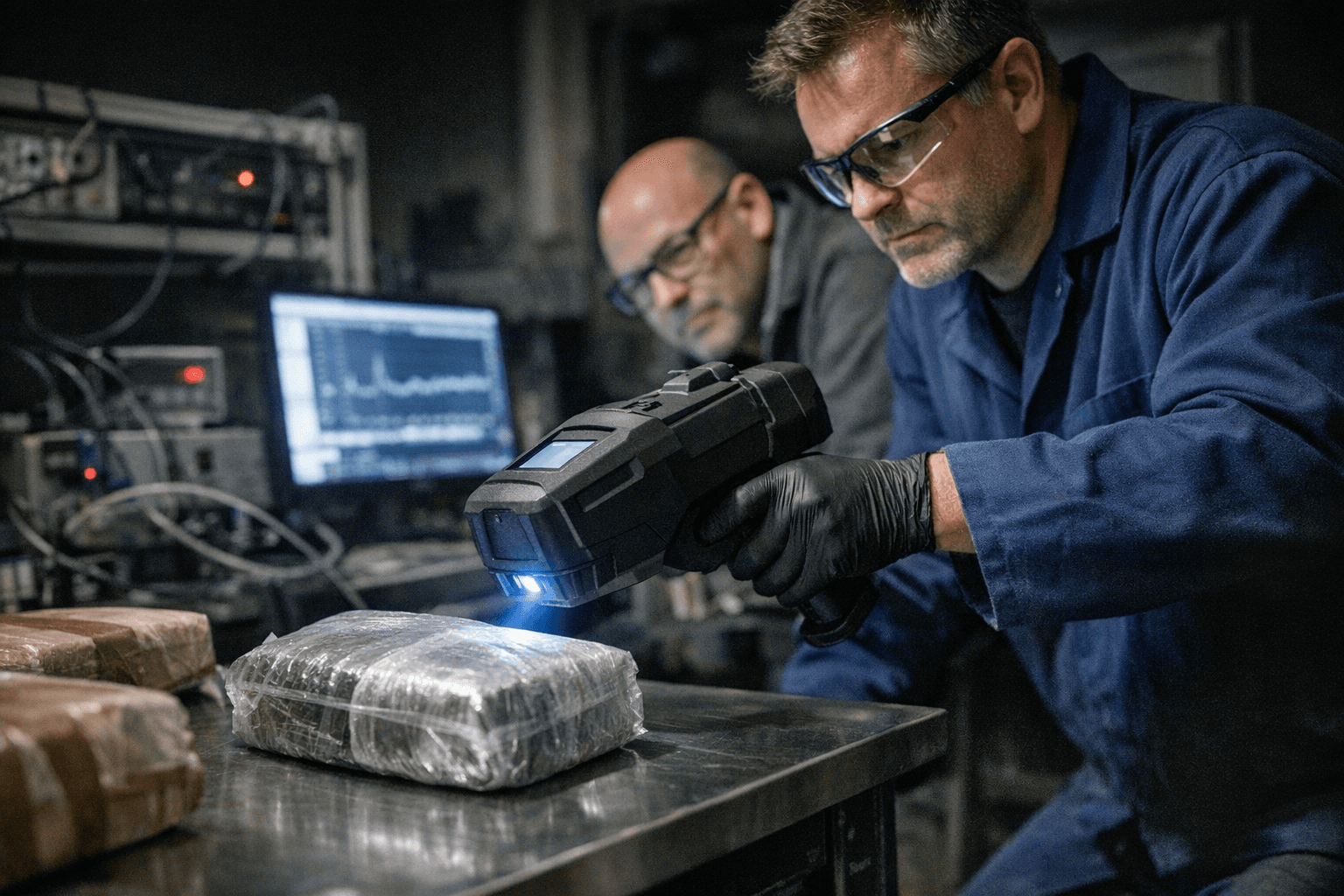
Los Alamos National Laboratory researchers in Los Alamos County announced in a late February 2026 STE‑Highlights newsletter that their project combining machine learning with nuclear quadrupole resonance achieved a March 2024 milestone: the first NQR reading for any fentanyl analog, recorded on fentanyl HCl. The LANL‑led work appears as LANL report LA‑UR‑26‑21283 and is published in the journal Data Science in Science.
NQR detection at LANL is being repurposed from explosive detection to look for the nitrogen‑14 chemical core present in fentanyl analogs. The laboratory explains the excitation coil produces a pulsed alternating current magnetic field that drives the nitrogen system out of thermal equilibrium, and after the pulse the nitrogen nuclei emit a much smaller AC magnetic field that the detector coil observes. LANL wrote that “modern machine‑learning methods can clean up NQR signals far better than traditional techniques,” and the team says neural networks designed for complex NQR signals “significantly improved the reliability of fentanyl detection, even under difficult conditions.”
The prototype system described in LANL summary materials consists of a handheld unit about the size of a clothes iron connected to a laptop carried in a backpack along with two digital‑analog converters. Illustrations show excitation and detection coils co‑located in the handheld unit, with the detector coil signal quantified by laptop software and the result shown as either a red light, meaning fentanyl was detected, or a green light, meaning it was not. LANL lists intended capabilities as room temperature operation, penetration of cardboard, plastic, glass and metallic foils, and a target decision time of under a minute.
LANL framed the March 2024 reading as a proof of concept but cautioned further work is needed: “The successful NQR reading was a big deal because it proved that an NQR‑based fentanyl detector is possible, and it also filled a gap in the scientific understanding of these compounds.” The laboratory also said “Now that the scientists have proven that their system works, it’s essentially back to the drawing board to examine different analogs, establish limitations, and determine efficacy.” LANL identified funding from the Laboratory Directed Research and Development program.
Other national labs and research teams are pursuing different sensor plus machine‑learning routes. Lawrence Livermore National Laboratory reported a model that can distinguish opioids from other chemicals with accuracy over 95% in laboratory settings and noted the work used 650 samples. LLNL computational mathematician Colin Ponce said, “When law enforcement finds a new clandestine drug operation, those labs often produce never‑before‑seen fentanyl derivatives. We can't just go check a database, and we can't just go back to who made it and ask how they did it,” and “And law enforcement needs to identify the samples they find quickly because there's going to be another sample tomorrow. I think that's a little bit of a unique situation.” LLNL scientist Kourosh Arasteh added, “When a model like this eventually gets into the hands of a user, the output has to be interpretable and trustworthy,” and “We explored machine‑learning methods ranging from simple regression and random forests to more complex neural network approaches to balance interpretability with performance.” The LLNL material also explains that “The random forest approach runs through a collection of decision trees. Each tree asks a series of questions about the data and, based on each answer, lands on a prediction: opioid or not. Together, they vote on the final classification.”
Johns Hopkins University Applied Physics Laboratory has published separate results using gas chromatography–mass spectrometry and Raman spectroscopy with machine learning. JHU/APL reported 99% correct identification of fentanyl analogs for GC‑MS in Forensic Chemistry in March 2022 and 85–90% success with Raman in an October 2022 SSRN preprint, with false‑positive rates of 2% or less. Koshute of JHU/APL said, “Given the fentanyl analogs that we are aware of, and their chemical structures, we’ve found that we can identify novel fentanyl analogs with an encouraging degree of accuracy.”
For Los Alamos County and wider law enforcement, the LANL prototype suggests a new instrument could one day screen sealed packages for “many different forms of fentanyl.” But LANL has not released numeric sensitivity, specificity or false‑positive rates for its ML‑enhanced NQR method, and the lab says it must test different analogs to “establish limitations, and determine efficacy.” Intended users listed in the research materials include government sponsors and law enforcement, leaving operational, regulatory and field‑trial questions unresolved even as the clothes‑iron sized scanner moves from proof of concept toward further testing.
Know something we missed? Have a correction or additional information?
Submit a Tip