Late night hosts mock Trump's billionaire business trip to Beijing
Stephen Colbert called it Trump’s “fabulous billionaire boys trip” as 17 CEOs, including Tim Cook and Elon Musk, landed in Beijing with him.
Stephen Colbert turned President Trump’s Beijing arrival into a punch line, calling it Trump’s “fabulous billionaire boys trip” as the president touched down with 17 chief executives, including Tim Cook and Elon Musk. The joke landed because the image was so unusual: a U.S. president traveling into a high-stakes summit with a corporate entourage as large as a cabinet photo-op.
Trump arrived in Beijing on Wednesday for a two-day summit with Xi Jinping scheduled for May 14 and 15, 2026, with the White House saying the agenda spanned trade, artificial intelligence, geopolitics, tariffs, rare earths, Taiwan and the Iran war. The trip put the spotlight on the intersection of presidential diplomacy and corporate access, especially at a moment when Washington and Beijing were still locked in broader economic and strategic tension.
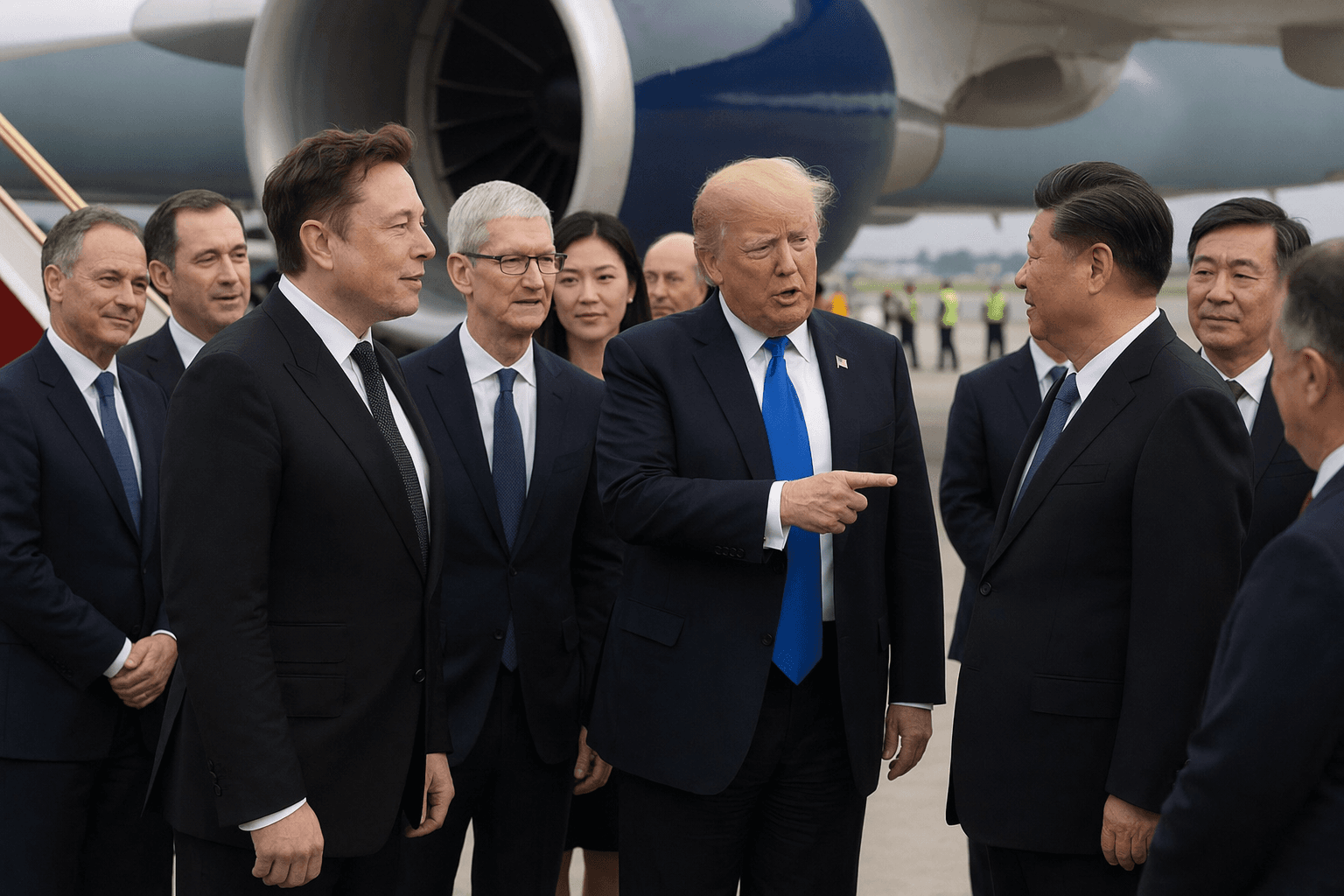
Reuters reported that the U.S. business delegation was made up largely of companies trying to solve longstanding issues with China, and that more than a dozen CEOs and top executives from firms including Tesla, BlackRock, Illumina, Mastercard and Visa were traveling with Trump. CNBC said the White House invited executives including Elon Musk, Apple’s Tim Cook, BlackRock’s Larry Fink, Boeing’s Kelly Ortberg, GE Aerospace’s Larry Culp, Cisco’s Chuck Robbins, Micron’s Sanjay Mehrota, Mastercard’s Michael Miebach, Qualcomm’s Cristiano Amon and Visa’s Ryan McInerney.
That roster matters because it suggests the summit was not just a diplomatic meeting, but a market-access negotiation with direct consequences for some of the world’s most valuable companies. China remains the world’s second-largest economy, and the delegation reflected the pressure many U.S. firms face when sales, supply chains and regulatory approvals depend on Beijing’s decisions.
The optics also fed a familiar political critique. To Trump’s critics, the trip reinforced a pay-to-play narrative in which corporate leaders gain proximity to power while the president uses business relationships as a showcase of influence. To supporters, the business presence signaled that the White House was bringing commercial firepower to negotiations that could affect tariffs, semiconductor supply, rare earths and broader U.S.-China trade terms.
Late-night hosts seized on that tension because it distilled the larger story in one image: a president on a Beijing-bound mission with billionaire allies at his side. The summit’s policy stakes were substantial, but the traveling party ensured that the first public reaction was not about protocol. It was about who gets a seat on the plane, and what that seat buys.
This article was produced by Prism’s automated news system from verified source data, official records, and press releases, then run through automated quality and moderation checks before publishing. The system is built and supervised by the people who set the standards it runs under. Read our full AI policy.
Did this article answer your question?