LLNL crossed-beam CBET enables single-shot, billion-fold stronger ICF plasma diagnostics
LLNL demonstrated a crossed-beam CBET diagnostic that yields signals ~10^9 times stronger than Thomson scattering, enabling single-shot, non-perturbative ICF plasma measurements.

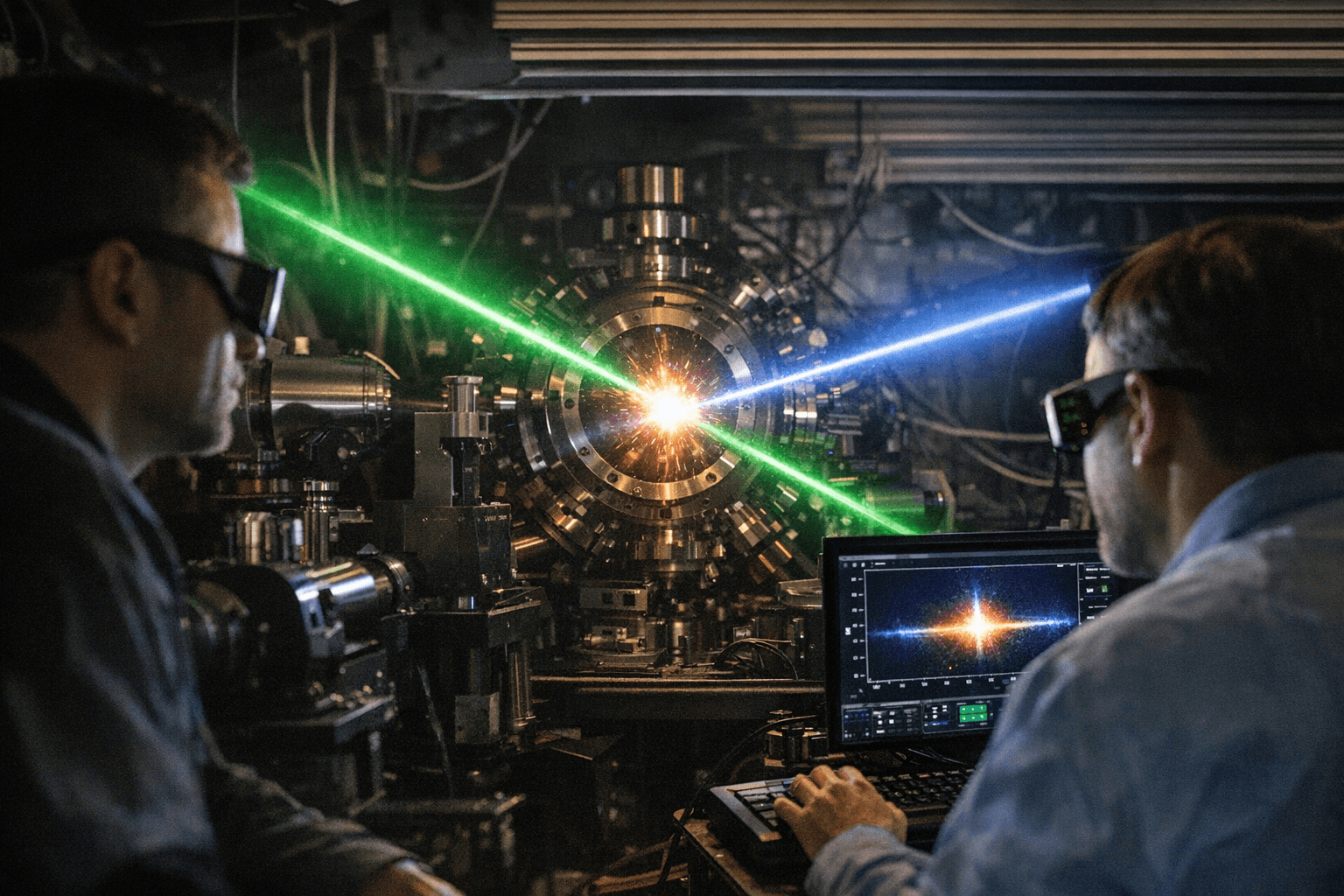
Lawrence Livermore National Laboratory researchers have demonstrated a crossed-beam measurement technique that amplifies diagnostic signals by roughly a billion-fold compared with conventional Thomson scattering, opening single-shot access to density, temperature and flow in inertial confinement fusion plasmas. The advance uses a monochromatic pump beam intersecting a broadband probe so that crossed-beam energy transfer - CBET - mediated by ion-acoustic waves imprints plasma conditions directly onto the probe spectrum.
The method converts weak scattered light information into a much stronger spectral signature on the transmitted probe, reducing the probe intensity needed to obtain clean data and avoiding perturbation of the target by overly bright diagnostic beams. That makes it practical to measure conditions in high-energy-density regions and beam-crossing zones that were previously difficult or impossible to probe without altering the experiment itself. The technique delivers single-shot measurements of electron density, electron and ion temperature, and bulk flow velocity in the laser-crossing region.
Laboratory experiments have demonstrated the proof of principle, and the work is described in a recent Physical Review Letters paper and related LLNL coverage. The crossed-beam approach leverages ion-acoustic wave coupling so that the broadband probe carries a direct spectral imprint of plasma parameters after traversing the interaction volume. Compared with standard collective Thomson scattering, the signal enhancement of about 10^9 vastly improves signal-to-noise and slashes integration time requirements.
Practical value for the HED and ICF community is immediate. Facilities such as the National Ignition Facility have long wrestled with blind spots where multiple laser beams cross and exchange energy, affecting implosion symmetry and drive balance. This CBET-enabled diagnostic provides a tool to map that laser-laser energy exchange in situ and validate the models used to tune implosions. Reduced probe intensity also lowers the risk of introducing measurement-driven artifacts in sensitive experiments.
Adoption will require engineering the monochromatic pump and broadband probe geometry into existing beamlines, calibrating spectral response against known plasma conditions, and demonstrating robustness under the full range of ICF shot conditions. If those steps succeed, researchers will gain a repeatable, non-perturbative means to collect single-shot datasets that previously demanded many repeats or were out of reach.
For experimentalists and modelers, the immediate payoff is clearer, shot-resolved data on beam-crossing physics and implosion asymmetries. For the wider community, the technique promises faster turnaround on high-value experiments and tighter constraints on simulations, helping to close the gap between design and performance in HED and ICF campaigns.
Know something we missed? Have a correction or additional information?
Submit a Tip