Louisiana approves new congressional map after Supreme Court ruling
Louisiana’s new map strips Black voters of a second majority-Black district, giving Republicans a 5-1 edge after a 66-35 House vote.
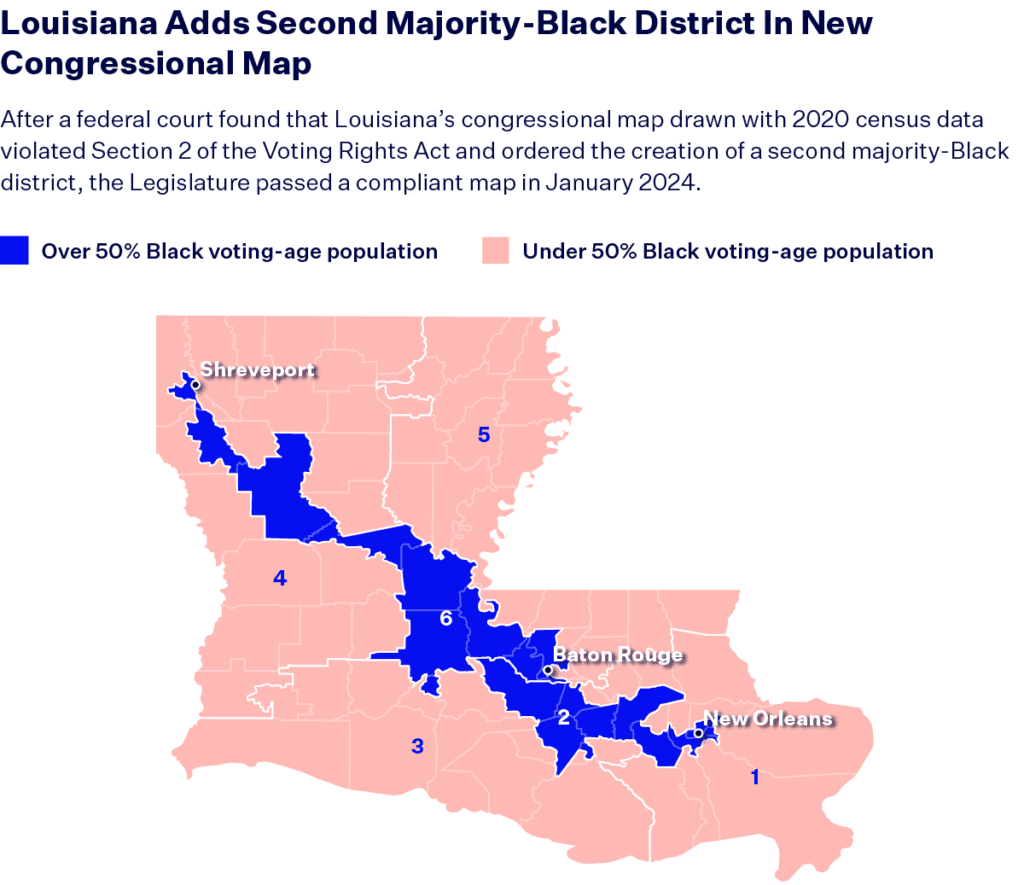
Louisiana’s new congressional map would leave Black voters with just one majority-Black district in a state where they make up roughly one-third of the population, a dramatic shift that hands Republicans a 5-1 advantage in the state’s six-member delegation.
The Louisiana House approved the plan on May 28 by a 66-35 vote after more than seven hours of debate, clearing the way for the Legislature to finish redistricting before the June 1 end of session. The Senate had already advanced the map earlier in May, putting lawmakers on a fast track to redraw district lines after the U.S. Supreme Court’s April 29 decision in Louisiana v. Callais.
In that 6-3 ruling, the justices struck down Louisiana’s previous congressional map as an unconstitutional racial gerrymander and left in place a lower-court order barring the state from using it in future elections. The challenged map had created a second majority-Black district after lawmakers adopted it in 2024 to respond to a Section 2 Voting Rights Act lawsuit and a federal judge’s finding that the earlier lines likely diluted Black voting strength.

The new plan eliminates the majority-Black District 6 currently represented by Cleo Fields and preserves Troy Carter’s New Orleans-based District 2 as the state’s only Democratic-leaning seat. Under the proposed lines, Carter’s district would stretch from New Orleans along the Mississippi River and absorb majority-Black neighborhoods in East Baton Rouge Parish, raising the possibility of a member-versus-member primary between Carter and Fields depending on the final court posture and election calendar.
Democratic lawmakers pushed an alternative map that would have preserved the 4-2 split, but Republicans prevailed with the 5-1 configuration as part of a broader redistricting scramble across the South. The ruling has intensified fears that Voting Rights Act protections could weaken further, encouraging Republican-led states to revisit district lines and revisit how many majority-minority districts remain on the map.
This article was produced by Prism’s automated news system from verified source data, official records, and press releases, then run through automated quality and moderation checks before publishing. The system is built and supervised by the people who set the standards it runs under. Read our full AI policy.
Did this article answer your question?

