Lucid Recalls 4,476 Gravity SUVs After Seat Supplier Defect Hurt Q1 Sales
A seat supplier's unauthorized weld change grounded Lucid Gravity deliveries for 29 days, triggering a 4,476-vehicle recall and a 42% quarterly sales drop.

A single unapproved weld change at seat supplier Camaco Automotive halted Lucid Gravity deliveries for 29 consecutive days during the first quarter of 2026, triggering a recall of 4,476 vehicles and contributing to a 42% quarterly sales collapse that erased much of the momentum the Newark, California-based automaker built throughout 2025.
Lucid Group (NASDAQ: LCID) disclosed that it delivered just 3,093 vehicles in Q1 2026, down sharply from Q4 2025 and roughly 0.5% below the same period a year earlier, despite producing 5,500 vehicles during the quarter. The gap between production and deliveries is the clearest evidence of the problem's impact: Lucid was building cars it could not legally ship.
The cause traces directly to a quality failure that Lucid did not initiate. Camaco Automotive, the supplier responsible for second-row seat assemblies on the Gravity SUV, altered its manufacturing process without notifying Lucid or obtaining its approval. The unauthorized change produced outboard lap belt anchor bracket welds that were shorter than required and incorrectly positioned, leaving affected vehicles non-compliant with Federal Motor Vehicle Safety Standards 207 (Seating Systems) and 210 (Seat Belt Assembly Anchorages). Lucid discovered the defect in January 2026 during an internal combined test on the second-row seats conducted for an unrelated reason, when one bracket failed to hold the required load for the required time.
Lucid filed a formal recall with the National Highway Traffic Safety Administration covering 2025 and 2026 model year Gravity SUVs produced between December 2, 2024, and February 3, 2026, at its Casa Grande, Arizona manufacturing plant. The NHTSA estimates that approximately 97% of the 4,476 recalled vehicles, roughly 4,342 units, actually contain the weld defect. Camaco has since reverted to the original design specification, and vehicles produced after February 14, 2026, are not subject to the recall.
The episode illustrates a structural vulnerability in low-volume EV manufacturing: a single-source supplier deviation affecting one sub-component of one seat row was sufficient to freeze deliveries for nearly a month. Lucid has not publicly disclosed whether it intends to add a second seat supplier for the Gravity or redesign the component to reduce dependency risk, questions likely to surface on the company's May 5 earnings call. That call will also provide the first detailed look at cash burn for the quarter, a critical figure for a company that produced just 17,840 vehicles across all of 2025.
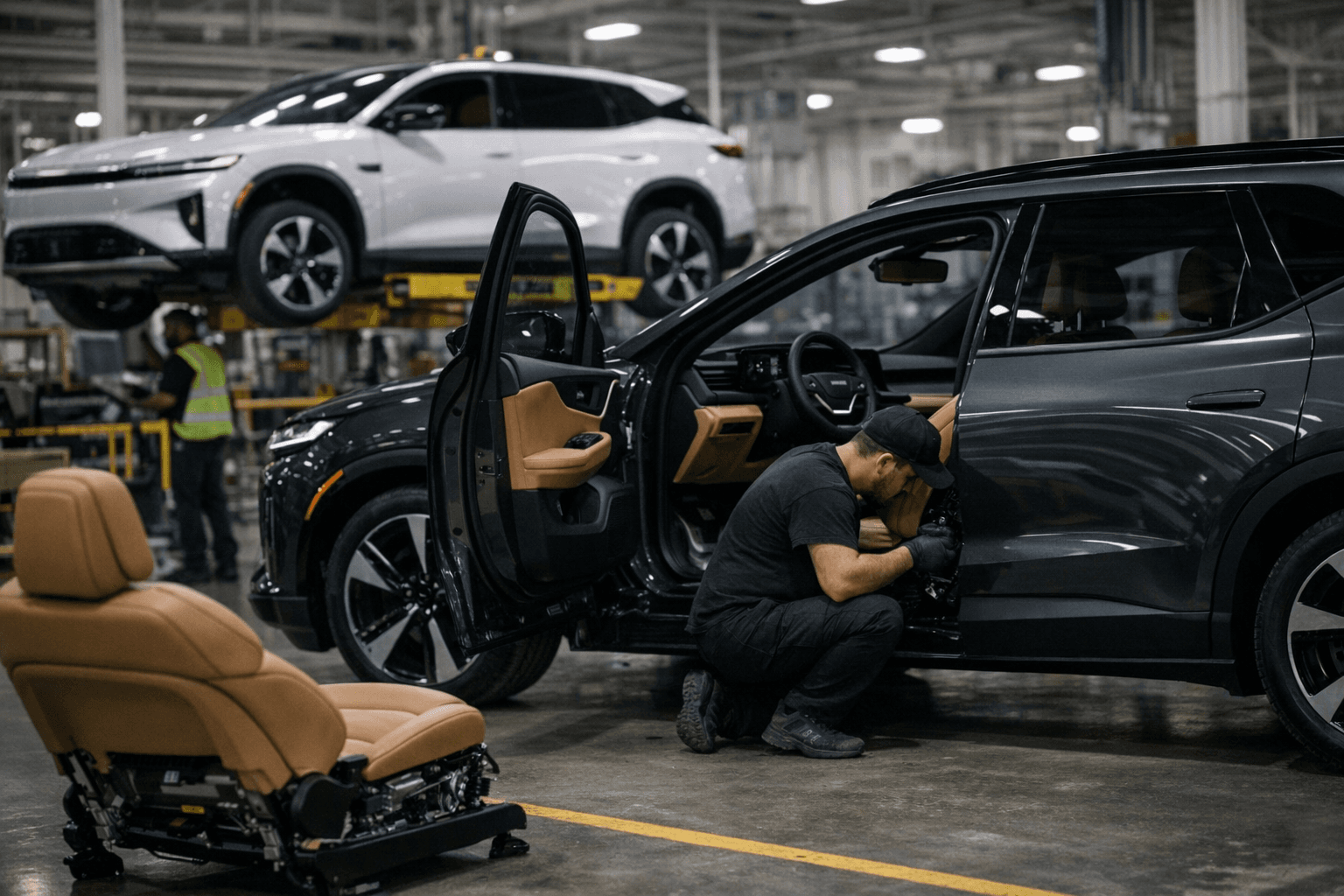
The Gravity, which carries up to 450 miles of EPA-rated range and was named the 2026 World Luxury Car of the Year by the World Car Awards on April 1, chosen by more than 100 automotive journalists, remains central to Lucid's growth ambitions. The company reaffirmed its full-year 2026 production guidance of 25,000 to 27,000 vehicles, but reaching even the low end of that range requires averaging roughly 7,300 deliveries per quarter for the next three quarters. That task falls to Interim CEO Marc Winterhoff, who has led the company since founder Peter Rawlinson stepped down on February 25, 2025, and transitioned to the role of Strategic Technical Advisor to the Chairman. A permanent CEO search is ongoing.
The seat defect is not the first quality issue tied to the Gravity's interior. Earlier in 2025, Lucid recalled 66 Gravity SUVs after mislabeled seat backrest covers, left covers marked as right and vice versa, were found capable of interfering with airbag deployment.
Beyond the supplier problem, Lucid is contending with elevated tariffs on auto parts imports, chip shortages, uncertain rare earth material supplies, and the downstream effects of a fire at an aluminum supplier in September 2025. Lucid's shares were trading at approximately $9.96 at the time of the Q1 announcement, well below the stock's 200-day moving average of $16.58 and far beneath its 52-week high of $33.70.
This article was produced by Prism’s automated news system from verified source data, official records, and press releases, then run through automated quality and moderation checks before publishing. The system is built and supervised by the people who set the standards it runs under. Read our full AI policy.
Did this article answer your question?

