Machine learning identifies Raman fingerprint tied to liquid‑like ion flow
AI for Science paper finds a low-frequency Raman signature linked to liquid-like ionic motion, a spectroscopic marker that could speed screening of solid-state battery materials.
Researchers published a study on March 7, 2026 in the journal AI for Science that used a machine-learning-accelerated workflow to identify a distinct low-frequency Raman spectral signature tied to liquid-like ionic motion in crystalline solid electrolytes. The paper argues the signature correlates with superionic behavior and offers a practical spectroscopic marker to accelerate discovery of fast-ion conductors for solid-state batteries.
The team combined ML force fields with tensorial ML models to simulate Raman spectra, producing what the authors describe as an ML-accelerated Raman pipeline that bridges atomistic simulations and experimental observables. The method was validated on several sodium-ion conductors, where materials exhibiting strong low-frequency Raman features also showed high ionic diffusivity and dynamic relaxation of the host lattice. In contrast, materials whose ions move primarily by hopping between fixed positions did not display the same spectral signature.
The authors state that "strong low-frequency Raman intensity can serve as a clear spectroscopic marker of liquid-like ion conduction." They further frame the finding as generalizable, writing that their work helps in "generalizing the breakdown of Raman selection rules beyond canonical superionic systems" and in establishing "a unifying framework for interpreting diffusive Raman scattering across diverse material classes." Bioengineer.org framed the mechanistic interpretation this way: "As mobile ions journey through the crystal lattice, their motion disrupts local symmetry patterns, leading to a relaxation of traditional Raman selection rules. This dynamical symmetry breaking manifests as pronounced low-frequency Raman scattering peaks, serving as direct, spectroscopic hallmarks of rapid ionic diffusion."
The methodological advance responds to a known computational bottleneck. Conventional atomistic simulations that aim to predict liquid-like ion motion demand heavy computing resources and are impractical for screening large numbers of candidate materials. By accelerating simulations with machine learning, the new pipeline aims to make high-throughput, spectroscopy-linked screening feasible for materials scientists and battery engineers seeking viable solid electrolytes.

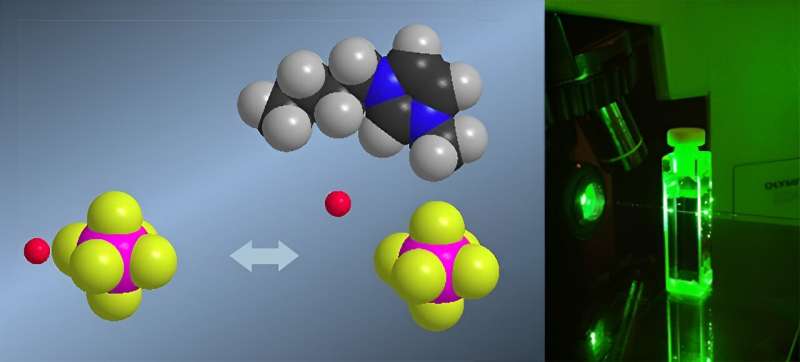
The paper stops short of publishing numeric conductivities, spectral peak positions, model architectures, or the identities of specific sodium compounds in the excerpts provided with the press materials. The journal release and accompanying coverage do not state whether the ML force fields, tensorial models, training datasets, or code are publicly available. An image accompanying the release, credited to Dr. Manuel Grumet and Dr. Waldemar Kaiser of Technical University of Munich, illustrates mobile ions moving through a sodium solid electrolyte material; the image credit does not indicate authorship of the study.
The implications for battery research are immediate and practical: a validated spectroscopic marker that links experiments to atomistic dynamics could sharply reduce the time and cost required to triage candidate solid electrolytes. The study positions the ML pipeline as a tool to accelerate data-driven materials discovery in energy storage and to "unlock faster solid-state batteries," as some press summaries have framed it.
For the claim to move from promising to practice, the community will require transparency on methods and data and independent experimental replication. Releasing model code, trained force fields, and raw spectra would allow other labs to test the proposed marker across chemistries and temperatures and to quantify how predictive the signature is of usable ionic conductivity in real battery cells. The paper presents a concrete route to speed materials screening; its long-term impact will depend on reproducibility and open access to the models and data that underlie the claim.
This article was produced by Prism’s automated news system from verified source data, official records, and press releases, then run through automated quality and moderation checks before publishing. The system is built and supervised by the people who set the standards it runs under. Read our full AI policy.
Did this article answer your question?