Madison festival presses on as Lake Mendota's freeze date slips later
Organizers staged the Mendota winter festival on Feb. 27, 2026 as local experts say the lake now freezes later than in past decades, shrinking the reliable window for ice activities.
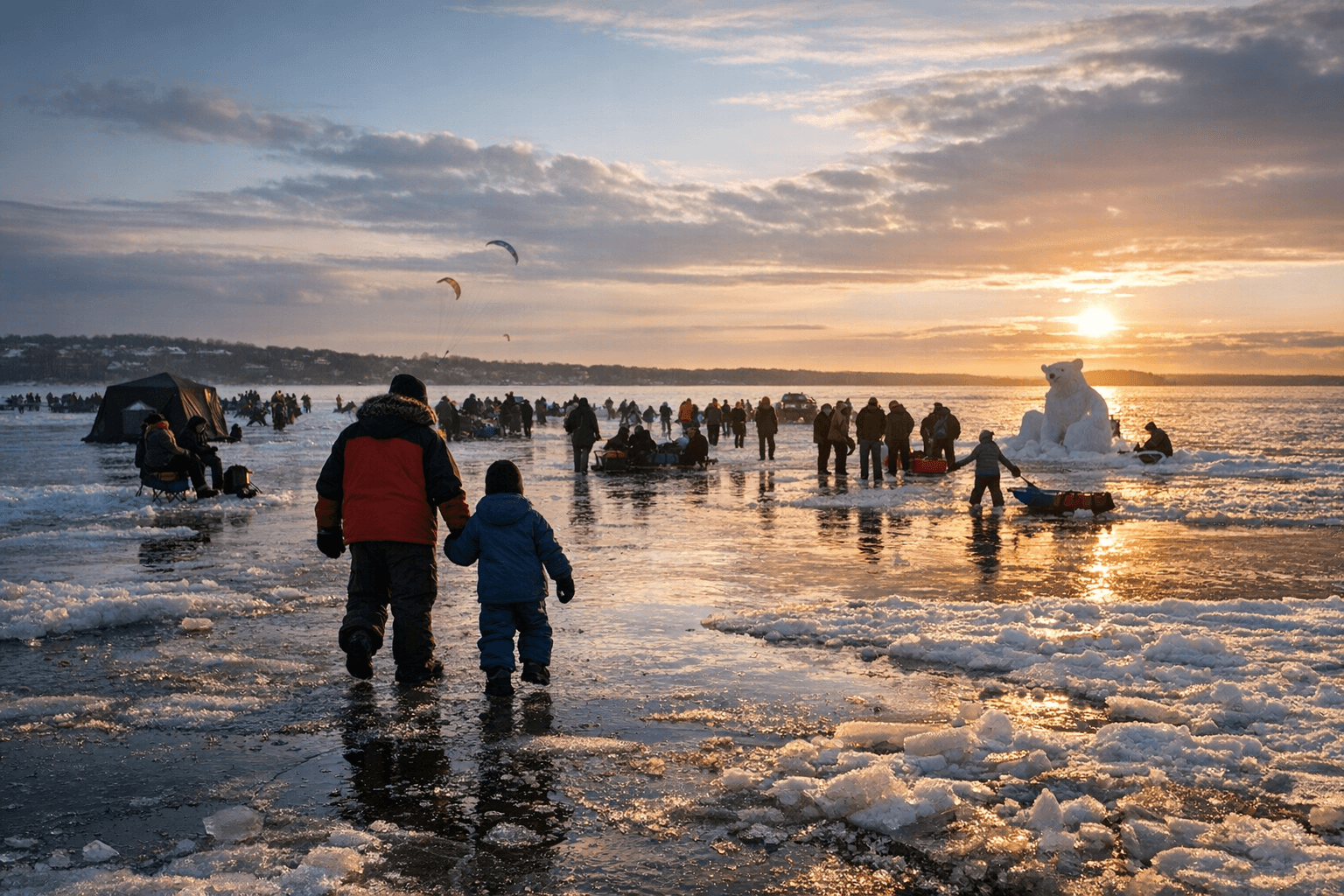
Organizers staged the Mendota winter festival on Feb. 27, 2026 on the ice of Lake Mendota even as local scientists and public safety officials warn that the lake is freezing later in the season than it did decades ago, compressing the period when snow- and ice-based recreation can be held safely.
The festival, long a fixture for neighborhood groups and campus organizations, framed itself around the "joys of a frozen lake" while acknowledging greater uncertainty about ice conditions. Community volunteers and municipal staff ran on-ice monitoring and contingency planning for the day, marking a practical shift from past years when organizers treated Lake Mendota as a reliably frozen platform for skating, fishing and winter markets.
Local experts say the later ice onset is part of a regional trend that makes predicting safe ice thickness more difficult. That uncertainty changes the calculus for event permits, emergency services and insurance coverage. Municipal officials in several Wisconsin communities have in recent years tightened permitting standards for on-ice activities, requiring more frequent checks and clearer contingency plans; organizers in Madison say this season's permits reflected those higher operational demands.
The changing freeze pattern has budget and governance consequences. Shorter or less reliable ice seasons increase demands on public safety resources for monitoring and rapid response, and they complicate volunteer-run emergency chains that rely on predictable conditions. City managers face trade-offs between continuing long-standing community traditions and allocating more staff time and taxpayer dollars to ensure those traditions do not endanger participants. Those decisions are likely to surface in spring budget discussions and at neighborhood meetings where voters weigh priorities for parks funding and public safety.
The institutional challenge extends beyond municipal permitting. State guidelines about ice safety and recreation, developed when freeze patterns were more stable, may require revision to address year-to-year variability. Natural resource managers and local governments will need clearer protocols for verifying ice before events and a common standard for communicating risk to residents, many of whom have deep cultural and recreational ties to winter lake use.
The festival also highlights a civic dimension: community attachment to seasonal activities that connect neighborhoods and drive volunteer engagement creates pressure to maintain those events even as the environment changes. That pressure can galvanize local action on adaptation measures ranging from expanded monitoring networks to investments in alternative winter programming that do not depend on lake ice. Such measures intersect with broader political choices about municipal spending, infrastructure priorities and climate adaptation, questions that voters will confront at the ballot box and in municipal forums.
For now, organizers and public safety teams emphasized contingency planning, on-site monitoring and clear signage as they moved forward with the festival. The event illustrated a familiar municipal dynamic: residents eager to preserve community rituals while local institutions adapt procedures and budgets to new environmental realities.
As communities across Wisconsin adapt, the Mendota festival serves as a local test case of how civic institutions balance tradition, public safety and fiscal responsibility when long-standing natural conditions no longer behave as they once did.
This article was produced by Prism’s automated news system from verified source data, official records, and press releases, then run through automated quality and moderation checks before publishing. The system is built and supervised by the people who set the standards it runs under. Read our full AI policy.
Did this article answer your question?

