Maine Senate race tightens as Platner, Collins poll within margin of error
Platner led Collins 49% to 47% in a Maine poll, as economic pessimism and anti-Trump sentiment sharpened a race that could decide Senate control.
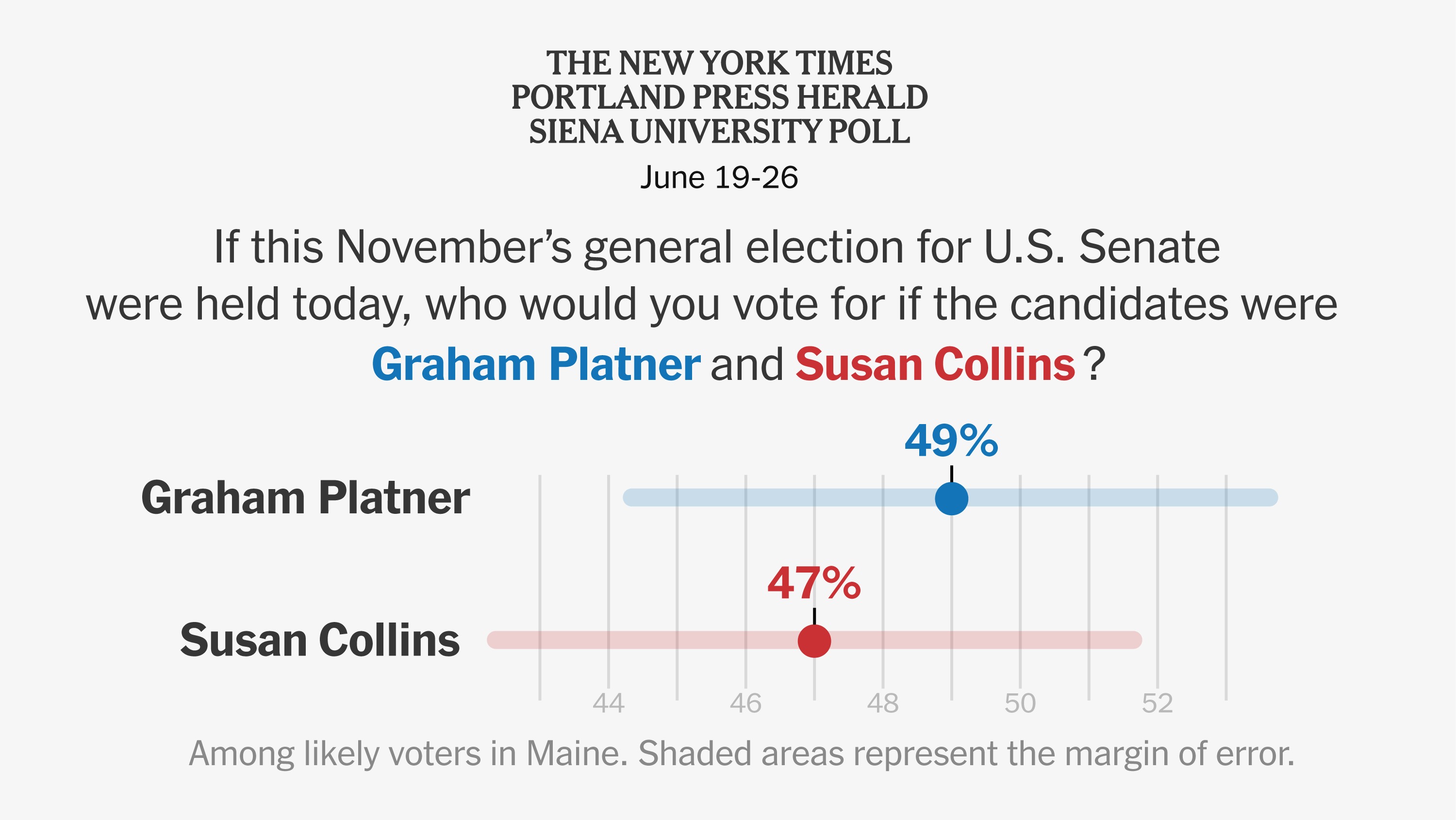
Graham Platner and Susan Collins were separated by just two points in a new Maine Senate poll, a margin that keeps one of the country’s most closely watched races on a knife edge as Democrats try to win back control of the chamber.
The New York Times, Portland Press Herald and Siena Research Institute poll released June 29 put Platner at 49% and Collins at 47% among likely voters, inside the 4.8-point margin of error. Siena said it surveyed more than 600 registered Maine voters from June 19 to June 26, and the toplines show a state where partisan loyalty is competing with voter frustration over the economy and Donald Trump.
That broader mood matters because the Senate math is unforgiving. Republicans hold the chamber 53-47, leaving Democrats needing to flip four seats to regain the majority, and Maine has become one of their clearest pickup opportunities. The contest is also unfolding without Gov. Janet Mills on the ballot, since she is term-limited and cannot seek reelection in 2026, making the state’s federal race even more central to this year’s political map.
The poll points to a race shaped by both candidate reputation and national polarization. Siena found that Maine voters preferred Democrats over Republicans in the generic House question and preferred Democratic control of the Senate. Majorities also disapproved of Trump and said his policies had hurt the economy, while 85% of respondents said Maine’s economy was no better than only fair or poor. At the same time, the survey’s toplines suggested Collins still benefits from a reservoir of trust on character and moral values, even as some voters expressed concerns about Platner.

Collins first won election to the Senate in 1996 and took office in January 1997, then won reelection in 2002, 2008, 2014 and 2020. She is seeking a sixth term on Nov. 3, 2026, and the narrow polling gap underlines how little room there is for either side to expand, especially in a state where economic anxiety, national partisanship and candidate image are all pulling in different directions.
This article was produced by Prism’s automated news system from verified source data, official records, and press releases, then run through automated quality and moderation checks before publishing. The system is built and supervised by the people who set the standards it runs under. Read our full AI policy.
Did this article answer your question?

