Master V60, Kalita Wave, Chemex, and Bee House pour-over techniques
Brew between 195–205°F, use 20–30 g coffee for 350–400 g water, and choose bloom times from 10s to 45s depending on the V60, Kalita Wave, Chemex, or Bee House you use.

Pour-over across the Hario V60, Kalita Wave, Chemex, and Bee House shares a core recipe: control temperature, dose precisely, rinse filters, and stage pours. Heirloom Coffee Roasters and Blue Bottle both recommend water between 195–205°F; Blue Bottle’s workflow uses 20–27 g coffee with 350 g water and targets a 2:30–3:30 minute brew, while Heirloom’s example guides use 30 g coffee and 400 g total water aiming for a 3–4 minute brew. Blue Bottle frames the method as ceremony: “Brewed by hand, one cup at a time, the pour over is as much ritual as method.”
Chemex remains the forgiving option for home brewers thanks to its thick paper filter. Wholelattelove notes that “the thick paper filter is quite forgiving, so you don’t need to be the most seasoned barista to make a decent one,” and offers Chemex sizes including a 3-Cup, 8-Cup, and 10-Cup model. That forgiving filter tolerates a less-than-perfect grinder and produces a very clean cup, which explains why many home brewers keep a Chemex in rotation despite the specialty trend toward thinner filters since the 2010s.
The Kalita Wave favors consistency through a flat-bottom design. Coffeechronicler recommends the ceramic Kalita Wave over the stainless steel version and warns that the stainless model has a prolonged flow rate unless you “hack” it with a dispersion screen. Coffeechronicler’s workflow calls for bleached paper filters, a digital scale and timer, and soft water with a TDS of 50–80 ppm for best results.
The Hario V60 and Bee House-style cones occupy the rest of the quartet. Intelligentsia lists the Hario V60 among the three drippers it calls fixtures in coffeebars and prescribes a controlled spiral pour at 8–10 g/s. Intelligentsia also instructs to “Start your timer and pour three times as much water as coffee (e.g. 23g coffee x 3 = 69g water) over the grounds” to bloom, then add water in stages of 100–250 g until final brew weight. Blue Bottle’s step sequence mirrors that staging: bloom to 50 g (finish that pour in about 10 seconds), then at 40 seconds pour to 150 g, finishing each pour in roughly 10 seconds.
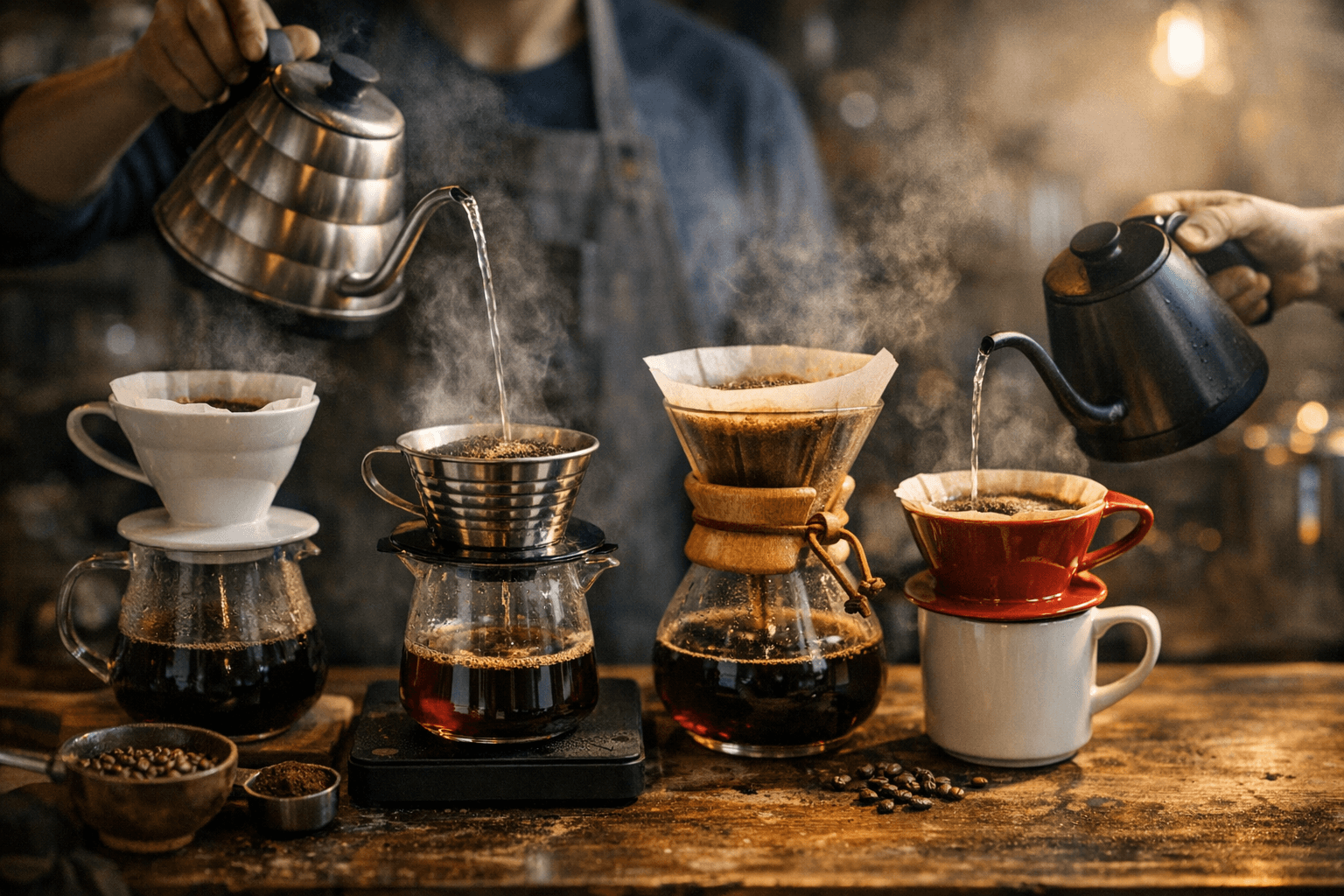
Practical steps that multiple sources converge on include rinsing and preheating the filter and vessel, dosing by weight, and stopping the brew when liquid disappears from above the grounds. Heirloom explicitly instructs to “Rinse the filter and vessel thoroughly with hot water, discarding the rinse water afterward. Do this three times.” Heirloom also captures the larger truth of hand brewing: “It’s both an art and a science, and once you master it, you’ll never look at coffee the same way again.”
If you need a baseline, use 195–205°F, a 1:16 to 1:17 target ratio (examples in the notes include 25 g:400 ml and 20–27 g:350 g), grind medium to medium-fine, bloom using 3x the coffee mass or a 50–60 g bloom on a 30 g dose depending on which recipe you follow, and aim for 2:30–4:00 total extraction. Avoid pouring directly onto the paper filter, pre-rinse filters, and adjust grind to tune flow rather than changing all other variables at once.
Know something we missed? Have a correction or additional information?
Submit a Tip