McDonald’s Accessibility page explains requesting accommodations and impact on hiring and retention
McDonald’s careers page lists inclusion@au.mcd.com and mcdhrbenefits@us.mcd.com for accommodation requests and says accommodations are decided "on a case-by-case basis."
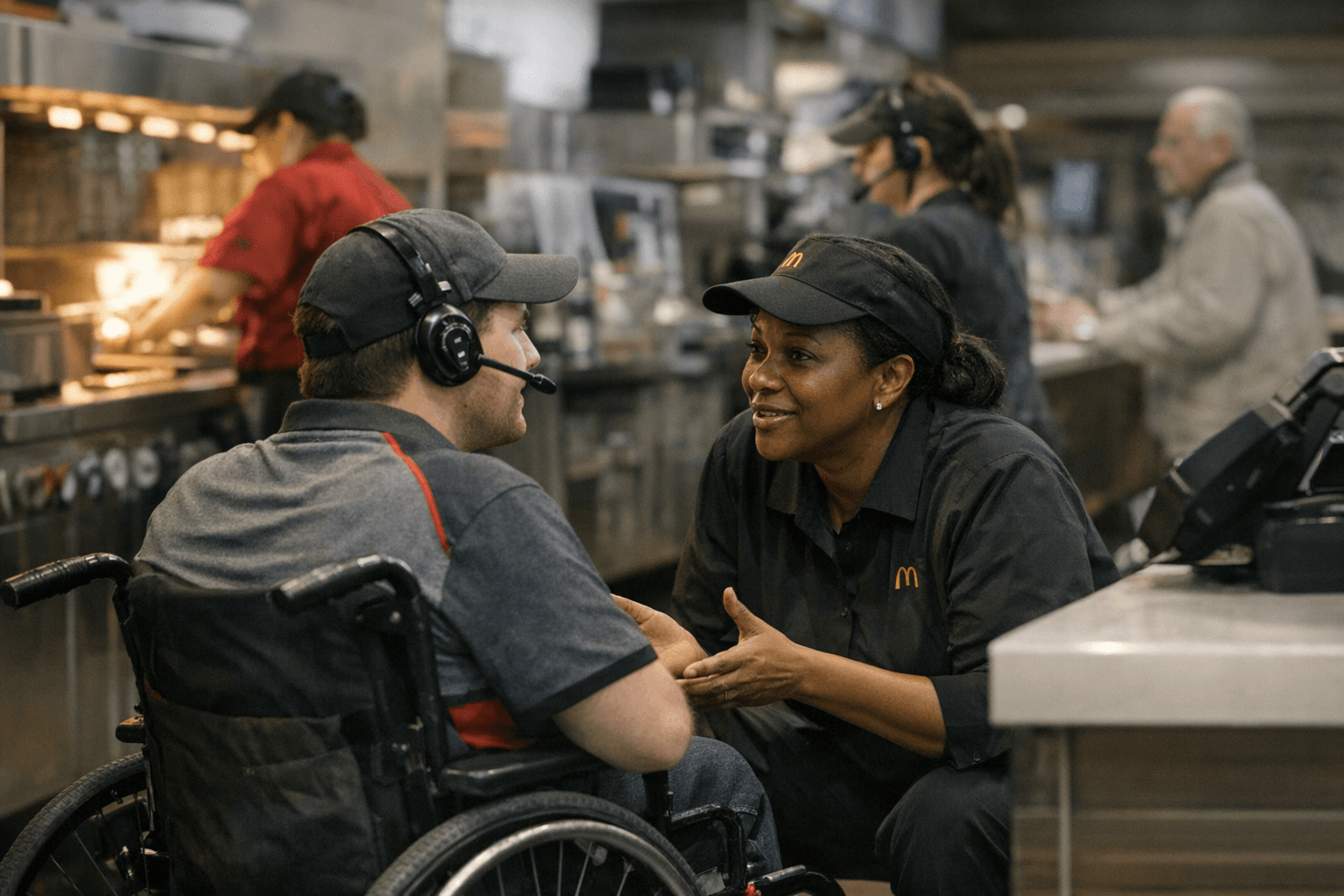
McDonald’s corporate careers site gives applicants two direct contact routes for accessibility needs and spells out that reasonable accommodations apply during hiring and to perform job functions. The Australia careers text tells readers, “If you need any reasonable accommodations to participate in this process, wish to identify your pronouns or preferred name, or have any inquiries concerning our commitment to DEI, please connect with us at inclusion@au.mcd.com.” The U.S. careers wording instructs: “If you need assistance accessing or reading this job posting or otherwise feel you need an accommodation during the application or hiring process, please contact mcdhrbenefits@us.mcd.com.”
The page frames accommodations within McDonald’s broader legal and DEI commitments. The U.S. careers excerpt names the corporate entities precisely as “McDonald’s Corporation and McDonalds USA, LLC (the "Company")” and states that the Company “comply with all U.S. immigration laws” while affirming a policy of Equal Employment Opportunity. The careers text preserves the full non-discrimination list: “We will not discriminate against an applicant or employee on the basis of race, color, sex, religion, national origin, citizenship status, age, disability, veteran or military status, sexual orientation, gender identity/expression, genetic information, or any other legally-recognized protected basis under federal, state or local laws, regulations or ordinances.” The page also notes that “Applicants with disabilities may be entitled to reasonable accommodation under the terms of the Americans with Disabilities Act and certain state or local laws.”
McDonald’s provides explicit process language: “McDonald’s provides reasonable accommodations to qualified individuals with disabilities as part of the application or hiring process or to perform the essential functions of their job.” The company also states that “Reasonable accommodations will be determined on a case-by-case basis.” The careers content includes employer-brand phrasing such as “We highly value Diversity, Equity and Inclusion (DEI) at McDonald's Australia and encourage all applicants to fully express their individuality throughout our hiring process,” and the snippet carries a 2025 copyright line, “© 2025 McDonald’s. All Rights Reserved,” plus the careers page metadata text “App Store Google Play.”
The McDonald’s excerpts leave some policy language incomplete in the provided text. The definition of reasonable accommodation is truncated as “A reasonable accommodation is a change or adjustment to a job or work environment that [...]” which prevents readers from seeing any full list of examples or limits. The snippet also does not state any technical web-accessibility standards or whether McDonald’s conducts audits against WCAG or another conformance level.
Separate guidance from Ronald McDonald House Charities Northeast Ohio offers concrete digital-accessibility tactics that careers pages can use. RMHCNEO’s “Top 10 Digital Accessibility Best Practices” lists: Provide alt-text for images; Add keyboard to mouse-over only behavior; Add field labels; Header Structure & H1 Code; Video Accessibility; Add PAUSE/PLAY buttons to rotating content; Adjust color contrasts to ensure a color ratio of 5.0:1; Use sans-serif fonts; Separate text from images; Add symbols to convey information. RMHCNEO frames accessibility as a continuing effort: “Digital accessibility is the ability of a website, mobile application or electronic document to be easily navigated and understood by a wide range of users, including those users who have visual, auditory, motor or cognitive disabilities,” and notes “Digital Accessibility is an evergreen initiative and requires regular reviews and evaluations.”
For applicants and hiring teams at McDonald’s, the practical takeaways in the public text are concrete: use inclusion@au.mcd.com in Australia to request accommodations or to provide pronouns or a preferred name, and use mcdhrbenefits@us.mcd.com in the U.S. to request help accessing job postings or request accommodations during hiring. But the truncated definition and the absence of explicit technical standards or metrics on accommodation requests leave unanswered how those case-by-case determinations affect hiring timelines and retention. Until McDonald’s publishes the complete definition and any web-accessibility compliance claims, the careers page promises access and non-discrimination while important implementation details remain to be clarified.
Know something we missed? Have a correction or additional information?
Submit a Tip