McDonald's workers told how to file OSHA complaints about hazards, retaliation
McDonald's workers can learn how to report safety hazards and retaliation to OSHA, including what to report, how to file, deadlines, protections, and contact numbers.

Front-line crew and managers at McDonald's have options to report dangerous conditions or retaliation to federal safety authorities. You have legal protections when you speak up, and OSHA provides multiple ways to file, online, by phone, mail, fax, or in person, plus Spanish-language options and confidentiality safeguards.
1. Your right to file a confidential safety or health complaint
“You (or your representative) have the right to file a confidential safety and health complaint and request an OSHA inspection of your workplace if you believe there is a serious hazard or if you think your employer is not following OSHA standards.” That right applies to most employees in the United States, including quick‑service restaurant workers. Filing can trigger an inspection and starts a documented process employers must respond to.
2. What counts as a safety and health complaint
A safety and health complaint reports a serious hazard or a belief that your employer is not following OSHA standards, examples include blocked fire exits, equipment that creates burn or cut risks, unsafe chemical handling, or repeated lack of PPE. The goal is to request an OSHA inspection to verify conditions and enforce corrective steps. The complaint should be filed promptly: “The complaint should be filed as soon as possible after noticing the hazard.”
3. What counts as a retaliation (whistleblower) complaint
Retaliation or whistleblower complaints report punishments from your employer for exercising safety rights, being fired, demoted, cut hours, or threatened for reporting hazards. These complaints follow a different legal track than hazard reports and often have much shorter deadlines for filing. File a retaliation complaint quickly because the time window varies by statute and can be short.
4. Deadlines: safety/health vs. retaliation complaints
For safety and health complaints, OSHA can generally not issue violations for incidents older than six months, so filing sooner is essential; sources summarize this as a six‑month limit. For retaliation complaints, the deadline depends on the particular whistleblower law: many claims require filing within 30 days, while others may allow up to 180 days. Keep in mind the specific clock for retaliation claims can be very short: “You have significantly less time to report a workplace retaliation complaint than a safety or health complaint – just 30 days from the time of the alleged infraction.”
5. How to file: the main methods
There are multiple filing options so you can choose what feels safest: online using OSHA’s complaint form (Spanish versions are available and usually labeled “[Español]”), by phone, by mail or fax with the OSHA complaint form, or in person at your local OSHA office. Complaints submitted online are routed to the appropriate local OSHA office, and a signed complaint is more likely to result in an onsite inspection. If you’re unsure which path to use, phone contact with OSHA can help you decide.
6. Emergency (imminent danger) complaints
If a hazard could cause immediate death or serious physical harm, report it as an imminent danger so OSHA can respond quickly. “If you believe the situation is imminently life-threatening, call 1-800-321-OSHA (6742).” Calling that number can prompt an Imminent Danger Inspection; explain the specific hazard, where it’s happening (store address), and who’s at risk.
7. What to include in your complaint
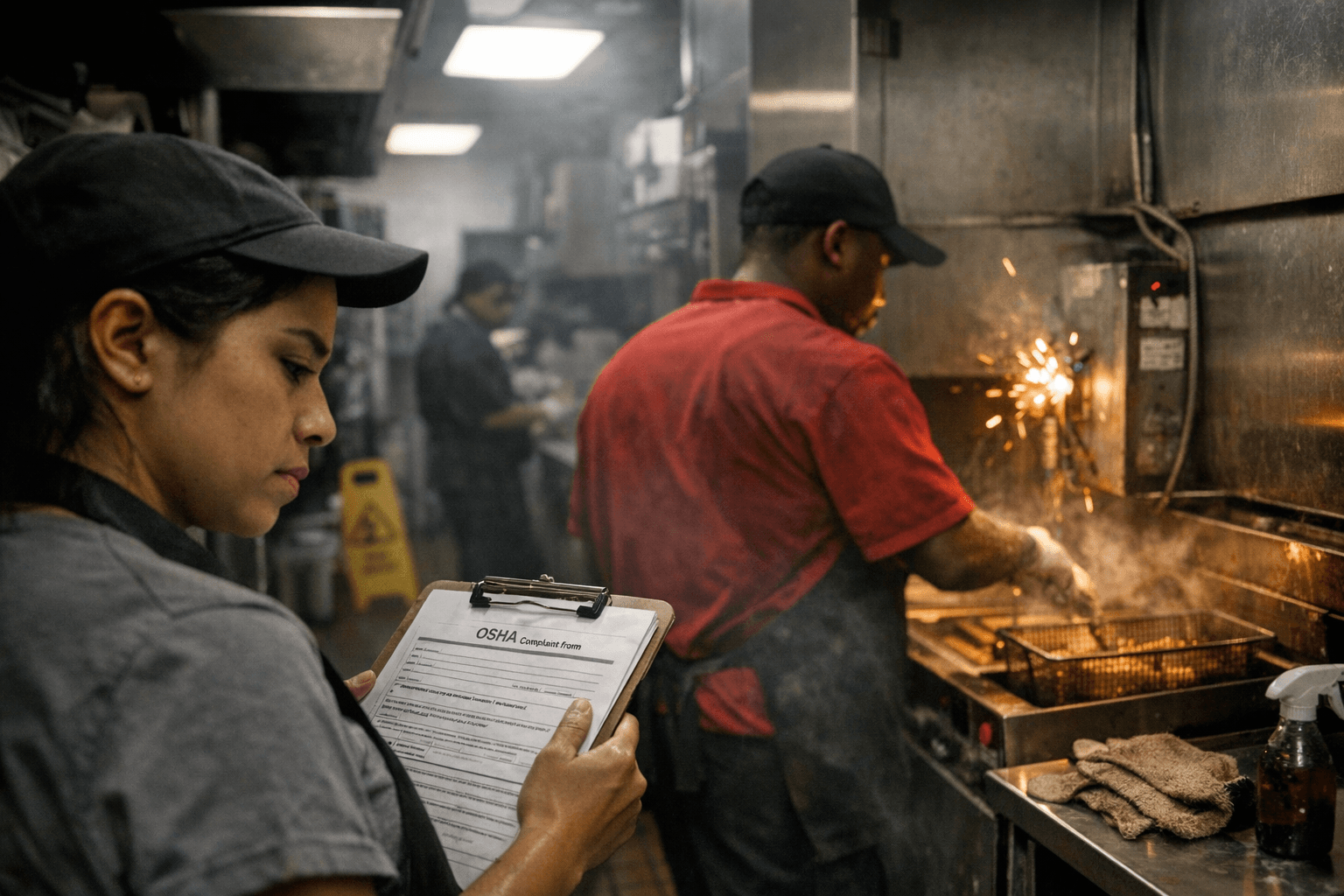
Provide the employer’s name, the location or address of the McDonald’s restaurant, and a clear description of unsafe or unhealthy conditions. You can submit oral or written complaints in any language, and you may file anonymously if you prefer. Keep records, dates, times, witnesses, photos, and any communications with managers, because signed and detailed complaints are more likely to lead to on‑site inspections: “A signed complaint is more likely to result in an onsite inspection.”
8. Confidentiality and filing through a representative
OSHA allows filing by a representative and can protect your identity on request. You can “allow someone to file for you,” and OSHA will treat the name of the complainant as confidential where appropriate. If you fear immediate retaliation, consider having a trusted representative, union rep, attorney, or advocacy group file on your behalf while preserving confidentiality.
9. What happens after you file: inspections and worker rights
Local OSHA offices evaluate complaints and may open an inspection; signed, local filings historically prompt more on‑site action. During an inspection employees retain rights to participate and provide information; OSHA’s process is designed so workers can speak privately with inspectors. If OSHA finds violations, the agency can require fixes and penalties; if it finds retaliation, it can pursue discrimination remedies.
10. Industry mapping and why McDonald’s reports go to OSHA
Most restaurant workplaces, including McDonald’s, fall under OSHA’s jurisdiction as “all other industries,” so complaints about hazards or retaliation at a McDonald’s restaurant are typically handled by OSHA. Some industries (aviation, interstate trucking, mining) are regulated by other federal agencies with their own complaint channels and phone numbers. For McDonald’s workers, OSHA’s complaint form and OSHA’s phone line are the right starting points in most situations.
11. Key phone numbers and multilingual access
OSHA’s central complaint number, useful for emergencies and general questions, is 1-800-321-OSHA (6742). Complaint forms and submission options are available in Spanish (“[Español]”) and workers may submit complaints in any language. If you need cross‑agency guidance for a specialized industry concern, other federal hotlines exist, but for restaurant hazards and retaliation OSHA is the primary federal regulator.
12. Practical concerns: will my employer retaliate or fire me?
Workers often ask, “Can my employer fire me for filing an OSHA complaint?” Employers are prohibited from retaliating against employees for reporting safety or health violations, and you can file a discrimination complaint if retaliation occurs. If you suspect retaliation after filing, document dates and actions and consider filing a whistleblower/retaliation complaint quickly, because those claims carry shorter deadlines than hazard reports.
- Take pictures and save text messages or incident logs that show dates and times; evidence strengthens a complaint.
- If you fear immediate employer retaliation, use a representative or file anonymously while you seek advice.
- Prefer local office submissions or signed complaints when possible, practical experience shows they may be more likely to trigger onsite inspections.
Tips for McDonald’s crew and shift leads
Closing practical wisdom Don’t wait until a small hazard becomes a big accident: file as soon as you reasonably can and gather simple, time‑stamped evidence. Use the OSHA phone line for imminent risks, pick the filing option that protects you best, and remember that confidentiality and representative filing are available. Speaking up protects you, your co‑workers, and the customers who walk through the door, grill the hazard, not the messenger.
Know something we missed? Have a correction or additional information?
Submit a Tip