Micron breaks ground on $100 billion New York megafab
Micron holds a ceremonial groundbreaking for a $100 billion memory complex in Clay, N.Y., promising tens of thousands of jobs and decades of construction.
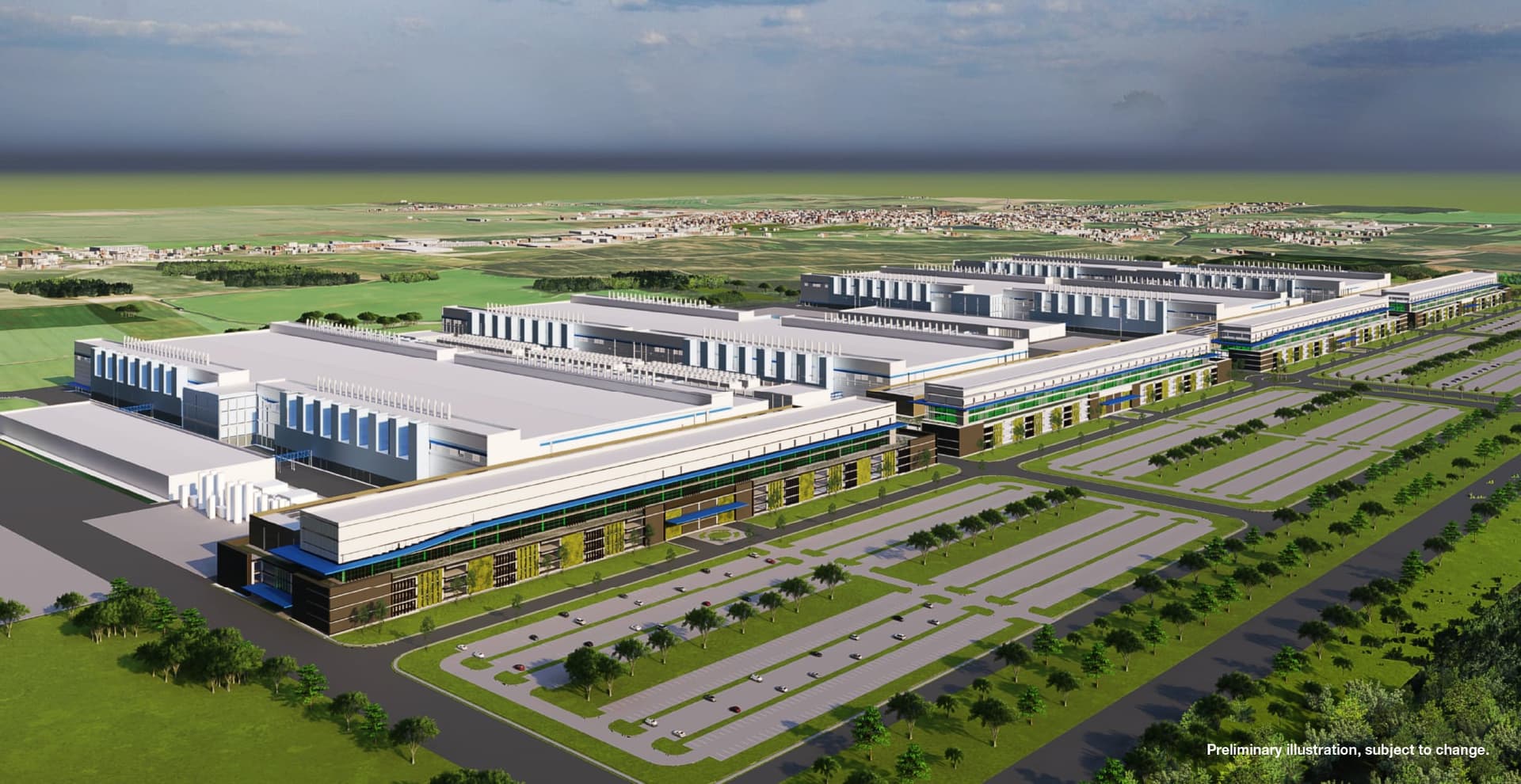
Micron Technology is holding a ceremonial groundbreaking in Clay, N.Y., for a planned $100 billion memory manufacturing campus that the company says could become the largest semiconductor facility in U.S. history. The on‑site ceremony is followed by a celebration program at Syracuse University’s National Veterans Resource Center as federal, state and local officials join company leaders to mark the start of construction work that Micron expects to span decades.
Micron describes the Clay campus as a leading-edge memory manufacturing complex capable of hosting up to four high-volume fabrication plants. The company projects the site could generate roughly 50,000 jobs in New York when suppliers and contractors are counted, and Micron says the first factories are now projected to open in 2030 with the campus potentially fully operational by the 2040s. Micron has characterized the project as part of an approximately $200 billion broader U.S. expansion that includes fabs in Idaho, modernization of a Virginia plant, advanced high-bandwidth memory packaging and increased research and development.
Sanjay Mehrotra, Micron’s chairman, president and chief executive, says the groundbreaking “underscores our commitment to building leading‑edge memory at scale in the United States” and thanked federal, state and local partners for their support. The company’s announcement lists attendance or support from President Donald Trump; Commerce Secretary Howard Lutnick; Labor Secretary Lori Chavez-DeRemer; Administrator Zeldin; Governor Kathy Hochul; Senators Charles Schumer and Kirsten Gillibrand; and a slate of members of Congress and local officials, including Onondaga County Executive Ryan McMahon.
The project occupies low-lying land near Route 31 and Caughdenoy Road that Micron and local officials say will be leveled and built up with roughly nine million cubic yards of imported gravel and fill. Local descriptions place the development’s footprint at about three times the size of the New York State Fairgrounds and say parking will be required on a scale comparable to the region’s largest retail centers. Construction and build-out are expected to be nearly continuous for as long as two decades, with early phases emphasizing local hiring. Micron has set an early goal of sourcing as much as 80 percent of the first-phase workforce locally.

State environmental review is complete. The supplemental environmental impact statement that the state approved in November 2025 runs 719 pages, and the New York State Department of Environmental Conservation has issued nine permits that the agency says reflect public review and comment and identify mitigation measures for anticipated environmental impacts. The documentation addresses wetlands, traffic, water and other local impacts that will shape permitting and construction plans.
The project has experienced schedule shifts since Micron announced plans roughly three years ago, with the openings of the first two fabs pushed back by two to three years from earlier targets. Federal incentives from the 2022 CHIPS Act could provide more than $20 billion in subsidies available to support projects of this scale, an element company and state advocates have cited as important to the investment calculus.
For Onondaga County and surrounding communities, the megafab represents a potentially transformative economic shift as well as a long-term land-use and environmental challenge. Micron and state regulators say mitigation measures and local hiring commitments are central to the plan, while construction timelines, permit compliance and the flow of federal support will determine how the project unfolds through the 2030s and 2040s.
This article was produced by Prism’s automated news system from verified source data, official records, and press releases, then run through automated quality and moderation checks before publishing. The system is built and supervised by the people who set the standards it runs under. Read our full AI policy.
Did this article answer your question?


