Minnesota Freight Train Derails, Sparks Fires and Forces Evacuations
Ethanol fires forced the entire town of Raymond, Minn. — all 800 residents — to flee after a BNSF freight train derailed at 1 a.m., drawing federal investigators already on alert after East Palestine.
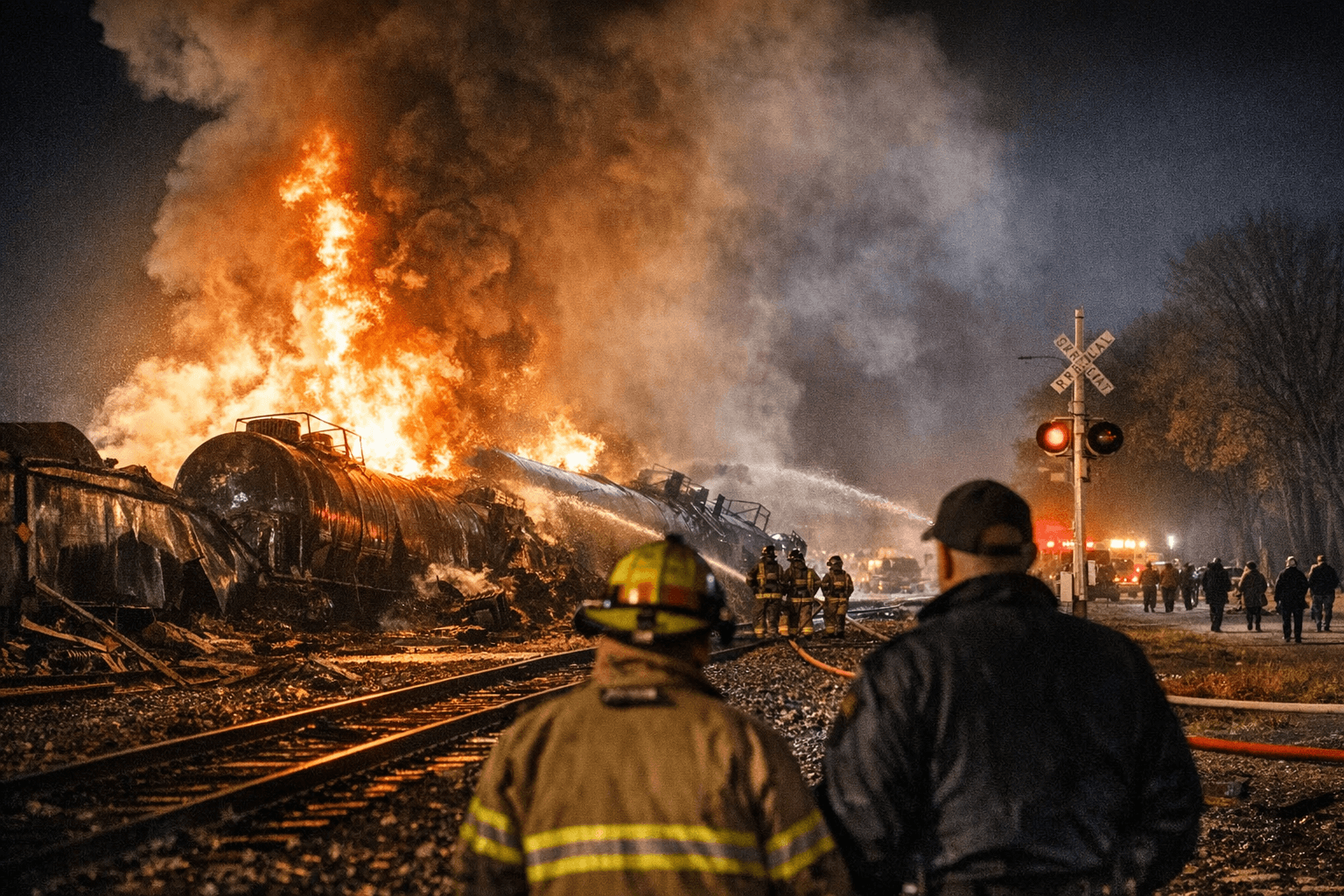
Raymond firefighters knocked on doors in the dark before 1 a.m. on March 30, waking residents of a small Minnesota town with a message: a freight train had just derailed nearby, ethanol was burning, and they needed to leave immediately.
The BNSF Railway train carrying mixed freight, including ethanol and corn syrup, derailed on the western edge of Raymond, roughly 100 miles west of Minneapolis, at approximately 1:02 a.m., according to BNSF spokesperson Lena Kent. Kandiyohi County Sheriff Eric Tollefson confirmed the train "had numerous rail cars derail" and that "several caught fire." Because the entire town of Raymond sits within a half-mile of the derailment site, every one of its roughly 800 residents faced a mandatory evacuation order.
BNSF confirmed to NPR that 22 cars derailed, four of which caught fire, and that about 10 of those railcars contained ethanol, a highly flammable alcohol whose vapors can cause headaches, nausea, unconsciousness, and irritation to the skin and eyes with prolonged exposure. Transportation Secretary Pete Buttigieg told CNN that about 14 of the train's cars were carrying hazardous materials in total. EPA personnel arrived at the scene by 6:30 a.m. to monitor air quality at the derailment site and throughout the surrounding community. By early afternoon, the Kandiyohi County Sheriff's Office confirmed: "There is no impact to groundwater."
About 150 people sheltered overnight at a school in nearby Prinsburg, with the Red Cross assisting evacuees. Firefighters and EMS personnel who had canvassed Raymond's streets in the early morning hours had little else to report by dawn: no deaths or injuries were recorded by any state, local, or federal official. The evacuation order was lifted later Thursday, allowing residents to return home.
Minnesota Gov. Tim Walz visited the scene, assuring the public that the derailed cars were "state-of-the-art" and "designed in such a way that they won't explode." He acknowledged that flare-ups could occur as cleanup crews moved cars during recovery operations. "There will be time to figure out what caused this," Walz said. Separately, Walz said: "Our multi-agency emergency response will continue working on the ground to protect the health and safety of Raymond."
Buttigieg confirmed on social media that the Federal Railroad Administration was already on the ground in Raymond. "At present no injuries or fatalities have been reported," he posted, adding that his office was "tracking closely as more details emerge and will be involved in the investigation." The National Transportation Safety Board said it was launching an investigative team expected to arrive in Raymond on Thursday afternoon. BNSF's main rail line through Raymond remained blocked as of Thursday afternoon, with no reopening timeline announced. The Minnesota Department of Transportation temporarily closed Highway 23 from Kandiyohi County Road 1 to Chippewa County Road 1 to accommodate the emergency response.
The derailment landed in a politically charged moment for railroad safety. Less than two months earlier, a Norfolk Southern freight train carrying hazardous materials derailed February 3 near East Palestine, Ohio, prompting the evacuation of roughly half of that town's 5,000 residents and an intentional burn of toxic chemicals to prevent an explosion. BNSF itself had seen two additional trains derail in separate incidents in Arizona and Washington state on March 16; the Washington derailment spilled diesel fuel on tribal land along Puget Sound. Federal Railroad Administration data shows just how routine such incidents have become: in 2022 alone, there were 1,154 rail derailments across the United States, an average of more than three per day.
BNSF's CEO pledged to reimburse hotel costs for any Raymond resident unable to return home Thursday, a gesture that did little to address the larger question investigators were just beginning to confront: what failed first on that track at 1 a.m., and whether federal inspection standards were equipped to catch it.
Know something we missed? Have a correction or additional information?
Submit a Tip