Mississippi’s America 250 blends pride with painful history, unlike Trump’s version
Mississippi's 250th anniversary display puts slavery, lynching and civil rights beside Elvis and Walter Payton. Washington is pushing a far cleaner national story.

Mississippi is using America’s 250th anniversary to put slavery, lynching and civil rights at the center of its public story, a choice that cuts sharply against the cleaner patriotic script emerging from Donald Trump’s Washington. In Jackson, the state is leaning on the Two Mississippi Museums to argue that commemoration should include the pain as well as the pride.
The museums opened on December 9, 2017, on Mississippi’s bicentennial and now anchor a complex that covers about 200,000 square feet and holds more than 22,000 artifacts, photographs and documents. The Mississippi Civil Rights Museum and the adjoining Museum of Mississippi History are built to show how the state’s story runs through Native American dispossession, slavery, segregation and the modern civil rights movement, not around them. One of the most searing elements is the Lynching Victims Monolith, which lists the names of more than 600 documented victims of racial killings in Mississippi and, in some cases, the motives their attackers gave.
The memorial’s force comes through individual cases like Malcolm Wright, who was beaten to death in 1949 in front of his family after his killers said he was hogging the road. Later research showed the wagon he was driving was simply moving too slowly. That kind of detail has made the museum experience emotionally heavy for visitors, and it has also become the template for Mississippi’s America250 effort: tell the full truth, even when the truth is brutal.
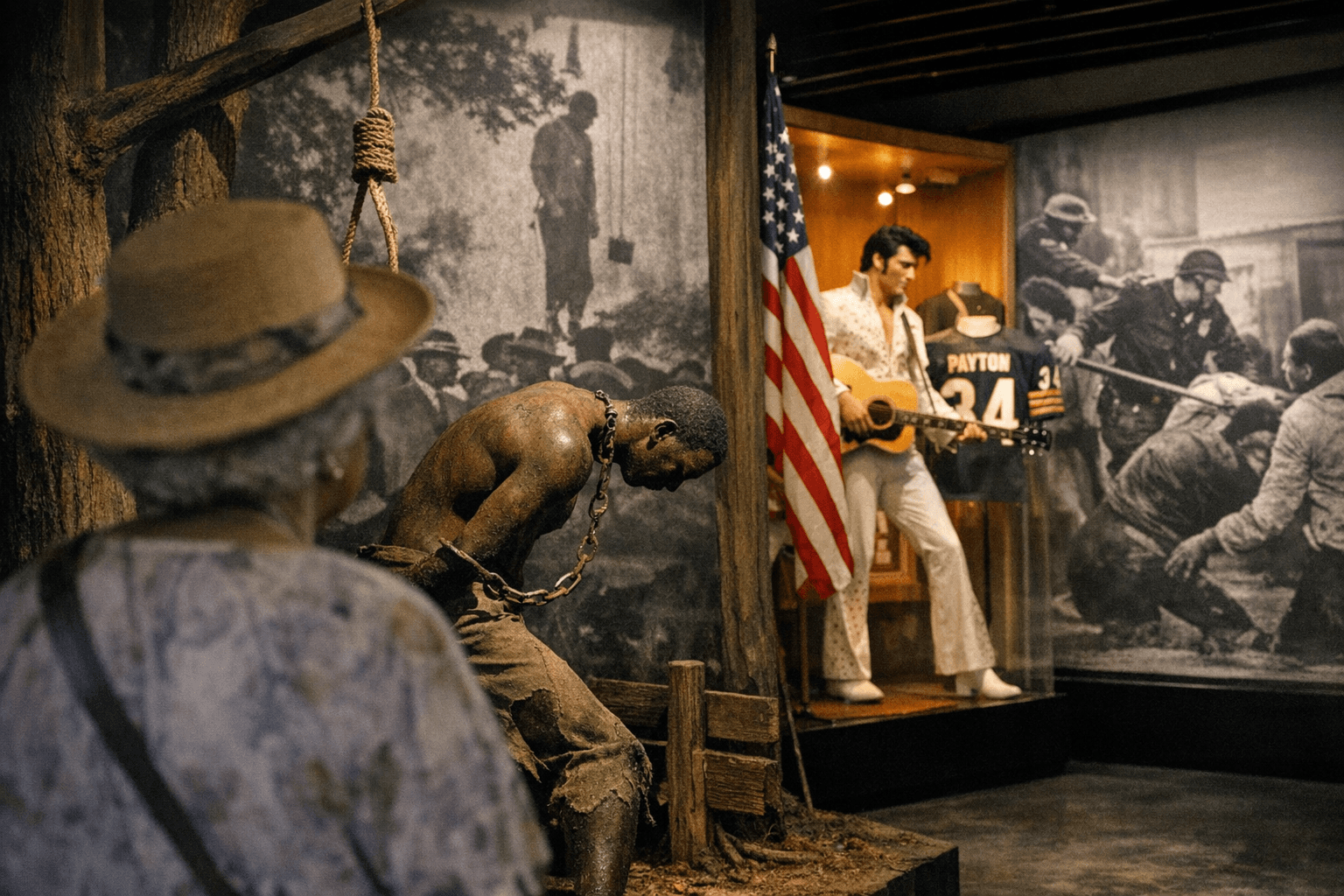
That philosophy is now visible in Mississippi Made, a temporary exhibit that opened in early March and runs through November 6. The display brings together 250 artifacts meant to show creativity, industry and innovation, while still sitting inside a museum complex that does not avoid the state’s darkest chapters. Among the objects are a 19th-century cotton gin, Elvis Presley’s bathrobe, a Marshall Ramsey cartoon, a Wheaties box featuring Walter Payton, a NASA flight jacket worn by Richard Truly and a B.B. King guitar. The message is deliberate: Mississippi wants its contribution to the nation to include cultural achievement and economic ingenuity, but not at the expense of historical honesty.
The state’s official America250 push began when Gov. Tate Reeves launched the America250 Mississippi Commission on July 3, 2025. The group includes First Lady Elee Reeves, Lt. Gov. Lynn Hosemann, Rochelle Hicks, Nancy Carpenter and Jolynn White, and says its programming will highlight Mississippi’s contributions to the United States alongside its own history. That approach stands apart from Trump’s federal orders in January and March, which ended diversity, equity and inclusion programs in the federal government and told the Smithsonian and Interior Department to strip out “improper, divisive, or anti-American ideology” and restore monuments or markers altered in the past five years. In Mississippi, the commemorative project is making a different bet: that the national story is stronger when it tells the whole truth.
This article was produced by Prism’s automated news system from verified source data, official records, and press releases, then run through automated quality and moderation checks before publishing. The system is built and supervised by the people who set the standards it runs under. Read our full AI policy.
Did this article answer your question?

